

Table of Contents
- The Raw Gold Valuation Formula: Spot Price x Purity x Weight
- How the Current Spot Price of Gold Sets Your Starting Number
- Gold Weight Conversion: Troy Ounces to Grams (and Pennyweight)
- How to Test Raw Gold Purity Before You Trust a Number
- Refining Payouts, Deductions, and Fees That Shrink Your Check
- Raw Gold vs. Jewelry vs. Bullion: Why Form Changes the Value
- Frequently Asked Questions
Last Updated: September 23, 2026
The Raw Gold Valuation Formula: Spot Price x Purity x Weight
Learning how to determine the value of raw gold comes down to one formula: spot price × purity percentage × weight. That's it. Every payout, every offer, and every "we buy gold" quote you'll ever get traces back to those three numbers.
Here's what makes it tricky. The spot price changes daily. Purity on raw gold is rarely stamped anywhere. And weight gets measured in grams, troy ounces, or pennyweight depending on who's holding the scale.
Parker's Gold exists because of this exact gap. We source real placer gold from Parker Schnabel's Dominion Creek operation, and every piece ships with an official Certificate of Authenticity. That document matters more than most buyers realize.

The three variables matter because each one can be manipulated or misunderstood. Get any of them wrong, and your valuation swings wildly.
Melt Value vs. Market Value: What Actually Sets Your Price
Melt value is what your gold is worth if you melted it down and sold the pure metal. Market value is what someone will actually pay you for it as-is.
For raw placer gold, melt value is your floor. Market value can sit above or below it depending on:
- Form and presentation (display pieces command more)
- Documentation and provenance
- Buyer type (refiner vs. collector vs. hobbyist)
- Current demand for raw specimens
A refiner only cares about melt value. A collector might pay well above it. Knowing which buyer you're talking to changes everything.
How the Current Spot Price of Gold Sets Your Starting Number
The current spot price of gold is the live market rate for one troy ounce of pure gold, set by trading on the London over-the-counter market and the COMEX futures exchange. It's the anchor for every calculation that follows.
Spot price moves constantly during trading hours. It responds to interest rates, currency strength, inflation expectations, and central bank demand. Most pricing sites update every few minutes, and the number you see at 9 a.m. can be different by lunch.
Two things trip people up:
- Spot price is quoted per troy ounce, not per regular ounce
- Spot price assumes 100% purity, which raw gold almost never is
So the spot price is a starting point, not an answer. You still have to adjust for purity and weight.
Where to Actually Find the Spot Price
You don't need a Bloomberg terminal. A handful of public sources publish the same benchmark:
- The London Bullion Market Association (LBMA) publishes a twice-daily auction price (the "fix") that many dealers use as a reference.
- Major metals data sites publish a continuously updating spot quote during market hours.
- Many refiner and dealer websites display a live spot ticker on their buy page.
Cross-check at least two of these before you accept a quote. If they disagree by more than a few cents, you're probably looking at one stale feed.
Live Market Data and the Bid-Ask Spread
There's a gap between what buyers pay and what sellers ask. That gap is the bid-ask spread.
Dealers buy below spot (the bid) and sell above it (the ask). For raw gold, the spread widens because purity is uncertain and refining costs apply. A common pattern is a spread of a few percent on bullion and considerably wider on raw placer gold, where the buyer is absorbing purity risk.
A few practical rules:
- Check two or three live market data sources before accepting any offer.
- Ask the buyer whether their quote is based on the bid or the ask, and whether it's before or after refining deductions.
- If a quote sits far below spot, ask why. Sometimes it's refining cost. Sometimes it's just a lowball.
Why the Spot Price Alone Won't Price Raw Gold
Spot price is a benchmark for pure, refined, deliverable metal. Raw placer gold is none of those things. It's an alloy of gold, silver, copper, and sometimes platinum-group metals, in a form that has to be refined before it can be sold into the spot market.
That means the spot price is the ceiling of what your gold could be worth after refining, not the price you'll be offered. The gap between spot and your actual payout is where purity, weight, and fees all get applied. Understanding that gap is the whole game.
Gold Weight Conversion: Troy Ounces to Grams (and Pennyweight)
Gold weight conversion trips up more people than any other part of the process. Gold uses the troy ounce, which is heavier than the standard ounce you'd use for flour.
Parker Schnabel Yukon Gold Flakes →
Here's the conversion set you actually need:
| Unit | Grams | Common Use |
|---|---|---|
| 1 troy ounce | 31.1035 g | Spot price quotes |
| 1 gram | 0.03215 troy oz | Small raw gold |
| 1 pennyweight | 1.555 g | Older jewelry, scrap |
| 1 tola | 11.6638 g | Traditional markets |
Use a gram scale with 0.01 g accuracy for small pieces.
How to Test Raw Gold Purity Before You Trust a Number
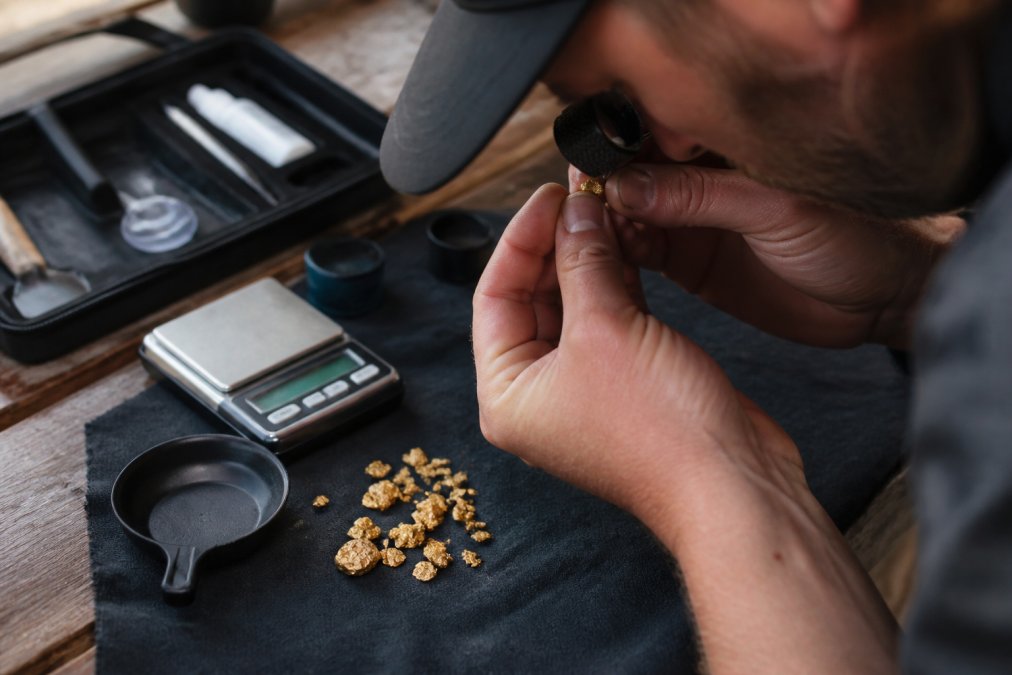
Raw gold purity is rarely obvious. Placer gold often runs 70-95% fine, with the rest being silver, copper, or other metals. You can't assume 100%.
The Magnet Test: Fastest First Pass
Gold is not magnetic. If a magnet sticks to your piece, it's not gold, or it's gold attached to a ferrous base metal. A strong neodymium magnet is the cheapest tool in the kit.
The Streak Plate Test
Rub the piece against an unglazed ceramic streak plate. Gold leaves a distinctive yellow streak. Pyrite ("fool's gold") leaves a greenish-black streak. This is a quick visual discriminator, not a purity measurement.
The Density Test
This is the most useful home test for raw gold because it gives you an actual number.
- Weigh the piece dry on a 0.01 g scale.
- Suspend it in water (a thin wire or thread works) and weigh it again.
- Divide the dry weight by the weight lost in water.
Acid Testing
Jewelry supply stores sell gold testing kits with small bottles of nitric acid in different concentrations. The procedure: make a small scratch on a test stone, apply a drop of acid, and watch the reaction. Different karat concentrations react differently.
Electronic Gold Testers
Handheld electronic testers measure conductivity and can give a karat reading in seconds. They work well on flat, clean surfaces but struggle with irregular raw nuggets and placer flakes. Treat the reading as a data point, not a verdict.
Professional Assay
For anything valuable, an assay is worth the cost. A fire assay is the industry standard: a small sample is melted with lead and cupelled to separate the gold, then weighed precisely. The result is a documented purity number you can hand to any buyer.
Reading Hallmarks and Karat Stamps on Scrap Gold
A hallmark is a stamp indicating metal type and purity. On jewelry you'll see marks like 10K, 14K, 18K, or 24K. The karat number tells you the gold purity scale position.
Use this conversion when you find a stamp:
- 24K = 99.9% pure (fine gold content)
- 18K = 75% pure
- 14K = 58.3% pure
- 10K = 41.7% pure
Refining Payouts, Deductions, and Fees That Shrink Your Check
Refiners don't pay spot. They pay a refining payout based on the fine gold content they recover, minus fees.
Typical deductions include:
- Refining charge (often a flat fee or percentage)
- Assay fee if purity is unknown
- Shipping and insurance
- Minimum lot charges for small quantities
Raw Gold vs. Jewelry vs. Bullion: Why Form Changes the Value
Form changes everything about liquidity and price. Bullion is the easiest to sell. Jewelry sits in the middle. Raw gold is the hardest to price accurately.
| Form | Purity Known? | Typical Buyer | Resale Premium |
|---|---|---|---|
| Bullion | Yes, stamped | Dealers, investors | Low, near spot |
| Jewelry | Usually stamped | Refiners, resellers | Moderate |
| Raw gold | Rarely | Refiners, collectors | Varies widely |
Frequently Asked Questions
What is 1 oz of raw gold worth?
One troy ounce of raw gold is worth its fine gold content multiplied by the current spot price. If spot is $2,400 per troy ounce and your raw gold tests at 85% purity, the melt value is roughly $2,040. Raw placer gold often runs 70% to 95% pure, so it rarely sells at the full spot price. Refiners also deduct refining fees, which lowers your final payout.
How do you calculate the purity of raw gold?
Start with a density test, then confirm with an assay or XRF scan. A density test compares your sample's weight in air to its weight suspended in water. Pure gold has a density of 19.3 g/cm3, so a lower reading signals gold alloy or trapped quartz. For placer flakes, many sellers use an assay to get an exact purity percentage before quoting a price.
Does raw gold have a higher value than refined gold?
Refined bullion usually sells for closer to spot because its purity is guaranteed. Raw gold carries more uncertainty, so buyers apply a discount for refining costs and purity risk. The exception is collectible raw gold with documented origin, like authenticated placer gold from a named mining operation. That provenance can add a resale premium above melt value.
How can I sell my raw gold without getting ripped off?
Weigh your gold on a calibrated gram scale, convert to troy ounces, and check the live spot price before you talk to any buyer. Ask for the refining payout formula in writing, including any assay fee or minimum deduction. Compare at least two quotes. A buyer who won't explain their deductions or show a scale reading is a buyer to walk away from.