

Table of Contents
- The Enduring Allure of Gold Rush History Collector Items
- Yukon Gold Mining History Facts That Drive Collector Demand
- The Types of Artifacts and Memorabilia Collectors Chase
- How to Verify Gold Rush Memorabilia Before You Buy
- Investment vs. Sentimentality: What Actually Drives Value
- Storage and Conservation for Long-Term Preservation
- The Psychology of Collecting Gold Rush History
- Frequently Asked Questions
Last Updated: September 17, 2026
The Enduring Allure of Gold Rush History Collector Items
Why gold rush history collector items are popular comes down to scarcity, story, and a growing market that treats frontier-era objects as both cultural heritage and tangible assets. At Parker's Gold, we see this demand firsthand: enthusiasts want something they can hold, not just read about. This guide covers the artifacts, authentication rules, and psychology behind the pursuit.

Yukon Gold Mining History Facts That Drive Collector Demand
Yukon gold mining history facts explain much of the collector interest: the scale of the migration, the harsh conditions, and the volume of material left behind created a deep supply of authentic artifacts. That context separates a serious collector from a casual buyer.
The Scale of the Klondike Migration
The Klondike stampede pulled tens of thousands of people north in a matter of months, one of the largest mass migrations in North American history. Towns like Dawson ballooned almost overnight, and the frontier economy that grew around them left a paper trail that survives today. According to [Parks Canada's Klondike Gold Rush(/blogs/news/how-to-verify-authentic-placer-gold) history | pc.gc.ca], that migration reshaped the region's settlement patterns within a single generation.
What Miners Actually Left Behind
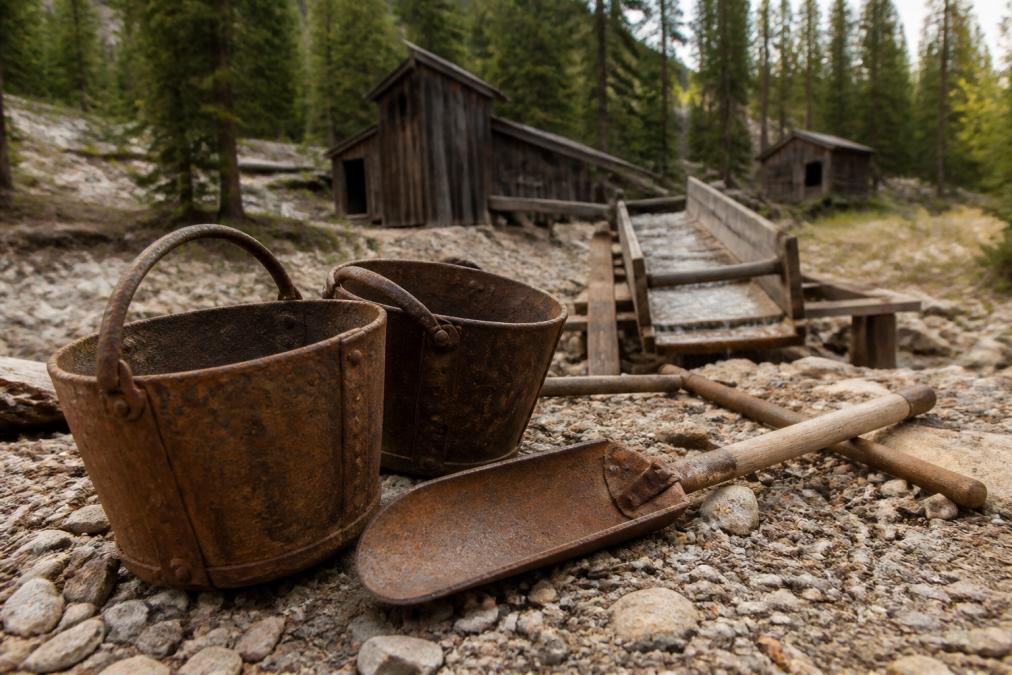
Prospectors abandoned equipment when the ground froze or claims ran dry. Ore buckets, picks, sluice box components, and blasting cap tins were heavy and cheap to replace, so they stayed where they fell, as did panning gear and assay office records. That abandonment is the collector's gain.
The Types of Artifacts and Memorabilia Collectors Chase
The most sought-after gold rush items fall into five categories, each with a different price profile and preservation challenge.
- Mining equipment: ore buckets, picks, shovels, and sluice box parts
- Ephemera: assay office receipts, claim notices, letters, and photographs
- Containers: blasting cap tins, mercury flasks, and medicine bottles
- Personal items: buttons, belt buckles, and tobacco tins
- Raw material: gold dust, nuggets, and placer gold with documented origin
How to Verify Gold Rush Memorabilia Before You Buy
Verifying gold rush memorabilia means checking provenance, materials, and manufacturing marks before money changes hands. No single test is enough; you need at least three points of agreement. "Check the paperwork" fails the moment a seller hands you a convincing forgery with a typed provenance letter. Here is how to separate period pieces from reproductions.
The Three-Layer Authentication Method
Experienced collectors work in layers, from cheapest to most invasive:
- Visual and tactile inspection, period iron is hand-forged, showing irregular hammer marks and an uneven surface; modern reproductions are drop-forged or cast, leaving smooth faces or seam lines. Period glass has bubbles, faint color variation, and a pontil mark or mold seam consistent with 1800s production.
- Material and tool-mark dating, a Phillips-head screw on a "period" mining tool is an immediate red flag; it wasn't widely used in North American manufacturing until the 1930s. Machine-cut square nails, wire nails, and certain alloys date an object to a window of years. A jeweler's loupe and small magnet catch most material mismatches.
- Documentary cross-check, match maker's marks, patent dates, and label typography against known manufacturers of the era. A claim notice dated 1898 but printed on modern-watermarked paper is a reproduction, no matter how old the ink looks.
How Fakes Are Actually Aged
Reproduction sellers use a handful of repeatable tricks:
- Artificial rust, vinegar, salt, and hydrogen peroxide produce surface rust in days. Real rust from 1890s iron is deep, flaky, and pitted in a pattern following the original forging. Fake rust wipes off with a cloth; real rust does not.
- Tea and coffee staining, yellows paper for a false patina. Hold it to a light: real age produces foxing (small brown spots) and a brittle feel, while tea staining is uniform and the paper stays flexible.
- Relabeled reproductions, the most common scam is an honest reproduction sold with a fabricated provenance letter. A typed letter with no letterhead, signature, or return address is worthless as documentation.
- Composite pieces, a genuine 1880s pick head on a modern handle, sold as "all original." Ask the seller to identify original versus replaced parts in writing.
What to Ask Before Money Changes Hands
- Who owned it before, and can that chain be documented with names and dates?
- Does the material match the era (hand-forged iron, period-correct glass, aged paper)?
- Are there maker's marks consistent with known manufacturers?
- Has the item been appraised, and by whom? Get the appraiser's name and credentials.
- Will the seller put the authentication claims in writing and accept a return if a third party disagrees?
The Smithsonian Institution's collections care guidance is a useful reference for understanding how institutions document and preserve historical objects, which is the same standard private buyers should expect.
Investment vs. Sentimentality: What Actually Drives Value
Value in this market comes from two engines that rarely pull in the same direction: investment logic and emotional attachment. Investment buyers care about rarity, condition, and resale liquidity; sentimental buyers care about story, display appeal, and connection to a place or show.
Parker Schnabel Yukon Gold Flakes →
How to Evaluate Investment Potential by Category
Not all gold rush artifacts behave the same on resale. Here is how major categories tend to perform, based on patterns collectors report:
| Category | Rarity | Resale Liquidity | Condition Sensitivity | Long-Term Outlook |
|---|---|---|---|---|
| Paper ephemera (claim notices, assay receipts) | High | Moderate | Very high, foxing and tears cut value sharply | Strong, because supply only shrinks |
| Photographs (cabinet cards, stereoviews) | Moderate to high | Moderate | High, fading and mounting damage | Strong for documented subjects |
| Mining tools (picks, shovels, buckets) | Low to moderate | High | Low, rust is expected | Flat; supply is large |
| Containers (blasting cap tins, bottles) | Moderate | High | Moderate, dents and chips matter | Stable |
| Personal items (buttons, buckles, tins) | Moderate | Moderate | Moderate | Stable, story-dependent |
| Raw placer gold with documented origin | Varies | High | Low | Tracks gold spot price plus a provenance premium |
The Liquidity Question Most Buyers Skip
An item can be rare and still hard to sell. Liquidity depends on how many buyers actively seek that category. A one-of-a-kind assay receipt from a defunct mining district may be genuinely rare, but if only a handful of specialists collect that district, selling it can take years.
Why Sentimental Value Often Outperforms
Sentimental items often hold value better than people expect, because the pool of buyers who care about the story keeps growing. A documented personal item, a miner's tobacco tin with a name and claim number, carries a story a generic ore bucket does not. As new buyers enter, story-driven items find fresh demand.
The Provenance Premium, Quantified
Provenance is the single biggest lever on value in this market. An object with a documented chain of ownership outsells an identical object without one, often by a wide margin. The premium comes from reduced risk: a documented item is far less likely to be a reproduction, and the buyer inherits the story too. For raw gold, that premium is built into the certificate, origin, batch number, and characteristics, which is why certified placer gold from a named operation commands more than unverified gold of the same weight.
Storage and Conservation for Long-Term Preservation
Proper storage keeps a collection from quietly losing value. Metal, paper, and gold each need different conditions; treating them the same is a costly error.
- Keep metal artifacts in a dry space with stable humidity to slow rust
- Store paper ephemera flat, in acid-free sleeves, away from sunlight
- Handle gold with clean gloves; skin oils dull the surface over time
- Avoid airtight plastic on anything that might still hold moisture
- Photograph and catalog every item with its documentation
The Psychology of Collecting Gold Rush History
Collecting is partly about ownership, partly about identity. People who collect frontier artifacts are often buying a connection to an adventure they can't experience themselves. The object becomes a stand-in for the story.
Frequently Asked Questions
Why do collectors value authentic gold rush artifacts?
Authentic artifacts carry verifiable provenance, the documented chain of ownership and origin that separates a real piece of history from a reproduction. Collectors value items like blasting cap tins, assay office records, and raw placer gold because they connect to a specific time, place, and person. Scarcity matters too: the Klondike rush lasted only a few years, so surviving ephemera and equipment from that window is limited. That combination of documented origin and finite supply is what sustains demand in the collectible market.
What types of gold rush memorabilia are most sought after by collectors?
The most sought-after categories include raw placer gold with documented origin, vintage mining equipment such as ore buckets and sluice box components, blasting cap tins, assay office paperwork, and personal ephemera like letters and photographs from mining camps. Gold dust and nuggets recovered from named operations command a premium over generic placer gold because the provenance is traceable. Mass-produced souvenirs have far less collector interest than items with a verifiable connection to a specific mining operation or historical figure.
How does the history of the gold rush influence the value of collector items?
Historical significance sets the floor for value. The Klondike Gold Rush triggered a mass migration of roughly 100,000 prospectors, transformed the frontier economy, and left a cultural heritage that still draws interest today. Items tied to well-documented operations, named miners, or specific boomtowns carry more weight than anonymous finds. When a piece connects to a known figure or a televised operation, like gold from Parker Schnabel's Dominion Creek claim, that documented link adds a layer of demand that generic placer gold does not have.
What is the difference between mass-produced mining souvenirs and authentic historical artifacts?
Mass-produced souvenirs are manufactured reproductions with no connection to the original era or location. Authentic artifacts were made and used during the gold rush itself, or in the case of raw gold, recovered from the actual gold-bearing gravels of a documented claim. The key distinction is documentation: authentic items come with a Certificate of Authenticity, batch numbers, or recovery records that let you trace where they came from. Reproductions rarely have that paper trail, which is why they sell for a fraction of the price.