

Table of Contents
- What Started the Klondike Gold Rush: Discovery on Bonanza Creek
- How Much Gold Was Found in the Yukon: Numbers Behind the Rush
- The Stampede: Migration Routes, the Chilkoot Pass, and White Pass
- Life of a Klondike Gold Miner: Hardship, Technique, and Daily Reality
- Dawson City: Boomtown, Ghost Town, and Preserved Frontier Legacy
- Modern Gold Mining in Yukon: From Dominion Creek to Today
- Yukon Gold Mining History Facts Worth Owning a Piece Of
- Conclusion
Last Updated: August 9, 2026
What Started the Klondike Gold Rush: Discovery on Bonanza Creek
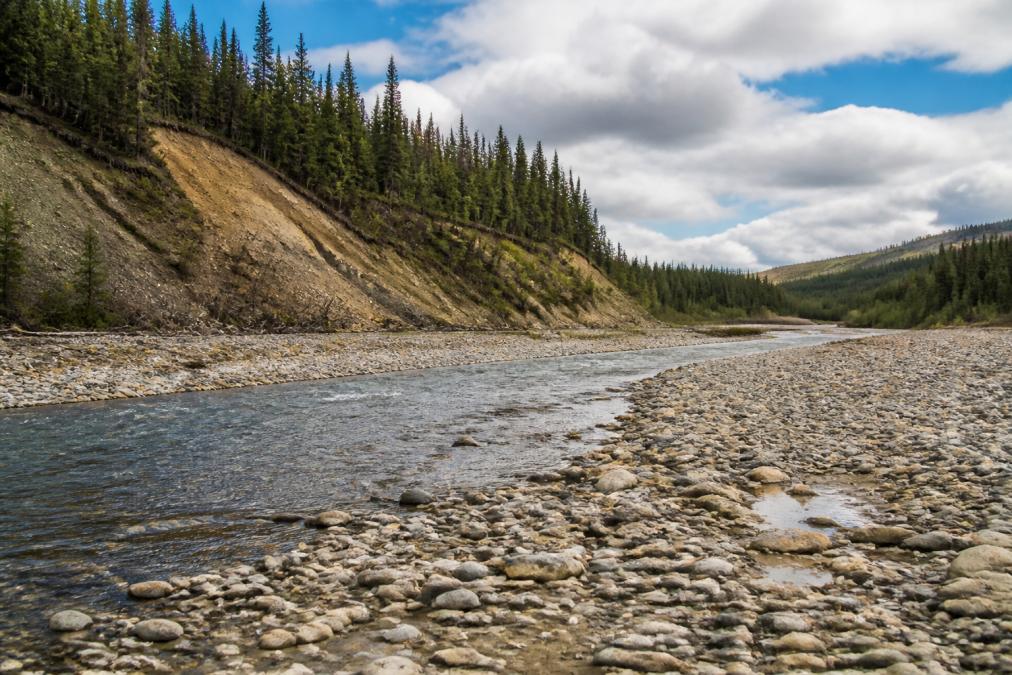
On August 16, 1896, prospectors made a discovery on a tributary of the Klondike River that would trigger one of North America's most dramatic mass migrations. The creek, originally called Rabbit Creek, was quickly renamed Bonanza Creek. Word spread slowly at first within the small prospecting community, but by July 1897, when news reached Seattle and San Francisco, the stampede had begun.
The Role of Skookum Jim, Tagish Charlie, and George Carmack
The conventional story credits George Carmack as the discoverer, but the fuller picture is more complicated. The party included Carmack, his Tagish wife Kate, her brother Skookum Jim Mason, and their nephew Dawson Charlie (also known as Tagish Charlie). Many historians now believe Skookum Jim actually found the gold, but because Indigenous people could not legally hold mining claims under the laws of the time, Carmack registered the discovery claim. Carmack staked the discovery claim and two adjacent claims, while Skookum Jim and Tagish Charlie each staked one claim. All four eventually profited, though Carmack's name dominated the historical record for decades.
Indigenous Perspectives on the Gold Rush
The Klondike Gold Rush unfolded on the traditional territories of the Tr'ondëk Hwëch'in people, who had lived along the Klondike and Yukon rivers for generations. Their settlement at the confluence of the two rivers, called Tr'ochëk, was a well-established fishing camp long before prospectors arrived.
The rush brought catastrophic disruption. The Tr'ondëk Hwëch'in were displaced from their traditional fishing grounds as Dawson City grew around their camp. Disease, loss of land access, and the collapse of traditional food sources followed. The Canadian government relocated the community to Moosehide, several kilometers downriver. As documented in Parks Canada's Klondike National Historic Sites resources, the Tr'ondëk Hwëch'in have worked for decades to reclaim and preserve their cultural heritage in the region.
How Much Gold Was Found in the Yukon: Numbers Behind the Rush
The scale of gold extraction from the Klondike is staggering. According to the Yukon government's historical records on the Klondike Gold Rush, peak production in 1898 and 1899 saw millions of ounces of placer gold recovered from creek beds and hillsides around Dawson City, making it one of the most productive placer mining regions in North American history.
The gold came almost entirely from placer deposits, loose gold-bearing gravel and sediment in creek beds and ancient hillside benches, not hard-rock ore veins. This distinction matters. Placer gold requires no blasting or smelting; it can be separated from gravel with water and gravity, making the rush possible for ordinary people with minimal equipment.
Geologically, the Yukon's gold deposits formed over millions of years as quartz veins eroded from bedrock and gold particles were carried downstream by glacial meltwater and river action. The Klondike basin escaped the most severe glacial scouring, which preserved gold-rich gravels in creek valleys rather than scattering them across a wider landscape, resulting in extraordinary concentration in a relatively compact area.
| Creek | Status | Notable For |
|---|---|---|
| Bonanza Creek | Discovery site, 1896 | First claim staked; triggered the rush |
| Eldorado Creek | Richest tributary | Produced extraordinary gold concentrations |
| Dominion Creek | Major producer | Active today; Parker Schnabel's operation |
| Hunker Creek | Long-running producer | Among the earliest claims after discovery |
| Bear Creek | Industrial era | Site of Dredge No. 4 National Historic Site |
The Stampede: Migration Routes, the Chilkoot Pass, and White Pass
Few episodes in American and Canadian history match the sheer physical audacity of the Klondike stampede. Most prospectors had never spent a night in the wilderness.

The two main overland routes began at the Alaska Panhandle coast. The Chilkoot Pass, rising steeply from Dyea, was the more direct but brutally demanding route. The White Pass, starting at Skagway, was longer but less vertical. Canadian authorities required every person crossing into the Yukon Territory to carry a full year's worth of supplies, roughly 2,000 pounds of goods per person. Hauling that weight over the Chilkoot Pass meant dozens of trips up a 45-degree slope in sub-zero temperatures.
The "Golden Staircase," the final ascent of the Chilkoot, became one of the defining images of the era. Photographs show an unbroken line of men climbing single file, bent under their loads. Many turned back. Some died. Those who made it still faced hundreds of miles of river travel before reaching Dawson City.
The White Pass earned the nickname "Dead Horse Trail" for the thousands of pack animals that died on its treacherous path. The White Pass and Yukon Route railway, completed in 1900, effectively ended both foot routes, but by then most of the best claims were already staked.
Life of a Klondike Gold Miner: Hardship, Technique, and Daily Reality
The life of a Klondike gold miner was defined by frozen ground, exhaustion, and frontier survival logistics. Most stampeders arrived to find every productive claim already staked and became wage laborers on other men's claims or drifted to Dawson City for service economy work.
Those who held claims faced a particular challenge: permafrost. Miners developed a technique of thawing frozen earth using steam points, metal pipes driven into the ground and fed with steam from wood-fired boilers. Once thawed, the gravel was sluiced with water to separate the gold.
The daily reality involved hauling wood for fuel, driving steam points into permafrost overnight, shoveling thawed gravel into sluice boxes, managing water supply from creek diversions, and maintaining equipment in temperatures that could reach -50°F in winter.
Placer Mining Methods: Panning, Sluice Boxes, and Claim Staking
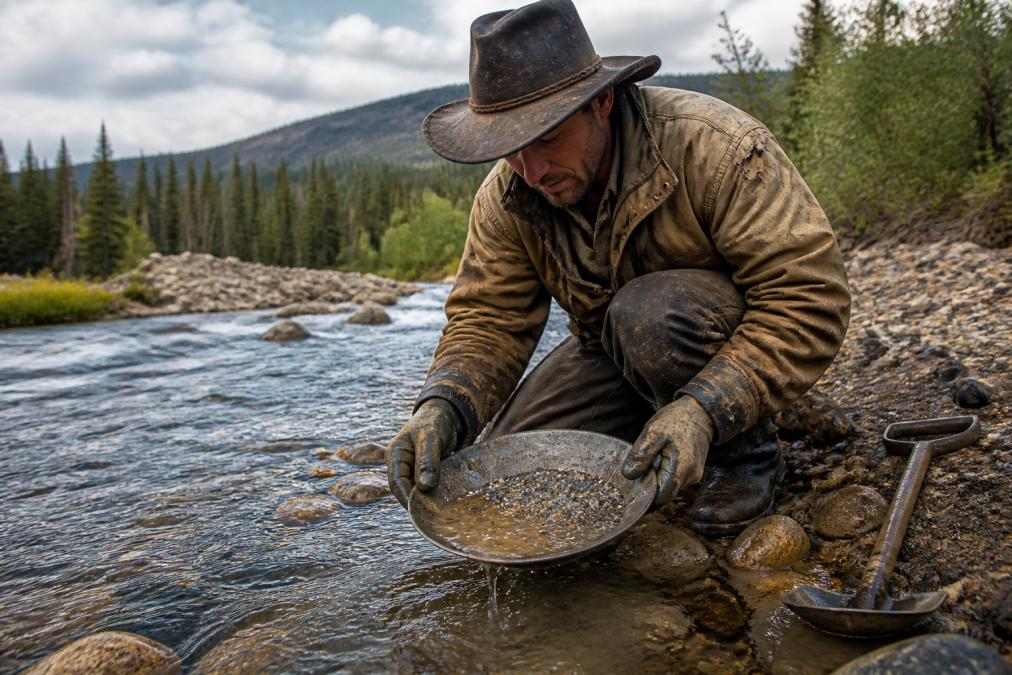
Placer mining is the extraction of gold from loose sediment, gravel, sand, and soil, using water to separate heavier gold particles from lighter material.
Panning, the simplest method, involves swirling water and sediment in a shallow pan until lighter gravel washes over the rim and heavier gold settles to the bottom. Panning works for prospecting but is too slow for serious production.
The sluice box scaled that principle up. A long wooden trough with riffles (cross-bars on the bottom) allowed water to carry gravel through while riffles trapped heavier gold particles. A well-built sluice box could process far more material per day than individual panners.
Claim staking followed strict Canadian mining law rules. A miner registered a claim by marking its boundaries with posts and filing a record with the Gold Commissioner's office in Dawson City. Creek bed claims measured 500 feet along the waterway. Hillside and bench claims above the creek were staked separately.
The Role of Women in the Gold Rush
Women were present throughout the Klondike Gold Rush, though their contributions rarely made the official record. Some came as wives and partners of miners. Others came independently, running boarding houses, laundries, restaurants, and supply businesses in Dawson City. A smaller number staked and worked their own mining claims.
The most commercially successful women were often entrepreneurs rather than miners. Running a laundry or boarding house in a boomtown where labor was scarce and prices were high could generate substantial income. Kate Carmack, wife of George Carmack and sister of Skookum Jim, was present at the original discovery but received almost no recognition in the historical narrative. Her story, and the stories of other Indigenous women, are only now being recovered through the work of historians and Indigenous communities.
Dawson City: Boomtown, Ghost Town, and Preserved Frontier Legacy
Dawson City grew from nothing to roughly 40,000 people within two years of the discovery. It had electric lighting, running water, two newspapers, an opera house, and a stock exchange, all in the subarctic wilderness, hundreds of miles from the nearest railroad.
The decline was nearly as fast as the rise. The 1899 discovery of gold at Nome, Alaska, drew thousands away almost overnight. By 1902, Dawson was a fraction of its former size. What the rapid depopulation preserved was remarkable. Buildings that would have been demolished in a living city simply stood empty. Today, Dawson City retains an extraordinary collection of late-Victorian and Edwardian frontier architecture. The Klondike National Historic Sites, managed by Parks Canada, protect dozens of original structures and the dredge fields that followed the rush.
Mining camps along Bonanza Creek, Eldorado Creek, and other tributaries were abandoned with their equipment in place. Some of that equipment, including massive gold dredges that replaced individual miners after 1900, still stands in the landscape. According to the National Park Service's Klondike Gold Rush historical documentation, the American side of the story is preserved at the Klondike Gold Rush National Historical Park in Skagway, Alaska.
Modern Gold Mining in Yukon: From Dominion Creek to Today
Modern gold mining in Yukon looks nothing like 1898, yet it is a direct continuation of the same geological reality that triggered the rush.
Dominion Creek, one of the major gold-producing creeks in the Klondike region, has been mined continuously for over a century. Today it is the site of Parker Schnabel's operation, featured on Discovery Channel's Gold Rush. Equipment is vastly different, excavators, wash plants, and heavy machinery have replaced steam points and sluice boxes, but the fundamental process remains the same: separating gold from placer gravel using water and gravity.
Modern Yukon gold mining operates under a comprehensive regulatory framework administered by the Yukon and Canadian federal governments. Environmental assessments, land use permits, and reclamation bonds are standard requirements. The Yukon still produces significant quantities of placer gold each year through family-run operations and larger commercial ventures.
Yukon Gold Mining History Facts Worth Owning a Piece Of
Understanding Yukon gold mining history is one thing. Holding a piece of it is another.
Parker's Gold offers collectors and enthusiasts a direct connection to this history through the Parker Schnabel Yukon Gold Flakes - Dominion Creek Collector Package, priced at $199.00. Each package contains genuine raw placer gold flakes recovered from Parker Schnabel's Dominion Creek operation, the same creek that has been producing gold since the rush era, now made famous again through Discovery Channel's Gold Rush.
Every package includes an official Certificate of Authenticity that documents the gold's origin. The gold is presented in a handcrafted tri-fold display case, making it ready to display or gift without additional preparation. Shipping is fully insured, tracked, and signature-required.
For fans of the show, the connection is immediate: this is gold from Parker Schnabel's actual operation, recovered using the same placer mining methods that have defined Yukon gold mining for 130 years. For collectors, the Certificate of Authenticity provides documentation that distinguishes verified gold from generic placer gold. With over 319 reviews, the package has built a track record among collectors who understand the difference between owning gold and owning a piece of documented Yukon history.
| Feature | Parker's Gold Dominion Creek Package |
|---|---|
| Gold source | Parker Schnabel's Dominion Creek, Yukon |
| Documentation | Official Certificate of Authenticity |
| Presentation | Handcrafted tri-fold display case |
| Shipping | Fully insured, tracked, signature-required |
| TV connection | Featured on Discovery Channel's Gold Rush |
| Price | $199.00 |
Collecting authentic Yukon placer gold is harder than it sounds. The market has generic gold sold without documentation, gold with unverifiable provenance claims, and gold that looks the part but has no traceable origin. Parker's Gold addresses all three problems directly: the gold comes from a named, documented operation on Dominion Creek, it ships with a Certificate of Authenticity, and the connection to Parker Schnabel's Discovery Channel operation provides a level of public verifiability that no anonymous supplier can match. Claim yours and own a piece of the history this guide has traced from 1896 to today.
Frequently Asked Questions
What started the Klondike Gold Rush in 1896?
The rush began on August 16, 1896, when George Carmack, Skookum Jim Mason, and Tagish Charlie discovered gold in gold-bearing gravel along Bonanza Creek, a tributary of the Klondike River in Canada's Yukon Territory. Word reached the United States in July 1897 when ships arrived in Seattle and San Francisco carrying prospectors and their gold, triggering a mass stampede of over 100,000 people toward the Yukon.
Is there still gold mining activity in the Yukon today?
Yes. The Yukon remains one of North America's most active placer mining regions. Modern gold mining in Yukon uses heavy equipment, advanced sluice systems, and satellite-guided claim staking. Operations like Parker Schnabel's Dominion Creek mine, featured on Discovery Channel's Gold Rush, continue to pull significant amounts of placer gold from the same geological formations that drew prospectors in 1896.
How many people got rich from the Yukon Gold Rush?
Very few. Of the roughly 100,000 prospectors who attempted the journey, only around 30,000 to 40,000 reached Dawson City. Most arrived after the best claims had already been staked. Estimates suggest fewer than 4,000 miners found gold in meaningful quantities, and only a few hundred became genuinely wealthy. The majority returned home with little more than the experience of a lifetime on the frontier.
What were the biggest challenges faced by miners in the Klondike?
Miners faced brutal winters with temperatures dropping well below freezing, a grueling trek over the Chilkoot Pass or White Pass carrying a year's worth of supplies, and the near-impossible task of thawing frozen ground to reach gold-bearing gravel. Once on site, the life of a Klondike gold miner meant backbreaking physical labor with basic tools, scarce food, disease outbreaks, and the constant risk that a neighboring claim would yield far more than their own.
This article was written using GrandRanker