

Table of Contents
- What Makes a Gold Mining Book Worth Your Shelf Space
- Gold Rush History Books That Cover the Full Timeline
- Prospecting Journals and Memoirs: Hearing It From the Miners
- Technical Guides to Gold Prospecting and Historical Mining Methods
- Life in Mining Camps: Boomtowns, Frontier History, and Social Change
- Gold Mining Books That Take On the Environmental Legacy
- Reading Gold Mining History Alongside Real Placer Gold
- Frequently Asked Questions
Last Updated: October 3, 2026
What Makes a Gold Mining Book Worth Your Shelf Space
The best gold mining books for history buffs do two things at once: they get the facts right, and they make you feel the mud, the cold, and the noise of a working claim. A book that only does one of those things ends up on the donation pile.
At Parker's Gold, we care about which accounts actually hold up. Below, we break down how to separate a keeper from a coffee-table ornament, covering primary sources versus secondary accounts, the full timeline of gold rush history books, prospecting journals and memoirs, technical guides, life in the mining camps, and the environmental legacy most reading lists skip.
One thing before you buy anything: a mining memoir is only as good as its sourcing. A book built on archival records and a geological survey will still be useful in twenty years. A book built on vibes will not.
Primary Sources vs. Secondary Accounts: Which Reads Better
Primary sources are first-hand records written by people who were there, while secondary accounts are later interpretations that synthesize multiple sources.
Primary sources include letters, claim staking records, assay certificates, and diaries. They give you texture: what a miner ate, what a bad week looked like, how gold fever actually sounded. Their weakness is bias and gaps. A single diarist sees one creek, not a territory.
Secondary accounts trade intimacy for context. A good historian can connect a boomtown's rise to national economic history, resource management policy, and geological survey data. The catch is distance. Every retelling filters the original.
For a balanced library, we suggest roughly two secondary histories for every primary source. Read the secondary account first for the map, then the primary source for the weather.
Gold Rush History Books That Cover the Full Timeline
A library built only around one strike gives you a slice, not a story. The gold rushes ran in waves, and the strongest gold rush history books follow those waves from the early strikes through the later frontier booms.
California Gold Rush Narratives
California set the template: sudden migration, instant boomtowns, and a social order that never quite settled. Look for narratives that include women, merchants, and immigrant miners rather than only the prospector with a pan. The best of them read like frontier history and economic history at the same time.
Colorado Mining History and the Later Strikes
Colorado mining history covers the shift from surface placer mining to hard rock mining, when shafts replaced creek beds and companies replaced individuals. This is where mining technology and labor history enter the story. Books on this period tend to be more technical and more sober, which is exactly why they belong on the same shelf.
| Era | What Changed | What to Look For |
|---|---|---|
| Early placer rushes | Panning and sluicing on creeks | Diaries, camp letters |
| Later hard rock era | Deep shafts, company mining | Labor and technology history |
| Modern retrospectives | Historian synthesis | Strong citations, maps |
Prospecting Journals and Memoirs: Hearing It From the Miners
Prospecting journals and memoirs are the closest thing to standing on the claim yourself. These are the books where you learn that most days produced nothing, that a good seam could vanish in a week, and that gold fever was as much a financial disease as a romantic one.
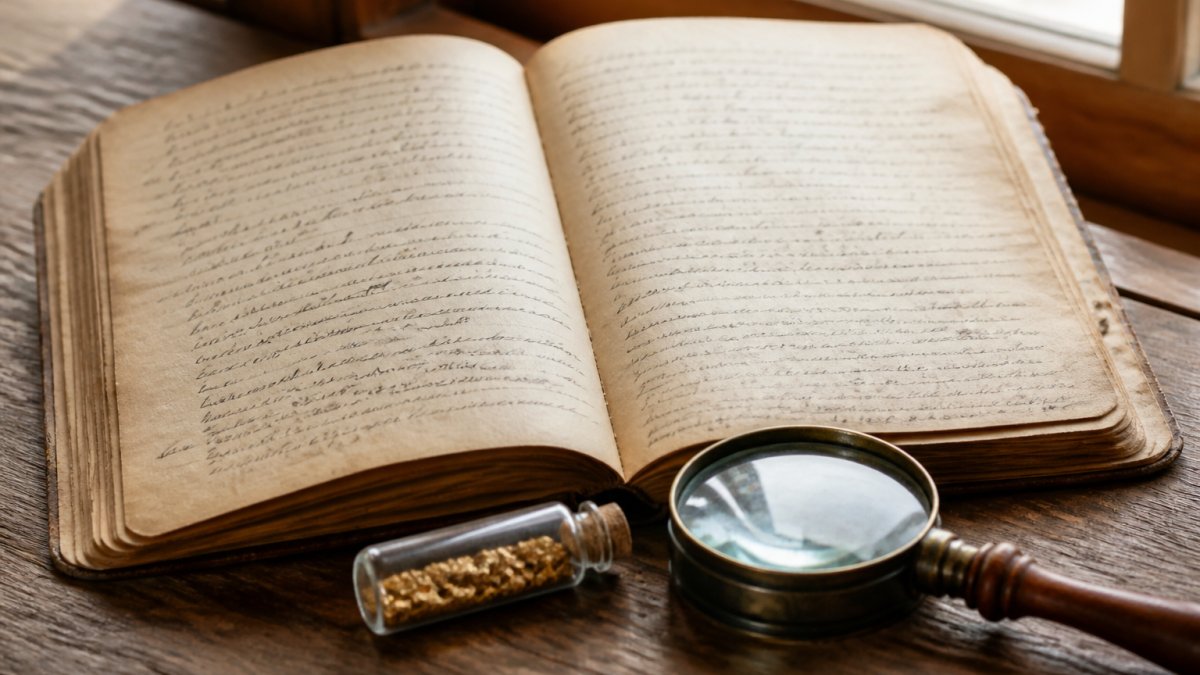
Read them for the small details. How a miner described the color of gold flakes in a pan. What he wrote after a failed claim. Those passages do more for your understanding of the era than any summary chapter.
What most guides miss is that memoirs need cross-checking. Memory drifts, and old miners had reasons to exaggerate. Pair each memoir with a secondary account of the same district so you can spot the embellishment.
Technical Guides to Gold Prospecting and Historical Mining Methods
Technical guides answer a different question than history books: not what happened, but how it was done. Panning, sluicing, and placer mining each have their own manuals, and the historical editions double as primary sources. A reader who understands the mechanics will read every history book differently afterward.
The core mechanisms are worth knowing before you buy a guide. Placer deposits form when weathering releases gold from lode rock and water carries it downstream, concentrating it in gravel bars and bench deposits. Lode mining follows the vein in place, which is why hard rock districts needed stamp mills to crush ore and mercury or cyanide to recover the gold. Hydraulic mining used high-pressure water monitors to wash entire hillsides into sluice boxes, a method so destructive that it triggered some of the earliest environmental litigation in the country.
Look for guides that explain ore deposits and assaying in plain language, and that distinguish between placer and lode methods rather than treating "gold mining" as one activity. Modern editions often annotate the old methods, which helps when the original terminology has fallen out of use.
The Environmental Legacy of Historical Mining
The environmental legacy of historical mining is the angle most reading lists avoid, and it is the one that connects the technical guides to the history books. Hydraulic mining moved entire hillsides into river systems, and the sediment traveled downstream for decades, raising riverbeds and worsening floods. Mercury used in gold extraction stayed in the ground and in the water long after the camps emptied.
Books on this subject connect resource management, water policy, and economic history into a single story. They are not comfortable reading, but they explain why some creeks still carry the marks of work done more than a century ago. If you want your library to hold up as serious history, this shelf matters as much as the adventure shelf.
Life in Mining Camps: Boomtowns, Frontier History, and Social Change
Mining camps were temporary societies, and the best books about them are really books about people. Boomtowns appeared in months, developed their own economies, and often vanished just as fast when the gold ran out.
The strongest accounts cover the full camp: merchants, cooks, laundresses, and families alongside the miners. That wider cast is where frontier history gets interesting, and it is where you find the women in gold mining history that older books tended to leave out entirely.
Gold Mining Books That Take On the Environmental Legacy
The environmental legacy of historical mining is the angle most reading lists avoid. Hydraulic mining moved entire hillsides, and the sediment traveled downstream for decades. Mercury used in gold extraction stayed in the ground long after the camps emptied.
Books on this subject connect resource management, water policy, and economic history into a single story. They are not comfortable reading, but they explain why some creeks still carry the marks of work done more than a century ago. If you want your library to hold up as serious history, this shelf matters as much as the adventure shelf.
Reading Gold Mining History Alongside Real Placer Gold
History reads differently when there is a physical object next to the book. A vial of raw placer gold flakes, sourced from an active operation rather than a faceless dealer, turns an abstract chapter about placer mining into something you can hold.
U.S. Geological Survey gold resource information publishes background on how placer deposits form, which pairs well with any technical guide on your shelf. Library of Congress primary source collections hosts digitized journals, photographs, and archival records from the western mining era, free to browse. For anyone comparing digitized archives against published histories, National Archives research resources is a useful check on what the primary record actually says.
That is where Parker's Gold fits naturally. Each limited-edition package contains genuine raw placer gold flakes from Parker Schnabel's Dominion Creek operation, presented in a handcrafted tri-fold display case with an official Certificate of Authenticity. It is a reading companion, not a substitute for the books, but it makes the history tangible in a way a photograph cannot.
Gold rush history rewards readers who build a shelf instead of buying one book. The timeline books give you the arc, the memoirs give you the voice, the technical guides give you the method, and the environmental histories give you the consequences. Parker's Gold exists for the moment you want something real to sit beside that shelf: verified placer gold from a working operation, shipped fully insured with tracking and signature required, ready to display or gift. Claim yours and put a piece of the story in your hands.
Frequently Asked Questions
What is the best gold mining book for someone new to the topic?
Start with a well-regarded narrative history of the gold rush before moving to primary sources. Broad histories give you the timeline, the major mining districts, and the economic context, so the diaries and journals make sense when you reach them. Once you have that framework, add a memoir from a working prospector to hear the daily reality of panning, sluicing, and claim staking in the miners' own words.
Are prospecting journals and memoirs more accurate than modern gold rush history books?
They answer different questions. Memoirs and journals capture daily life, prices, weather, and personal bias in the moment, but the writer only saw one slice of the gold rush. Modern history books draw on archival records, geological surveys, and many accounts at once, which corrects for individual exaggeration. The strongest reading list uses both: a memoir for texture, a modern history for verification and context.
Do any gold mining books cover the environmental legacy of historical mining?
Yes, and they are worth seeking out. Environmental histories examine how placer mining, sluicing, and hard rock mining reshaped rivers, forests, and soil across the American West, and how those effects persisted long after the boomtowns emptied. Reading one alongside a traditional gold rush narrative gives you a fuller picture of what mining actually cost the landscape, not just what it produced.
How do I judge whether a gold mining book is well researched?
Check the notes and bibliography first. Strong books cite archival records, historical journals, geological surveys, and named primary sources rather than repeating popular legends. Look for an author with a background in history, geology, or journalism, and be cautious with titles that promise treasure-hunting secrets instead of documented history. A book that shows its sources lets you verify claims and follow the trail yourself.