

Table of Contents
- Dominion Creek Gold: A Modern Gold Rush Story
- The Geology Behind Dominion Creek Gold
- Purity, Fineness, and What Makes This Gold Unique
- How to Value Raw Gold Nuggets and Flakes
- Buy Raw Placer Gold Online with Confidence
- The Economic Lifecycle of a Gold Claim
- Why Dominion Creek Gold Is a Collectible Worth Owning
- Frequently Asked Questions
Last Updated: September 15, 2026
Dominion Creek Gold: A Modern Gold Rush Story
Dominion Creek gold is raw placer gold recovered from the Dominion Creek drainage in the Klondike region of Yukon, Canada, and it earns its reputation from two things at once: a genuinely rich alluvial geology and a modern mining operation run by Parker Schnabel of Discovery Channel's Gold Rush. This guide from Parker's Gold covers where the gold comes from, why its purity and color stand out, and how collectors can own a verified piece of it.

The Klondike has produced legendary placer gold since the 1890s, and the Yukon Geological Survey's placer mining records document how the same creek systems have been worked for well over a century. What changed recently is scale. Modern equipment and methodical claim development have pushed recovery far beyond what hand crews managed, turning creeks like Dominion into serious industrial ground rather than hobby diggings.
Below, we'll break down the geology, the fineness, the real economics of a claim, and what separates a collectible from a generic bag of flakes.
The Geology Behind Dominion Creek Gold
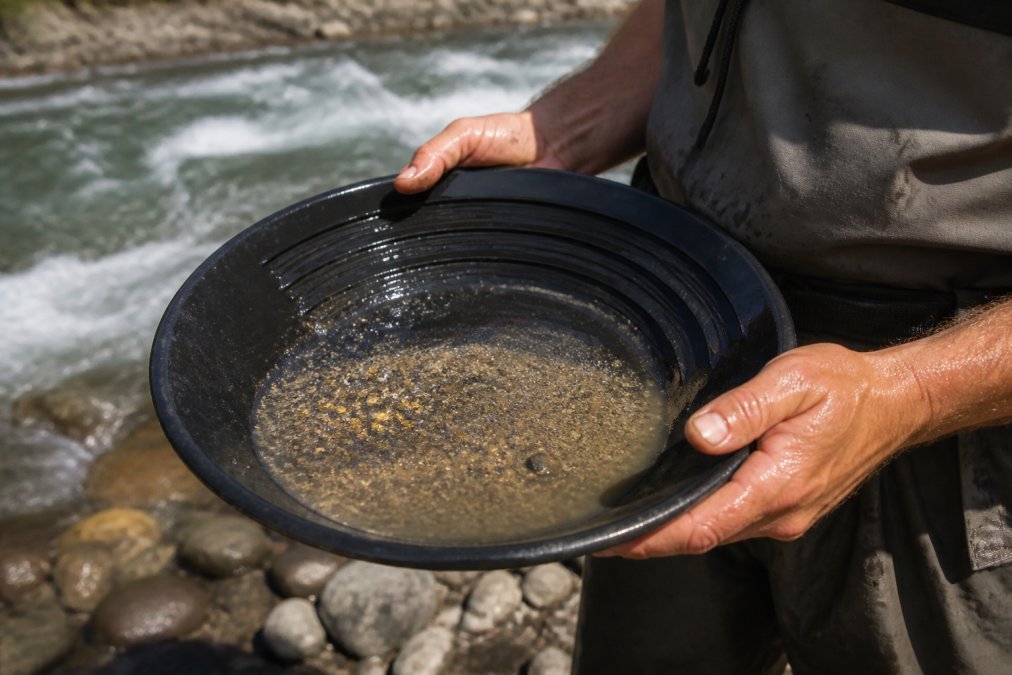
Dominion Creek's gold sits in alluvial deposits: loose gravel, sand, and cobbles laid down by ancient and modern stream action. Over millions of years, erosion freed gold from hard rock sources uphill, and flowing water carried the heavy particles downstream, concentrating them where the current slowed.
That concentration is the whole story. Gold is dense, roughly nineteen times heavier than water, so it settles out of a moving stream while lighter material keeps traveling (Gold). Geologists call the result a placer deposit, and the richest zones often sit on bedrock or behind obstructions that trap heavy minerals.
Alluvial Deposits: How Placer Gold Forms
Placer gold forms when weathering breaks down gold-bearing rock and water transports the freed particles into stream channels. As the current slows, dense gold drops out first, while quartz and lighter gravel wash away. Repeated flood cycles sort and re-sort the material, raising the heavy mineral concentration in specific layers.
Alluvial vs. Hard Rock Mining: What's the Difference?
Hard rock mining extracts gold still locked inside solid ore, usually quartz veins, by blasting and crushing rock. Placer mining, by contrast, recovers gold already freed by erosion and redeposited in gravel. The distinction matters because placer gold is generally purer at the point of recovery, since the natural transport process has already shed much of the base metal.
Purity, Fineness, and What Makes This Gold Unique
Klondike placer gold is prized for high fineness, meaning a high percentage of pure gold relative to silver and trace metals. Much of the gold from this region assays in the range of roughly 85 to 95 percent gold, with the balance largely silver (Placer depositional settings and their ages along Dominion Creek, Klondike area, Yukon...). That natural alloy gives the flakes a warm, saturated color collectors recognize instantly.
Fineness varies by location even within one drainage, which is why assay results matter. A higher gold-silver ratio typically reads as a brighter, deeper yellow. That visual signature, combined with documented origin, is a large part of why Dominion Creek gold is special rather than interchangeable.
How to Value Raw Gold Nuggets and Flakes
Valuing raw gold comes down to weight, fineness, and form. The base calculation is straightforward:
Value = weight in grams × spot price per gram × fineness (as a decimal)
A one-gram flake at 90 percent fineness, for example, contains about 0.9 grams of pure gold. Multiply that by the current spot price per gram to get the melt value, then adjust for the factors below.
- Weight: Measured in grams; larger nuggets command a premium over flake.
- Fineness: Higher purity raises both melt value and desirability.
- Form and character: Distinct nuggets and crystalline pieces sell above melt.
- Provenance: Documented origin, especially from a named operation, adds collector value.
What most guides miss is that melt value is the floor, not the price. For collectible placer gold, provenance and presentation often drive the sale price well above the metal content alone.
Buy Raw Placer Gold Online with Confidence
Buying raw placer gold online is safe when you verify three things: the seller's documentation, the stated weight and fineness, and the shipping protections. Without a Certificate of Authenticity, you're trusting a claim you can't check, which is exactly how buyers get burned.
Ask these questions before any purchase:
- Does the listing state the exact weight and fineness?
- Is there a Certificate of Authenticity naming the source?
- Is shipping insured, tracked, and signature-required?
- Are reviews from verified buyers?
This is where Parker's Gold fits naturally. Each limited-edition package contains genuine raw placer gold flakes recovered from Parker Schnabel's Dominion Creek operation, presented in a handcrafted tri-fold display case with an official Certificate of Authenticity. Shipping is fully insured, tracked, and signature-required, so the package is protected from mine to doorstep. You can see the Dominion Creek Collector Package here.
The Economic Lifecycle of a Gold Claim
Most coverage of gold claims jumps straight from "they found gold" to "they got rich," skipping the part that actually determines whether a claim is worth working. A placer claim moves through five distinct stages, and each one carries its own risk profile, cost structure, and timeline. Understanding them is what separates a viewer who watches the show from someone who can read a claim's real economics.
1. Staking and acquisition. In the Klondike, a placer claim is staked on ground open for location, then recorded with the territorial mining recorder. The staker pays a recording fee and commits to annual work requirements to hold the ground. This stage is cheap in dollars but expensive in judgment: most staked ground never produces economically recoverable gold.
2. Exploration and sampling. The operator drills or trenches to test gravel depth, gold grade, and bedrock topography. Placer gold is not evenly distributed, it concentrates in pay streaks, so sampling tells you whether a claim has a viable channel or just scattered color. This is where most claims die. A common pattern is that a claim looks promising on surface showings but fails to hold grade once tested at depth.
3. Development. Ground that passes sampling gets stripped of overburden, dewatered, and prepared for production. This is capital-intensive: equipment, fuel, labor, and reclamation planning all hit before the first ounce is recovered. On a large placer operation, development can consume an entire season before production begins.
4. Production. The operator runs gravel through a wash plant, sluices or runs it through a recovery circuit, and cleans up the concentrate. Recovery rates for fine placer gold are never 100 percent, some flour gold is lost to tailings, which is why operators chase efficiency as much as grade. Production is where revenue starts, but it is also where the clock starts ticking on depletion.
5. Depletion or resale. A placer claim is a finite resource. As pay gravel is worked out, recovery declines, and the operator either moves to new ground, sells the claim, or reclaims and walks away. This is the stage that makes documented gold from a specific operation scarce: once the ground is worked, that chapter is closed.
Where royalties fit. A royalty is a percentage of recovered gold paid to the claim owner or landholder, separate from the operator's costs. In placer arrangements, royalties are typically structured as a percentage of gross recovery or a fixed amount per unit of gravel processed. The structure matters because it determines how much margin actually flows to the operator, which in turn shapes how aggressively the ground gets worked. A high royalty can make marginal ground uneconomic; a low one can keep a declining claim in production longer.
Why this matters to a collector. Gold tied to a specific, documented operation is a limited resource by definition.
Why Dominion Creek Gold Is a Collectible Worth Owning
Frequently Asked Questions
What makes placer gold from Dominion Creek unique?
Dominion Creek placer gold is special because it comes from a historically rich alluvial deposit in the Yukon that has been mined for over a century. The gold is known for its high fineness, often between 85% and 95%, and its distinct flake and nugget forms. Unlike generic placer gold, Dominion Creek gold can be traced back to a specific mining operation, which adds collectible value and provenance.
How is raw placer gold from Dominion Creek verified?
Verification typically involves a Certificate of Authenticity that documents the gold's origin, weight, and purity. Reputable sellers like Parker's Gold provide certificates tied to specific mining claims and may include assay results. You can also look for documentation that traces the gold back to the Dominion Creek mining district, ensuring it's not misrepresented.
Is Dominion Creek gold considered a good investment for collectors?
Dominion Creek gold is more of a collectible than a pure investment. Its value comes from its provenance, connection to the Gold Rush TV show, and limited availability. While gold prices fluctuate, the premium for authenticated, historically significant placer gold often holds. For collectors, the enjoyment and rarity matter as much as financial return. Always buy from trusted sources with clear documentation.
How do I know my package won't get lost or stolen during shipping?
Parker's Gold ships all orders fully insured with tracking and signature required on delivery. If your package is lost or stolen, the insurance covers the full purchase price, and the company will replace it or refund you. This ensures your Dominion Creek gold arrives safely and securely, giving you peace of mind whether you're buying for yourself or as a gift.