

Table of Contents
- What Is Placer Gold and Why Verification Matters
- Visual Identification: The First Step in Verifying Authentic Placer Gold
- Gold vs Pyrite Identification: Separating Real Gold from Fool's Gold
- The Magnet Test and Streak Plate Test
- Specific Gravity Test for Gold: Measuring Density at Home
- How to Test Gold with Vinegar and Other Acid Tests
- Professional Authentication and Certificates of Authenticity
- Conclusion
Last Updated: August 23, 2026
What Is Placer Gold and Why Verification Matters
Placer gold is gold found in loose sediment deposits rather than embedded in solid rock. It occurs naturally in alluvial deposits, stream beds, and ancient riverbeds where water has concentrated heavier minerals over thousands of years. Understanding how to verify authentic placer gold is essential for collectors, prospectors, and enthusiasts who want to ensure they're purchasing genuine material.
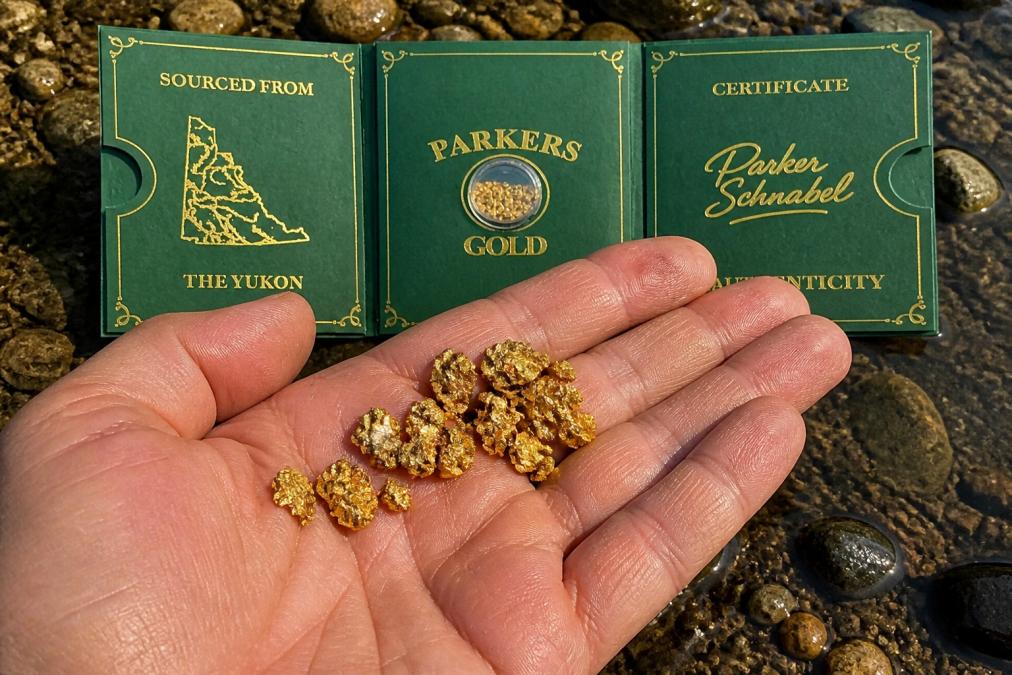
The stakes matter. Counterfeit gold and misidentified minerals can be a concern for buyers. A specimen that looks like gold might actually be pyrite, mica, or another sulfide mineral. Without proper verification methods, even experienced collectors can be deceived. This is why Parker's Gold includes an official Certificate of Authenticity with every purchase, it's proof that your placer gold has been authenticated and sourced directly from verified mining operations.

Verification isn't complicated, but it requires knowing which tests actually work in the field. The seven methods covered in this guide range from simple visual checks to specific gravity measurements. Each test builds confidence in your specimen's authenticity.
Visual Identification: The First Step in Verifying Authentic Placer Gold
The first step in verifying authentic placer gold begins with your eyes. Genuine placer gold exhibits specific visual characteristics that distinguish it from fool's gold and other minerals. Color, luster, and shape tell you a lot before you ever conduct a chemical test.
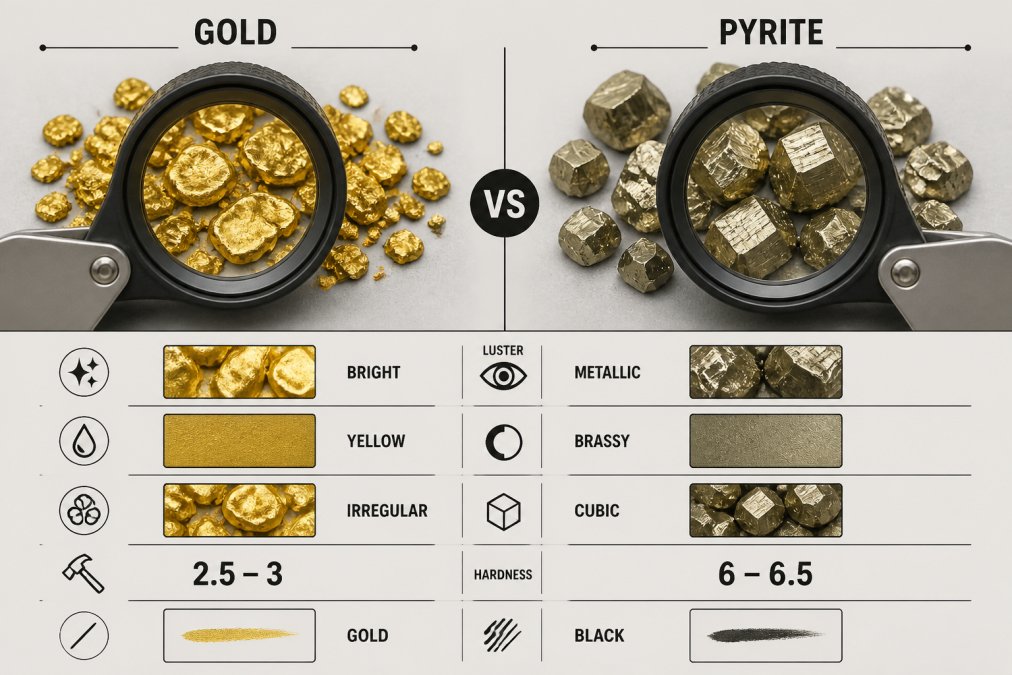
Real gold displays a warm, distinctive yellow color that remains consistent under different lighting conditions. The color doesn't fade or change tone. Pyrite, by contrast, has a brassy yellow that looks almost greenish under certain angles. Mica reflects light in a way that creates a silvery shimmer, which is fundamentally different from gold's warm glow.
Luster, the way light reflects off the mineral's surface, is another critical identifier. Gold has a metallic luster that looks smooth and reflective, like polished metal. The reflection is uniform across the specimen. Pyrite often shows a more angular, faceted reflection because it forms in cubic crystals. Mica breaks into thin sheets and reflects light in layers, creating a distinctly different visual effect.
Shape matters too. Placer gold typically forms as flakes, small nuggets, or irregular fragments. These shapes result from natural erosion and water transport. The edges may be rounded or jagged, but the overall form is organic. Pyrite, when found in placer deposits, usually appears as small cubic or octahedral crystals with sharp, geometric angles. This geometric precision is a red flag, natural gold doesn't form perfect geometric shapes in placer deposits.
Use a jeweler's loupe or magnifying glass to examine the specimen closely. At 10x magnification, the differences between gold and other minerals become unmistakable. Gold will show a consistent, smooth surface with a warm metallic sheen. Pyrite will reveal cubic crystal faces. Mica will show layered, reflective planes.
Gold vs Pyrite Identification: Separating Real Gold from Fool's Gold
Pyrite is the most common mineral mistaken for gold, which is why it earned the nickname "fool's gold." Separating real gold from pyrite is one of the most important verification skills you'll develop. The differences are real, but they require attention to detail.
The most obvious distinction is color under magnification. Gold is a consistent, warm yellow. Pyrite is brassy yellow with greenish or coppery undertones. Hold both specimens under a loupe and compare them side by side. The color difference becomes obvious once you've seen it. Gold looks like polished metal. Pyrite looks like tarnished brass.
Hardness provides another clear distinction. Gold is soft and malleable. Pyrite is brittle and hard. If you scratch your specimen gently with a steel knife or file, gold will show a visible scratch mark. Pyrite will resist scratching or shatter. This test requires caution, you don't want to damage a valuable specimen. Use a small, inconspicuous area if you're testing something precious.
Crystal structure is visible at higher magnification. Pyrite forms in cubic or octahedral crystals with perfect geometric angles. Gold in placer deposits doesn't form crystals, it appears as amorphous flakes and nuggets. If you see sharp, geometric crystal faces, you're likely looking at pyrite or another mineral, not gold.
Weight is also revealing. Gold is significantly denser than pyrite. Hold a specimen of each in your hand. Gold feels heavier for its size. This is why gold settles to the bottom in panning, it's denser than surrounding materials. If your specimen feels light for its size, it's probably not gold.
Mica is another common impostor. Mica forms in thin, reflective sheets that look silvery rather than golden. It's also much softer than gold and will break into fragments easily. Mica flakes apart in layers when pressure is applied. Gold doesn't.
The Magnet Test and Streak Plate Test
The magnet test is quick and non-destructive for initial verification. Gold is non-magnetic, meaning it won't respond to a standard magnet (peer-reviewed research). Pyrite and other sulfide minerals show varying degrees of magnetic attraction. This test eliminates many false positives immediately.
Use a strong neodymium magnet for the most reliable results. Hold the magnet near your specimen without touching it. Genuine gold won't move toward the magnet. If your specimen is attracted to the magnet, it contains ferrous minerals and is not pure gold. This test works because gold's atomic structure doesn't interact with magnetic fields the way iron-bearing minerals do.
The streak plate test is equally valuable. A streak plate is a piece of unglazed ceramic or porcelain. When you drag a mineral across it, the mineral leaves a colored mark, its "streak." This streak color often differs from the mineral's surface color, providing crucial identification information.
Drag your specimen gently across the streak plate. Gold leaves a yellow streak that matches its surface color. Pyrite leaves a greenish-black or brownish-black streak, which is completely different from its brassy yellow appearance. This contrast is diagnostic. If your specimen leaves a yellow streak, you're likely looking at gold. If it leaves a dark streak, it's pyrite.
Mica leaves a white or colorless streak. Chalcopyrite (another fool's gold impostor) leaves a greenish-black streak. By comparing the streak color to the surface color, you can rule out most common minerals that resemble gold.
Specific Gravity Test for Gold: Measuring Density at Home
The specific gravity test measures how dense your specimen is compared to water. Gold has a specific gravity of approximately 19.3, meaning it's 19.3 times denser than water (usgs.gov). This makes it far denser than most minerals that resemble it. Pyrite has a specific gravity of about 5.0, and mica is even lighter at around 2.7 (usgs.gov).
You can conduct this test at home with minimal equipment. You'll need a small scale accurate to at least 0.1 grams, a container of water, and a thin string. The process takes about five minutes and provides definitive verification.
First, weigh your specimen in air. Record this weight precisely. Next, tie the string around the specimen and suspend it in water without letting it touch the container's sides or bottom. Weigh the specimen while it's suspended in water. The difference between the two weights equals the weight of water displaced.
To calculate specific gravity, divide the weight in air by the weight of water displaced. If your result is close to 19.3, you have gold. If it's significantly lower, around 5.0 or below, you have a different mineral. This test is nearly foolproof because specific gravity is a fundamental physical property that can't be faked.
The beauty of this test is its accuracy. Even small quantities of gold can be verified. A single flake weighing 0.5 grams will still show the characteristic density difference. This is why collectors and prospectors rely on specific gravity testing when other methods are inconclusive.
How to Test Gold with Vinegar and Other Acid Tests
Acid testing is one of the oldest and most reliable methods for verifying gold authenticity. Gold is highly resistant to most acids. Pyrite and other sulfide minerals dissolve or react when exposed to certain acids. This fundamental chemical difference provides clear verification.
Vinegar contains acetic acid, which is weak enough to be safe for home use but strong enough to reveal differences. Pour a small amount of vinegar into a shallow container. Place your specimen in the vinegar and observe what happens. Genuine gold will show no visible reaction. Pyrite will begin to oxidize and may show discoloration or a slight reaction at the surface.
Nitric acid is more dramatic but requires careful handling. A single drop of nitric acid on pyrite causes an immediate, visible reaction, the surface may darken or show oxidation. Gold remains completely unchanged. This test is so reliable that professional assayers use it as a standard verification method. However, nitric acid is caustic and requires proper safety equipment. Only conduct this test if you have appropriate protective gear and knowledge of acid handling.
The reaction difference is chemical. Pyrite contains iron and sulfur. When exposed to acid, these elements oxidize. Gold contains no reactive elements at room temperature. It's inert in this context. The presence or absence of a reaction tells you definitively whether you're looking at gold or a sulfide mineral.
For home testing, vinegar is sufficient. If your specimen shows any discoloration, oxidation, or surface reaction in vinegar, it's not pure gold. Genuine gold will remain completely unchanged after extended exposure to vinegar. This simplicity is why acid testing has been used for centuries.
Professional Authentication and Certificates of Authenticity
When you've completed all field tests and remain confident in your specimen, professional authentication provides the final verification layer. Professional assayers and gemologists have access to advanced equipment and decades of expertise. They can confirm authenticity, measure purity, and estimate weight with precision.
A Certificate of Authenticity from a reputable source documents that your gold has been professionally verified. This certificate increases the specimen's value and provides confidence to future buyers or collectors. Parker's Gold includes an official Certificate of Authenticity with every Dominion Creek Collector Package, confirming that the gold was sourced directly from Parker Schnabel's verified mining operation and has been authenticated.
Professional certificates typically include several data points: specimen weight, estimated purity (karat rating), visual description, and authentication date. This documentation serves as permanent proof of verification. When you purchase authenticated placer gold like the specimens from Parker's Gold, you're investing not just in the gold itself, but in verified provenance and professional authentication.
The difference between authenticated and unverified gold is significant in the collector's market. Authenticated specimens can command higher prices because buyers have documented proof of authenticity. A Certificate of Authenticity from a recognized source essentially provides confidence that transcends any home test.
If you're purchasing placer gold as a collectible or investment, verify that the seller provides professional authentication documentation. Ask to see the certificate before purchase. Legitimate sellers like Parker's Gold make authentication documentation central to their offering because it's what separates genuine collectibles from uncertain specimens.
Verifying authentic placer gold requires patience and attention to detail, but the process is straightforward once you understand the key differences between gold and its common imposters. The seven tests outlined here, visual identification, magnet testing, streak plate testing, specific gravity measurement, acid testing, and professional authentication, provide multiple layers of verification that build confidence in your specimen's authenticity.
When you're ready to own a verified piece of Yukon history, the Parker Schnabel Yukon Gold Flakes - Dominion Creek Collector Package ($199.00) delivers authenticated placer gold with professional certification. Each package features genuine gold flakes recovered from Parker Schnabel's legendary operation, presented in a handcrafted tri-fold display case with an official Certificate of Authenticity. This combination of authentic material, professional verification, and secure delivery ensures you're investing in verified gold with documented provenance. Claim yours today and own a tangible piece of authentic mining history.
Frequently Asked Questions
Q: What's the fastest way to test the authenticity of gold?
A: The magnet test is the quickest field check: real gold is not magnetic, while pyrite and other sulfide minerals respond to magnets. For a more thorough result in under five minutes, combine the magnet test with visual inspection using a jeweler's loupe to examine luster, color, and surface texture. If you need definitive proof, acid testing with nitric acid provides reliable confirmation, though it requires careful handling and should be done outdoors or in a well-ventilated space.
Q: How can you tell the difference between gold and pyrite?
A: Real gold has a bright yellow luster that remains consistent under light, while pyrite displays a metallic brassy color with a darker tarnish. Gold is malleable (bends without breaking), whereas pyrite is brittle and shatters. Under a jeweler's loupe, gold appears smooth and uniform, while pyrite shows cubic crystal formations. The magnet test also distinguishes them: gold doesn't respond to magnets, but pyrite (iron sulfide) does. A streak test on a ceramic plate leaves a golden-yellow mark for gold and greenish-black for pyrite.
Q: How do I know the Certificate of Authenticity actually means something?
A: A legitimate Certificate of Authenticity from a reputable source like Parker's Gold includes specific details: the exact location of origin (such as Dominion Creek), the approximate weight or volume of gold, the date of recovery, and the issuing authority's credentials. For Parker's Gold products, each certificate is tied to the specific Dominion Creek operation featured on Discovery Channel's Gold Rush. Cross-reference the certificate number with the seller's records to confirm authenticity.
Q: Is placer gold worth anything beyond its collector value?
A: Yes, placer gold has intrinsic value based on its weight and purity. Raw placer gold typically ranges from 70-90% pure, depending on its source and whether it's been refined. You can calculate its bullion value by weighing the specimen and multiplying by the current spot price of gold. However, authenticated placer gold from documented sources like Parker Schnabel's Dominion Creek operation often commands a premium above spot price due to its provenance, historical significance, and collector appeal, especially when accompanied by a Certificate of Authenticity and displayed in a handcrafted presentation case.
This article was written using GrandRanker