

Table of Contents
- What Are Real Gold Flakes and Why Certification Matters
- How to Verify Gold Authenticity: Testing Methods You Can Use
- Identifying Real Gold vs. Fool's Gold: Key Differences
- Understanding Gold Purity and Karat Standards
- What a Certificate of Authenticity Actually Guarantees
- Value of Gold Flakes Per Gram and Pricing Factors
- Where to Buy Real Gold Flakes With Verified Certification
- Conclusion
Last Updated: August 18, 2026
What Are Real Gold Flakes and Why Certification Matters
Real gold flakes with certification represent authentic precious metal specimens verified for purity and origin. The precious metals market is flooded with counterfeits, fool's gold (iron sulfide), gold-plated base metals, and artificially colored brass all circulate as "gold" online. Without certification, you're purchasing on trust alone.
A certificate of authenticity serves as your proof of ownership and value, documenting the gold's purity level (measured in karats), weight, origin, and testing methodology. For collectors seeking tangible pieces of history, like authentic placer gold from legendary mining operations, certification transforms a novelty item into a verified asset.
At Parker's Gold, we understand this distinction intimately. Our Dominion Creek Collector Package features genuine raw placer gold recovered directly from Parker Schnabel's operation in the Yukon, as seen on Discovery Channel's Gold Rush. Each package arrives with an official Certificate of Authenticity that verifies the gold's origin and purity, presented in a handcrafted tri-fold display case designed for both protection and showcase.

Real gold flakes with certification give you three things unverified gold cannot: documented proof of what you own, confidence in its authenticity, and a story backed by verifiable evidence.
How to Verify Gold Authenticity: Testing Methods You Can Use
Verification starts with understanding the tests that separate real gold from counterfeits. While professional laboratory analysis provides the definitive answer, several practical methods let you assess authenticity before purchase.
Physical and Visual Tests
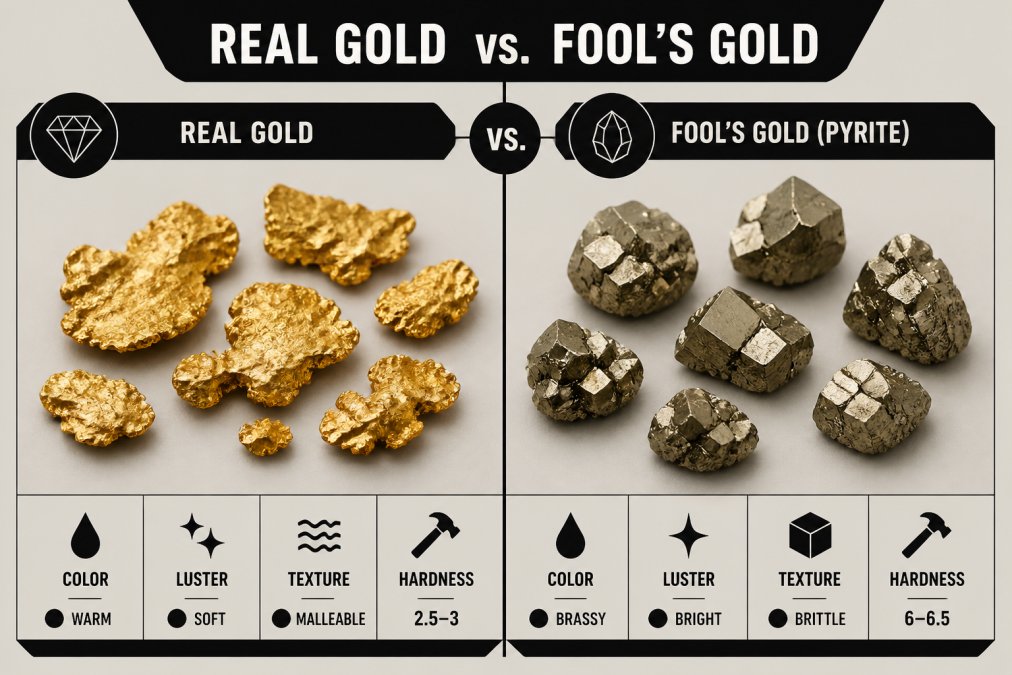
Color and luster. Authentic gold carries a distinctive warm, yellowish hue with a soft, rich metallic shine. Fool's gold (pyrite) produces a brassy, greenish-yellow color with a harder, more reflective shine. Under angled light, the difference becomes obvious.
Weight and density. Gold is significantly denser than most base metals and mineral imitations. Real gold at 19.3 grams per cubic centimeter feels noticeably heavier than fool's gold at 5.0 grams per cubic centimeter. Even small quantities of genuine gold have noticeable weight.
Surface texture. Real placer gold flakes show natural wear patterns from water erosion with slightly rounded, irregular edges. Imitation gold products often show uniform texture or artificial smoothness that suggests manufacturing rather than natural formation.
Professional Verification Options
Acid testing. Professional assayers use nitric acid to test gold purity. Real gold resists nitric acid, while base metals dissolve. Reputable gold dealers perform this test routinely and include results in certificates of authenticity.
X-ray fluorescence (XRF). This non-destructive testing method identifies elemental composition without damaging the specimen. XRF machines provide precise purity readings in minutes and are standard in professional certification labs.
Weight and dimension analysis. Laboratories measure the specimen's weight and dimensions, then calculate density to confirm whether the material matches gold's expected density of 19.3 grams per cubic centimeter. Deviations indicate either mixed metals or counterfeits.
Chain of custody documentation. For collectible gold like Parker's Gold's Dominion Creek flakes, origin verification matters as much as purity. Professional certification includes documentation of where the gold came from, who extracted it, and how it was processed.
Identifying Real Gold vs. Fool's Gold: Key Differences
The most common counterfeit gold substance is pyrite, commonly called fool's gold. Real gold is a soft, malleable precious metal that resists corrosion. Fool's gold is a brittle mineral composed of iron sulfide.
Hardness and brittleness. Real gold is soft enough to scratch with a knife or coin. Fool's gold is harder and more brittle, shattering or chipping when struck rather than deforming.
Streak test. Rub the specimen across unglazed ceramic (the back of a ceramic tile works well). Real gold leaves a golden-yellow streak. Fool's gold leaves a greenish-black or brownish-black streak. This test is quick, non-destructive, and highly reliable.
Magnetic response. Real gold is non-magnetic. Fool's gold contains iron, making it weakly magnetic. A strong magnet won't attract gold but may show slight attraction to fool's gold.
Shape and crystal structure. Fool's gold forms perfect cubic crystals with sharp geometric faces. Real placer gold appears as irregular, rounded flakes shaped by water erosion without geometric precision.
Specific gravity comparison. Real gold is approximately 19.3 times denser than water. Fool's gold is about 5.0 times denser. A specimen that feels unusually heavy for its size is more likely to be real gold.
Understanding Gold Purity and Karat Standards
Gold purity is measured in karats, a system that indicates the percentage of pure gold in a specimen or alloy.
24-karat gold represents pure gold, 100% by definition. It's the standard against which all other purity levels are measured.
22-karat gold contains 91.7% pure gold mixed with 8.3% other metals, strengthening the gold while maintaining its character.
18-karat gold contains 75% pure gold and 25% other metals, providing durability for everyday wear.
14-karat gold contains 58.3% pure gold and 41.7% other metals, the most common composition in jewelry.
10-karat gold contains 41.7% pure gold, the minimum standard legally considered "gold" in the United States.
Certificates of authenticity specify the karat purity of the gold they verify. This specification is critical because it determines the gold's actual value. Placer gold typically ranges from 18 to 24 karats in purity, depending on the source location. Parker's Gold's Dominion Creek specimens represent authentic placer gold with purity verified through professional testing methods.
What a Certificate of Authenticity Actually Guarantees
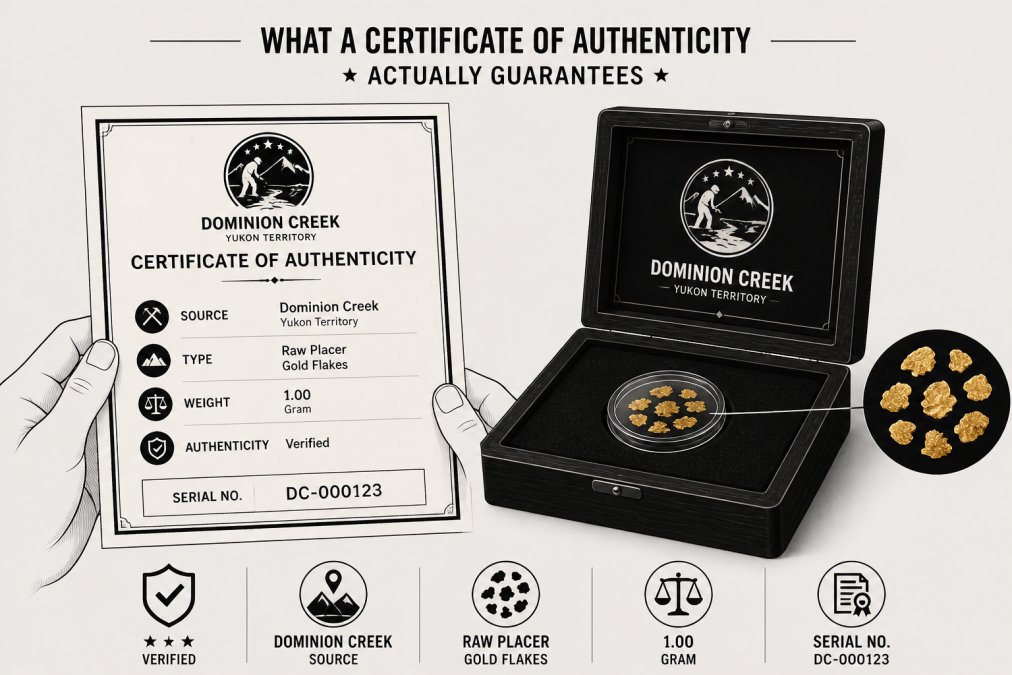
A certificate of authenticity is a formal document issued by a qualified testing laboratory confirming specific details about a gold specimen.
What a legitimate certificate verifies:
A proper certificate documents the specimen's weight (typically in grams or troy ounces), purity level (expressed in karats or fineness), testing methodology used, date of testing, and the laboratory's credentials. It includes a unique serial number for traceability and often a photograph of the specimen for identification.
The certificate guarantees that when tested on the specified date using the stated methodology, the specimen met the documented purity standard.
What a certificate does NOT guarantee:
A certificate does not guarantee the specimen's market value, as gold prices fluctuate daily. It does not guarantee the specimen won't be stolen, lost, or damaged after certification. It does not guarantee future resale value, though certified gold is more liquid and easier to sell than unverified gold.
Why certification matters despite these limitations:
Certification transforms gold from an unverified commodity into a documented asset. When you own certified gold, you can prove what you have, resell it with confidence, insure it properly, and gift it knowing the recipient receives verified authenticity.
For collectible gold like Parker's Gold's Dominion Creek specimens, certification adds another layer of value beyond the metal itself. The certificate documents the gold's origin from Parker Schnabel's legendary Yukon operation, appealing to collectors willing to pay premiums for authenticated pieces of Gold Rush history.
Value of Gold Flakes Per Gram and Pricing Factors
Gold pricing involves multiple variables beyond the spot price of gold on global markets.
Spot price baseline. The London Bullion Market fixes gold prices twice daily in U.S. dollars per troy ounce. One troy ounce equals 31.1 grams, so dividing the spot price by 31.1 gives you the approximate per-gram value of pure gold.
Purity adjustment. Gold flakes valued at 24 karats (pure gold) trade at the full spot price. Gold at 22 karats is worth approximately 91.7% of spot. 18-karat gold is worth 75% of spot. 14-karat gold is worth 58.3% of spot.
Form premium. Raw placer gold flakes command premiums over refined gold bullion because they appeal to collectors and enthusiasts. The natural form, rarity, and aesthetic appeal of authentic placer gold justify higher per-gram prices than commodity gold.
Origin and provenance. Gold with documented history, particularly gold from famous mining locations, sells at premiums to generic placer gold. Gold from Parker Schnabel's Dominion Creek carries premium value because it connects to a well-known mining operation and television program.
Certification and documentation. Certified gold with proper documentation sells at higher per-gram prices than unverified gold of identical purity. The cost of certification adds to the specimen's price but increases its marketability and resale value significantly.
Market demand and collector interest. Specialized collector markets affect pricing. Gold Rush memorabilia and items connected to popular television shows experience demand fluctuations based on show popularity and collector sentiment.
Parker's Gold's Dominion Creek Collector Package is priced at $199.00, reflecting the combination of authentic placer gold, professional certification, handcrafted presentation case, and the historical significance of the Dominion Creek source.
Where to Buy Real Gold Flakes With Verified Certification
Purchasing certified gold requires careful vendor selection.
Direct from mining operations. Some mining companies sell directly to collectors, eliminating middlemen and providing the strongest chain of custody documentation. Parker's Gold offers direct access to gold recovered from Parker Schnabel's Dominion Creek operation. The Dominion Creek Collector Package includes the official Certificate of Authenticity, handcrafted tri-fold display case, and fully insured, tracked, signature-required shipping.
Established bullion dealers. Reputable precious metals dealers maintain certification relationships with accredited laboratories. They typically stand behind their products.
Online marketplaces with verification. Some online platforms specialize in certified precious metals. Verify that the platform requires sellers to provide legitimate certification from recognized laboratories.
Auction houses and specialty collectors. High-end auction houses sell rare and certified gold specimens with documented provenance, though prices often reflect competitive bidding.
Red flags to avoid:
Never purchase gold without certification. Avoid sellers offering gold at prices significantly below spot value. Be skeptical of "exclusive deals" or pressure to purchase quickly. Check seller credentials and reviews carefully. When purchasing online, use secure payment methods that offer buyer protection.
Conclusion
Real gold flakes with certification represent the intersection of precious metal value and collector authenticity. Parker's Gold's Dominion Creek Collector Package delivers authentic placer gold recovered from Parker Schnabel's legendary Yukon operation, verified through professional testing, presented in a handcrafted display case, and backed by an official Certificate of Authenticity. With fully insured, tracked, signature-required shipping, you receive not just gold, but a verified piece of Yukon history. Claim Yours today and own something truly authentic.
Frequently Asked Questions
How can I test if gold flakes are real at home?
Several quick tests help identify real gold flakes. The magnet test works because genuine gold is non-magnetic, if flakes stick to a magnet, they contain iron and are not pure gold. The weight and density test shows real gold is significantly heavier than fool's gold or other metals of similar size. The acid test (using nitric acid) is more advanced but reliable; real gold resists acid while most imitations dissolve or discolor. For definitive verification, request a Certificate of Authenticity from the seller, which should include batch testing results and purity documentation.
What does a Certificate of Authenticity for gold flakes include?
A legitimate Certificate of Authenticity for real gold flakes includes the origin source, karat purity percentage, weight in grams, batch testing results, and traceability information. It may also list certifications such as GMP compliance or FDA food-grade status if applicable. The certificate should be issued by a reputable source with contact information for verification. Parker's Gold includes an official Certificate of Authenticity with each Dominion Creek Collector Package, documenting that the gold flakes are sourced directly from Parker Schnabel's verified operation and have undergone batch testing.
How much are real gold flakes worth per gram?
The value of gold flakes per gram depends on current spot gold prices, which fluctuate daily. As of 2026, spot gold trades around $2,000 per troy ounce, which equals approximately $64 per gram for pure 24k gold. However, certified collectible gold flakes, especially those with documented origin like placer gold from historic mining operations, often command premium prices above spot value due to authenticity, rarity, and provenance. Parker's Gold Dominion Creek packages are priced at $199, reflecting both the gold content and the exclusive collector value of verified Yukon-sourced material.
Where can I buy real gold flakes with certification?
Purchase real gold flakes with certification from reputable dealers who provide batch testing documentation and official verification. Parker's Gold offers authentic Yukon placer gold flakes from Parker Schnabel's Dominion Creek operation, each package including a handcrafted display case and Certificate of Authenticity. Verify any seller by checking for GMP compliance, FDA food-grade certification if edible gold is claimed, and detailed traceability information. Avoid sellers who cannot provide written certification or batch testing results, as these are red flags for imitation or unverified gold.
This article was written using GrandRanker