

Table of Contents
- Understanding Gold Mining Lifecycle Stages
- Placer Mining Techniques for Gold Collection
- Hard Rock Mining Methods and Ore Extraction
- Gold Ore Processing Methods: From Crushing to Recovery
- Gold Recovery from Tailings and Byproduct Mining
- Environmental Regulations for Gold Mining Operations
- Safety Protocols and Equipment Maintenance for Small-Scale Collection
- Owning Authentic Gold: Verification and Certification
Last Updated: August 16, 2026
Understanding Gold Mining Lifecycle Stages
Gold mining operates through distinct phases: exploration, development, production, and reclamation. Exploration uses core sampling and mineral analysis to identify ore deposits. Development establishes infrastructure like access roads and processing facilities. Production focuses on extraction and initial processing, while reclamation restores the site afterward.
Each phase determines which collection methods work best. Placer operations target loose gold in streambeds, while hard rock mines extract gold embedded in quartz. Parker's Gold sources its authentic Yukon gold directly from Parker Schnabel's Dominion Creek operation, which uses placer mining methods. The lifecycle also influences recovery rates and purity, placer mining typically yields lower-grade concentrates requiring less intensive processing, while hard rock operations extract higher-grade ore demanding more sophisticated refining.

Placer Mining Techniques for Gold Collection
Placer mining is the simpler, less capital-intensive method for collecting gold, exploiting the fact that gold is significantly denser than surrounding rock and sediment. When ore-bearing material is exposed to water and gravity, gold naturally separates and settles.
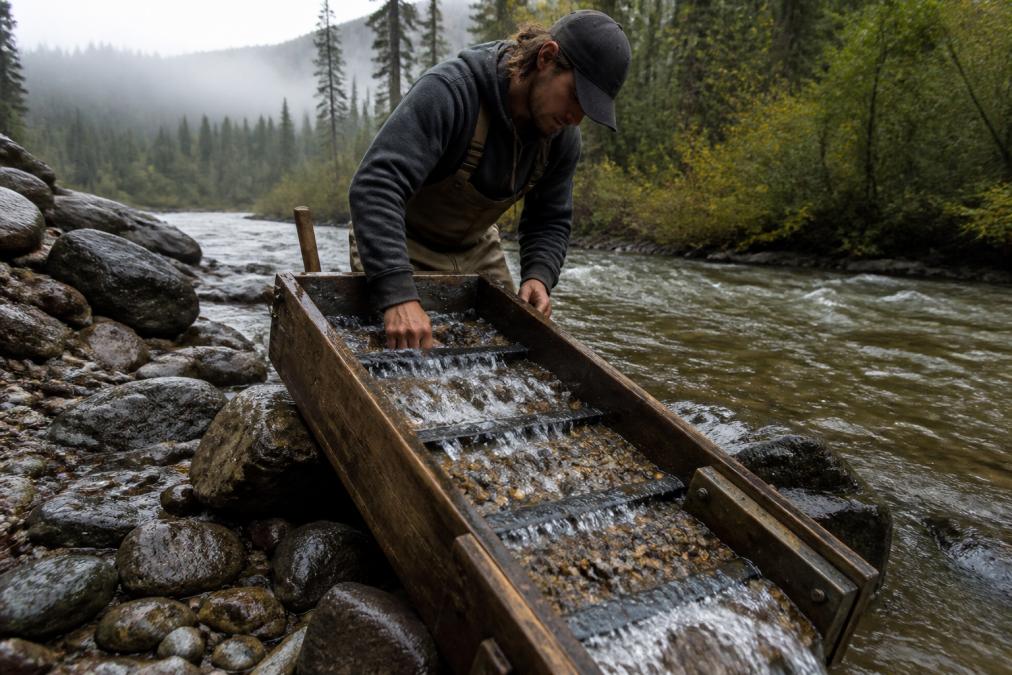
Sluicing is the most common placer method, where water carries ore-bearing material through a long box with internal baffles called riffles. Gold drops behind these riffles while lighter material washes away. Panning works on the same principle at smaller scale, using a shallow pan to swirl sediment in water until gold settles at the bottom. Crevicing probes cracks in bedrock to extract gold that has settled naturally in fissures over time.
The advantage of placer mining is speed and simplicity, a single operator can recover visible amounts of gold in a day using basic equipment. Recovery rates typically range from 70-90% of visible gold in processed material, and the gold recovered is usually quite pure, often 90-95% natural gold with minimal processing needed.
Hard Rock Mining Methods and Ore Extraction
Hard rock mining targets gold locked within solid rock formations, primarily quartz veins and mineral-rich ore bodies. This method requires significantly more equipment and expertise than placer mining but can access much larger gold deposits. The process begins with drilling and blasting to break ore from the rock face, then hauling it to processing facilities.
Hard rock mining demands careful geological analysis to locate ore bodies and assess viability. An ore grade of just 0.5 grams per ton can be economically viable in large operations. Extraction involves removing overburden and accessing the ore body through open-pit or underground methods. Open-pit mining is more common for shallow deposits, while underground mining becomes necessary when ore bodies lie deep below the surface.
Hard rock ore then enters processing, where it's crushed, ground, and treated with chemical reagents to extract gold. This differs fundamentally from placer mining because the gold is locked within mineral structures and cannot be separated by gravity alone. The advantage is access to much larger deposits, a single hard rock operation can produce thousands of ounces annually. The disadvantage is capital cost, regulatory complexity, and environmental impact.
Gold Ore Processing Methods: From Crushing to Recovery
Once ore is extracted, collecting gold from mining operations requires systematic processing to separate gold from surrounding rock and minerals.
Crushing and Grinding Processes
Raw ore arrives at the mill as large rocks. Crushing equipment breaks this into smaller pieces, typically 1-2 inches in diameter. Secondary grinding reduces ore further to a fine powder, typically 100-200 microns, exposing gold particles for subsequent chemical treatment. Grinding uses rod mills or ball mills, rotating cylinders filled with steel rods or balls that tumble ore into powder. The crushed and ground ore, now called slurry, moves forward for chemical extraction.
Chemical Extraction and Leaching
Chemical extraction dissolves gold from its mineral matrix using reagents that selectively attack gold while leaving other minerals intact. Cyanidation uses sodium cyanide solution to dissolve gold, forming a complex that is soluble in water. Leaching happens in large tanks where slurry is mixed with cyanide solution and aerated for hours to days. Once gold is dissolved, the solid ore is filtered away, leaving a gold-bearing solution.
Thiosulfate leaching uses thiosulfate compounds instead of cyanide, less toxic and increasingly preferred, though slower and less efficient. Mercury-free extraction methods have become standard in responsible mining operations, avoiding the environmental persistence of historical mercury amalgamation.
Smelting and Refining Gold
After chemical extraction, electrowinning forces dissolved gold to plate onto a cathode, a metal electrode. The recovered gold at this stage is typically 95-98% pure. Final refining uses smelting, where gold is heated to its melting point (1064°C) in a crucible. The molten gold is poured into molds to form bars or ingots.
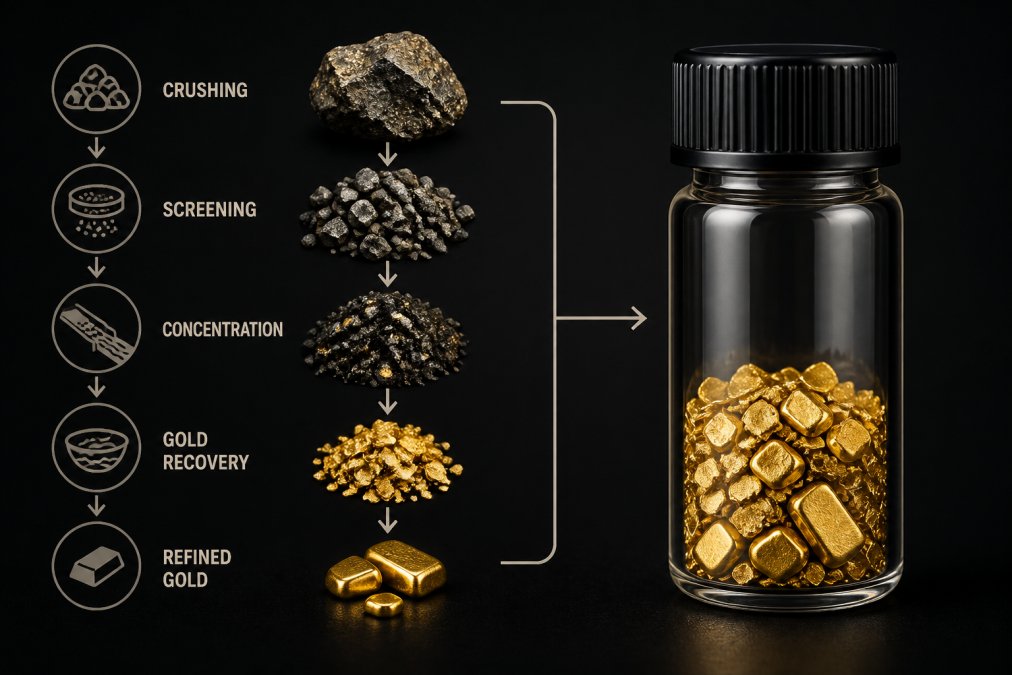
The entire processing cycle from raw ore to refined gold typically takes 2-4 weeks, depending on ore characteristics and facility throughput.
Gold Recovery from Tailings and Byproduct Mining
Tailings are the leftover material after initial gold extraction. Modern mining recovers additional gold from these byproducts, as tailings contain fine gold particles missed during primary processing. Reprocessing tailings involves re-grinding the material to expose additional gold particles, then repeating chemical extraction. This secondary recovery can yield 10-30% additional gold from the same ore body.
Some byproduct mining targets specific minerals alongside gold. Copper ore, for example, often contains significant gold recovered as a byproduct. Environmental regulations now require tailings management, so recovering additional gold from tailings serves both economic and environmental goals.
Environmental Regulations for Gold Mining Operations
Gold mining is heavily regulated to protect water quality, air quality, and land stability. The Environmental Protection Agency (EPA) oversees mining operations under the Clean Water Act and the Resource Conservation and Recovery Act. Water discharge must meet strict standards for pH, turbidity, and heavy metal content. Settling ponds allow sediment to settle before water is released, and chemical treatment removes dissolved metals.
Air quality regulations limit dust emissions from crushing and grinding operations. Wet suppression systems spray water on ore during handling to prevent dust from becoming airborne. Reclamation requirements mandate that mining sites be restored after operations cease, typically involving grading to prevent erosion, replanting vegetation, and monitoring water quality for years after mining ends.
Responsible mining operations like those producing Parker's Gold's authentic Yukon gold must invest in environmental controls. This increases operational costs but ensures that collecting gold from mining operations doesn't create lasting environmental damage.
Safety Protocols and Equipment Maintenance for Small-Scale Collection
Small-scale gold collection requires attention to safety protocols and equipment maintenance. Water safety is paramount, streams can have hidden currents, undercut banks, and sudden depth changes. Operators should never work alone, always wear personal flotation devices in deep water, and avoid operations during high water conditions.
Respiratory protection matters when working with fine sediment or dust. Grinding and crushing operations generate silica dust, which causes silicosis when inhaled over time. N95 masks or better should be used when handling fine materials. Chemical safety becomes critical when using cyanide or other reagents, requiring proper ventilation, spill containment, and personal protective equipment.
Equipment maintenance prevents accidents and ensures consistent gold recovery. Sluice boxes need regular cleaning to prevent sediment buildup. Grinding equipment requires frequent inspection for wear. Water pumps must be maintained to prevent cavitation and seal failure. Storage of equipment in dry conditions prevents rust and corrosion.
Owning Authentic Gold: Verification and Certification
The final step in collecting gold from mining operations is verification that your gold is genuine and its origin is documented. A Certificate of Authenticity should document the source of the gold, the date of collection, and verification of weight and purity. Reputable operations use third-party assayers to verify gold content, providing independent confirmation.
Provenance matters for collectible gold. Gold sourced from Parker Schnabel's legendary Dominion Creek operation, as featured on Discovery Channel's Gold Rush, carries historical significance beyond its intrinsic metal value. When purchasing gold, verify the certificate independently if possible. Contact the assayer or certifying organization to confirm the certificate is legitimate.
Storage and insurance are practical considerations for valuable gold. Insured, tracked shipping with signature requirement ensures your gold arrives safely. The handcrafted tri-fold display case that accompanies Parker's Gold's Dominion Creek Collector Package protects the gold while making it displayable, acknowledging that collectible gold serves aesthetic and historical purposes beyond mere metal value.
Collecting gold from mining operations connects you directly to the adventurous spirit of the Gold Rush and the skill of modern miners. Understanding how gold is extracted, processed, and verified ensures you appreciate what you own. Parker's Gold's Dominion Creek Collector Package brings this experience into your home with genuine placer gold from Parker Schnabel's legendary operation, complete with official certification and secure delivery. Explore the Dominion Creek Collector Package to own a verified piece of Yukon mining history. The $199.00 investment secures not just raw gold, but a documented connection to one of North America's most iconic mining operations.
Frequently Asked Questions
What is the most common process for extracting gold from ore?
Cyanidation is the most widely used method for extracting gold from ore in large-scale operations. The process involves crushing ore into fine particles, then using a cyanide solution to dissolve gold. The solution is then processed through carbon-in-pulp or carbon-in-leach systems to recover the gold. For smaller operations and placer mining, gravity separation and sluicing are more common, as they require less chemical processing and equipment.
Are there environmental regulations for gold mining operations in the US?
Yes. Gold mining operations must comply with the Clean Water Act, which regulates discharge of mining waste into waterways, and the Resource Conservation and Recovery Act (RCRA), which governs hazardous waste management. The EPA sets specific standards for tailings storage, mercury-free processing, and water quality. State regulations often impose additional requirements on permits, reclamation bonds, and environmental impact assessments before operations can begin.
How can I verify that gold I purchase is actually from a specific mining operation?
Authentic gold from verified sources comes with a Certificate of Authenticity that documents its origin, recovery location, and weight. Reputable sellers like Parker's Gold provide detailed documentation and chain-of-custody records. You can verify authenticity by checking the certificate's serial number, examining the gold's physical characteristics (color, weight, purity), and confirming the seller's credentials and track record with third-party reviews.
What is the difference between placer mining and hard rock mining for gold collection?
Placer mining extracts gold from surface deposits in streams and riverbeds using gravity separation, panning, and sluicing. It requires minimal equipment and chemical processing. Hard rock mining involves extracting gold from solid ore deposits deep underground, requiring crushing, grinding, and chemical extraction methods like leaching or cyanidation. Placer mining is simpler and faster for small-scale collection, while hard rock mining yields larger quantities but demands more infrastructure and regulatory compliance.
This article was written using GrandRanker