

Table of Contents
- Step 1: What You'll Need Before You Verify Any Artifact
- Step 2: What Is a Certificate of Authenticity and Why It Matters
- Step 3: Identifying Authentic Raw Placer Gold
- Step 4: Gold Rush Era Provenance Verification
- Step 5: Legal and Ethical Acquisition of Gold Rush Artifacts
- Step 6: Preserving and Caring for Your Gold Rush Artifacts
- Frequently Asked Questions
Last Updated: September 13, 2026
Step 1: What You'll Need Before You Verify Any Artifact
Authenticating gold rush era artifacts requires preparation before you examine a single flake. Gather a jeweler's loupe with 10x magnification, a precision scale accurate to 0.01 grams, a magnet, and a reference guide on placer gold characteristics. This guide walks through the verification process collectors actually use.
Raw placer gold is naturally occurring gold recovered from streambed deposits, typically found as flakes, grains, or nuggets rather than solid veins. Knowing what you are looking at matters before you spend money on it.
What most guides miss is that sellers rarely volunteer the full chain of custody. A common mistake is assuming a certificate alone proves origin. It proves claim, not fact. You need documentation, material evidence, and a seller willing to answer hard questions.
Step 2: What Is a Certificate of Authenticity and Why It Matters
A certificate of authenticity is a document issued by a seller or third party that states an item's origin, composition, and value. It matters because it creates a paper trail you can verify independently rather than taking a seller's word. But here is the part most guides skip: a certificate is only as strong as the evidence behind it, and a forged certificate is one of the most common tools used to move reproduction gold rush artifacts into collector hands.
The Federal Trade Commission guidance on advertising claims makes clear that sellers must be able to substantiate claims about a product's origin. If a certificate makes a claim the seller cannot back up, that is a problem you should walk away from. The FTC's truth-in-advertising standards apply to collectibles marketing the same way they apply to any other product claim.
What a Legitimate Certificate Should Contain
A credible certificate for a gold rush era artifact typically includes:
- The full legal name of the issuing business, not just a brand logo
- A verifiable physical address and phone number
- A unique serial or certificate number that ties to the specific item
- The item's exact weight in grams and, where applicable, purity in karats or fineness
- The recovery location and method (for example, placer mining on a named creek)
- The date of issuance and the signature of a named individual
- A statement of what the issuer is actually certifying versus what they are merely repeating from a prior seller
If any of those elements are missing, treat the certificate as a starting point for questions, not a conclusion.
Red Flags on a Certificate of Authenticity
Watch for these markers of a weak or fabricated document:
- No named issuer, only a generic logo or letterhead
- No contact information or verifiable business address
- Vague origin language like "authentic gold" without a specific claim
- No weight, purity, or composition details
- No date or serial number tying the certificate to the item
- Fonts, paper stock, or printing quality inconsistent with the claimed era of the item
- A certificate that describes a different item than the one you are holding
A certificate that names the source operation, the weight, and the recovery method is worth far more than one that simply says "genuine."
How to Verify a Certificate Independently
Do not stop at reading the document. Take these steps:
- Search the issuer's business name in your state's business registry to confirm the entity exists.
- Call the phone number on the certificate and ask the issuer to confirm the serial number and item description.
- Compare the stated weight to your own scale reading, a mismatch of more than a few hundredths of a gram is a warning sign.
- Ask the seller for the name of the operation that recovered the gold and, if possible, a receipt or transfer record from that operation.
- Cross-check any claimed historical dates against public records or well-documented mining operations of the period.
Why This Matters More for Gold Rush Artifacts Than Other Collectibles
The gold rush era ended more than a century ago, which means no living issuer can have firsthand knowledge of most items. That gap is exactly what forgers exploit. Modern casting and plating techniques can produce placer gold replicas that fool an untrained eye, and a professionally printed certificate adds an air of legitimacy that the metal itself does not earn. The certificate is a tool for verification, not a substitute for it.
Step 3: Identifying Authentic Raw Placer Gold
Authentic raw placer gold has irregular, organic shapes with soft rounded edges from water wear. It is heavy for its size, does not rust, and resists most acids. Counterfeits often look too uniform or too light.
Hold a flake under your loupe. Real placer gold shows surface texture and minor imperfections. Cast replicas look smooth and consistent. Weigh the item against its stated weight, since density is one of the hardest properties to fake convincingly.
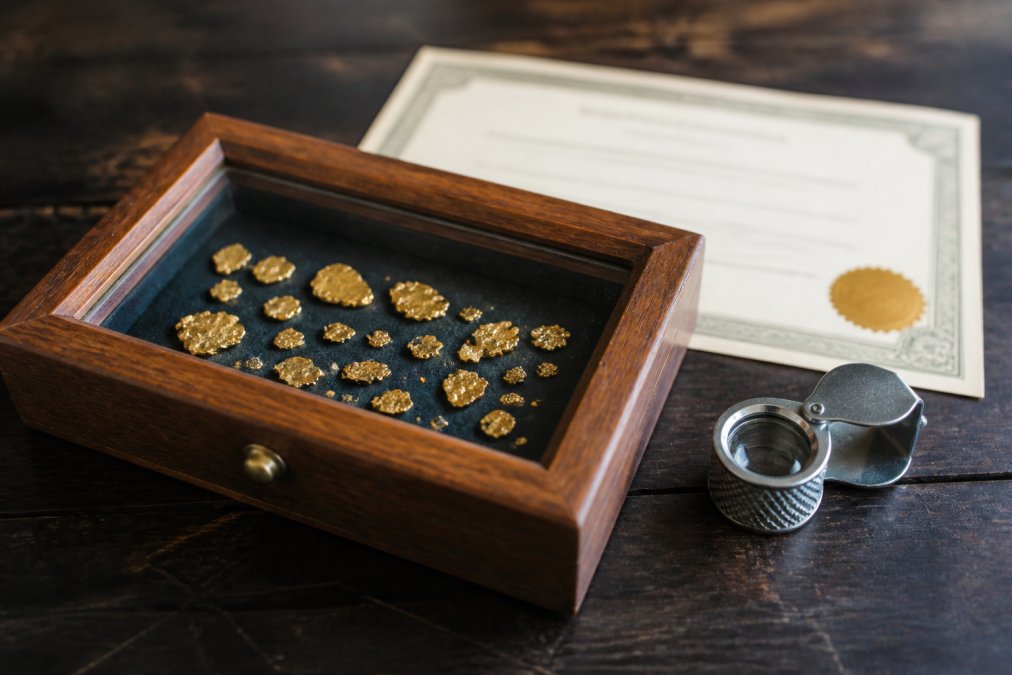
Common Forgery Markers in Placer Gold
- Uniform shape across multiple pieces
- Weight that does not match the stated figure
- Magnetic response, since real gold is not magnetic
- Color that looks brassy or too bright under natural light
- No provenance documentation of any kind
Step 4: Gold Rush Era Provenance Verification
Gold rush era provenance verification means tracing an item's history from recovery to your hands. It combines paperwork, material analysis, and a clear chain of custody. Without all three, you are guessing.
Documentation and material analysis work together. Paperwork tells you where an item claims to come from. Material testing tells you whether that claim holds up. A Smithsonian resource on historical artifact care notes that proper documentation is central to establishing an item's historical value.
Ask for records showing the recovery location, the date, and who handled the item afterward. Material analysis can confirm gold purity and composition, which helps rule out modern reproductions passed off as period pieces.
| Verification Method | What It Confirms | Best For |
|---|---|---|
| Certificate review | Claimed origin and weight | First-pass screening |
| Weight and density check | Physical authenticity | Catching cast replicas |
| Material analysis | Purity and composition | Ruling out modern gold |
| Chain-of-custody records | Recovery history | Establishing provenance |
Step 5: Legal and Ethical Acquisition of Gold Rush Artifacts
Legal acquisition means buying from sellers who can prove they obtained an item lawfully and can transfer that right to you. Ethical acquisition goes further, respecting heritage sites and avoiding items looted from protected land. For gold rush era material, the legal landscape is more specific than most collectors realize, and getting it wrong can mean confiscation, fines, or worse.
The Federal Framework You Need to Know
The primary federal law governing artifacts from the gold rush era is the Archaeological Resources Protection Act of 1979, commonly called ARPA. ARPA prohibits excavating, removing, damaging, or otherwise altering archaeological resources on federal or Indian lands without a permit. Gold rush era sites on federal land, including many in the western states, fall under this protection. Penalties under ARPA can include felony charges for serious violations, and the law applies to artifacts regardless of whether they were removed recently or decades ago.
The National Park Service guidance on archaeological resources explains that removing artifacts from protected land without a permit is prohibited. The NPS also enforces the Antiquities Act of 1906, which was the first federal law to protect archaeological sites on public lands and remains in force today.
State Laws and the Patchwork Problem
Beyond federal law, each state has its own rules about artifact recovery and sale. Some western states allow recreational metal detecting on certain public lands with restrictions; others prohibit it entirely on state-managed historic sites. Before you buy or recover anything, check the specific state's statutes. A common pattern is that artifacts recovered legally on private land with the landowner's written permission are generally transferable, while artifacts removed from public land without authorization are not.
What Provenance Documentation Should Include
For a gold rush era artifact to change hands cleanly, the seller should be able to provide:
- A written record of where the item was recovered, including the property description or claim name
- The date of recovery and the name of the person who recovered it
- Evidence of permission if the recovery was on private land, or a permit if on public land
- A chain of ownership showing how the item passed from the recoverer to the current seller
- Any prior certificates or appraisals that document the item's history
If the seller cannot produce at least some of this, the item may still be authentic, but you are accepting legal risk along with it.
The Ethical Dimension
Even where an acquisition is technically legal, ethical collectors consider whether removing an artifact destroys historical context. Archaeologists value gold rush era items most when they can be studied in place, alongside the tools, structures, and debris that tell the story of a mining camp. An item stripped from its site loses that context permanently. Buying from sellers who can demonstrate responsible recovery practices supports the preservation of the historical record rather than its destruction.
For collectors who want a clean, documented path, buying directly from an active mining operation removes much of the guesswork. Parker's Gold sources its flakes directly from Parker Schnabel's Dominion Creek operation, and each package ships with an official Certificate of Authenticity.

Step 6: Preserving and Caring for Your Gold Rush Artifacts
Preservation keeps both the physical item and its documentation intact over time. Store gold flakes in a stable, dry environment away from direct sunlight and handle them with clean, dry hands or gloves.
Keep the Certificate of Authenticity in the same place as the item. A certificate separated from its artifact loses most of its value. If you display the piece, use an enclosed case that limits dust and moisture exposure.
For collectors who want a piece that arrives ready to display and gift, the Parker Schnabel Yukon Gold Flakes Dominion Creek Collector Package presents genuine raw placer gold in a handcrafted tri-fold case with embossed detailing. It is a straightforward way to own verified gold without chasing down provenance yourself.
Verifying gold rush era artifacts comes down to evidence you can check, not claims you have to trust. From certificate review to material analysis, each step builds a case for authenticity that holds up under scrutiny. Parker's Gold sources gold directly from a documented mining operation, including an official Certificate of Authenticity, a handcrafted tri-fold display case, and fully insured, tracked, signature-required shipping. Claim yours and own a piece of verified Yukon history.
Frequently Asked Questions
How can I tell if a gold artifact is from the 1850s?
Look for physical wear consistent with age, such as softened edges and a natural patina that cannot be faked quickly. Check for period-correct tool marks from hand mining equipment like picks and shovels. Request a certificate of authenticity that details the item's provenance, including the specific claim or region. Material analysis, such as metallurgy testing, can confirm the gold's composition matches historical placer deposits from the California Gold Rush or Klondike. Modern replicas often have uniform surfaces and lack the irregular texture of authentic gold rush artifacts.
What documentation is required to prove the origin of raw placer gold?
A valid certificate of authenticity should include the exact location of recovery, such as a named claim or mining operation, and the date of extraction. It must be signed by a reputable source, like the mining company or a licensed appraiser, and include a unique serial number for verification. Supporting documents may include assay reports, geological survey records, or chain-of-custody letters. For gold rush era provenance verification, historical records linking the gold to a specific mining district add significant value. Without this paperwork, authenticity claims are difficult to substantiate.
What are common forgery markers in gold rush era artifacts?
Forged items often show inconsistent aging, such as new scratches on old metal or a patina that rubs off. Check for modern tool marks that are too precise or uniform. Weight and density can be wrong if the item is hollow or made from a gold-plated base metal. Certificates of authenticity with vague language, missing contact information, or no serial number are red flags. Also, be wary of prices that seem too low for genuine placer gold. Material analysis can detect alloys not used in the 1800s.
How do I preserve and care for authentic gold rush artifacts?
Store gold rush artifacts in a climate-controlled environment away from direct sunlight and humidity. Handle them with clean cotton gloves to prevent oils from your skin causing corrosion. Use acid-free tissue or archival foam in display cases. Avoid cleaning with harsh chemicals; if needed, consult a professional conservator. For raw placer gold, keep it in a sealed container to prevent dust buildup. Document any restoration work and keep it with the provenance records. Proper care maintains both the historical significance and value of your collection.