

Table of Contents
- Visual Identification: What Authentic Gold Nuggets Actually Look Like
- The Gold Nugget Density Test: Specific Gravity and Weight Verification
- The Difference Between Fool's Gold and Real Gold: Pyrite, Chalcopyrite, and Other Impostors
- Non-Destructive Field Testing: Sound, Magnet, and Ceramic Plate Streak Test
- Understanding Karat Markings, Hallmarks, and Assay Reports
- Chemical Testing with Nitric Acid: Safety and Limitations
- Geological Context of Discovery and Comparative Visual Gallery
- Conclusion
- Frequently Asked Questions
Last Updated: September 18, 2026
Visual Identification: What Authentic Gold Nuggets Actually Look Like
Identifying authentic gold nuggets starts with your eyes. Real gold has a warm, buttery yellow color that stays bright even in shadow and does not flake or fade when scratched.
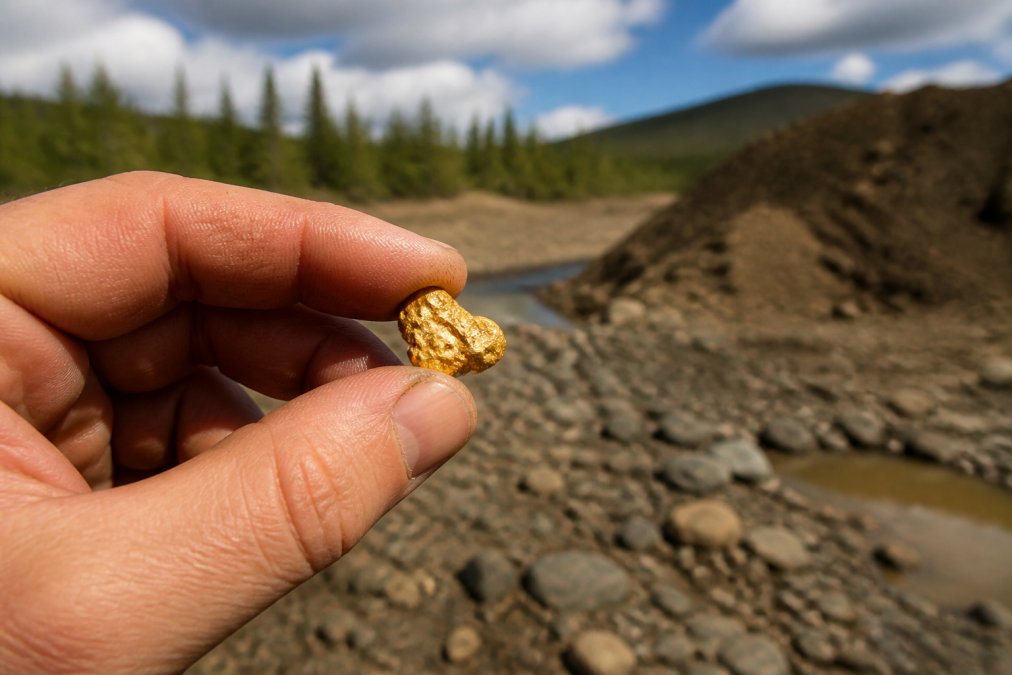
Here is what to look for:
- Metallic luster: Real gold reflects light with a soft, deep glow. Pyrite glints sharply and looks brassy.
- Color: Native gold leans warm yellow. Add silver and it shifts pale. Add copper and it turns reddish.
- Tarnish: Gold does not tarnish. If your specimen turns green or black, it is not gold.
Metallic Luster and Color Variations
Pure gold keeps the same color on a fresh break and on the surface. Pyrite and chalcopyrite oxidize, so their color changes over time.
Surface Texture and Oxidation Clues
Authentic placer gold often shows a rough, water-worn surface with small dents and rounded edges. A shiny, perfect crystal face is more likely a mineral specimen than a nugget.
The Gold Nugget Density Test: Specific Gravity and Weight Verification
The gold nugget density test is the most reliable field check you can run. Gold's specific gravity near 19.3 makes it far heavier than most minerals of the same size, so a suspect nugget that feels light is probably pyrite or gold-painted rock.
How to Perform a Simple Density Displacement Test
Measure density with a kitchen scale and a cup of water:
- Weigh the specimen dry and write down the number in grams.
- Fill a cup with water and set it on the scale. Tare it to zero.
- Tie the specimen to a thread and suspend it fully underwater.
- Record the new weight. This is the displaced water weight.
- Divide the dry weight by the water weight.
Understanding Specific Gravity in Placer Gold
Placer gold is rarely pure, silver, copper, and trace metals lower the density, so a reading of 15 to 18 still fits genuine placer gold.
The Difference Between Fool's Gold and Real Gold: Pyrite, Chalcopyrite, and Other Impostors
Telling fool's gold from real gold comes down to three quick checks: streak, hardness, and magnetism. Pyrite has a pale brass color and a greenish-black streak, while real gold leaves a golden yellow streak, a single test that settles most arguments.
Streak Test and Hardness Scale Comparison
Rub the specimen on an unglazed ceramic tile. Soft gold smears rather than scratches; harder pyrite leaves a dark powder.
| Test | Real Gold | Pyrite (Fool's Gold) | Chalcopyrite |
|---|---|---|---|
| Streak color | Golden yellow | Greenish black | Greenish black |
| Mohs hardness | 2.5-3 | 6-6.5 | 3.5-4 |
| Magnet reaction | None | None | None |
| Malleability | Bends, dents | Brittle, shatters | Brittle |
| Tarnish | Never | Oxidizes | Oxidizes fast |
Magnetic Susceptibility and Malleability Checks
Gold is not magnetic, and neither is pyrite, so a magnet alone will not separate them. Magnetite and black sand are magnetic, which helps rule them out.
Non-Destructive Field Testing: Sound, Magnet, and Ceramic Plate Streak Test
Most guides assume a lab bench, nitric acid kit, and calibrated scale, but in the field you have a pocket, a truck, and daylight. Non-destructive field testing lets you sort a find without harming it.
The Field Kit Checklist
A complete non-destructive kit fits in a quart-size zip bag:
- Ceramic streak plate, an unglazed porcelain tile or the back of a bathroom tile; a glazed tile will not produce a true streak.
- Rare-earth magnet, a small neodymium magnet on a string reaches farther and gives a cleaner yes/no than a refrigerator magnet.
- 10x jeweler's loupe, the standard magnification for gem and mineral work.
- Steel pin or sewing needle, for the malleability check.
- Small glass vial or pill bottle, for holding a specimen without losing it in gravel.
- Notebook and pencil, record each test result next to a specimen number.
- Smartphone with a macro lens clip, for a photo record to compare later against reference images.
Run the Tests in This Order
Order matters: each test rules out a class of impostors and narrows what the next must prove.
- Magnet first. If the magnet sticks, you have magnetite, black sand, or steel slag, not gold. Gold is diamagnetic, very weakly repelled rather than attracted.
- Streak plate second. Rub the specimen firmly across the unglazed tile. Gold leaves a golden-yellow streak; pyrite and chalcopyrite leave a greenish-black streak; mica leaves a pale, flaky smear. The streak shows the powdered mineral's color, which is more reliable than eyeballing the surface.
- Loupe third. Under 10x, real placer gold shows rounded, water-worn edges, soft dents, and a consistent buttery color. Pyrite shows flat crystal faces, sharp corners, and often a striated or cubic structure. Mica shows thin, flat sheets that peel apart.
- Pin last. Press a steel pin into an inconspicuous spot. Gold is soft (Mohs 2.5-3) and dents, holding the pin's shape. Pyrite (Mohs 6-6.5) and chalcopyrite are brittle and will chip, crack, or shatter.
Sound and Resonance: A Weak Signal, Used Carefully
Tapping a specimen is a folk test, not a diagnostic one. Gold tends to thud dully and pyrite rings sharper, but sound depends on size and shape, so use it only as a tiebreaker.
Parker Schnabel Yukon Gold Flakes →
What Each Test Cannot Tell You
No single field test is conclusive:
- The magnet rules out magnetite and steel but does not separate gold from pyrite, since neither is magnetic.
- The streak test separates gold from pyrite and chalcopyrite, but a heavily tarnished specimen can give a misleading streak.
- The loupe is only as good as your reference set; without known samples, crystal structure is easy to misread.
- The pin confirms malleability but alters the specimen slightly, so choose an inconspicuous spot.
The U.S. Geological Survey mineral resources program publishes free guides and photographs of common ore minerals, which are a useful reference set for the loupe and streak comparisons. Pair those with the density test above, and you have a complete non-destructive workflow that never requires opening a bottle of acid.
Understanding Karat Markings, Hallmarks, and Assay Reports
Jewelry and refined gold carry karat stamps; raw nuggets usually do not. Common stamps include 10K, 14K, 18K, and 24K, where 24K means nearly pure gold and anything lower is an alloy. An assay report is different: it states the actual metal content of a specific sample, making it the strongest proof of what you own.
Chemical Testing with Nitric Acid: Safety and Limitations
Nitric acid testing can confirm gold, but it is a last resort: the acid dissolves most metals and leaves gold untouched, yet it burns skin, damages eyes, and gives off harmful fumes.
- Work outdoors or under strong ventilation
- Wear nitrile gloves and sealed safety glasses
- Keep a baking soda solution nearby to neutralize spills
- Store the acid in a locked, labeled container
Geological Context of Discovery and Comparative Visual Gallery
Every test in this guide tells you what a specimen is; geology tells you whether it should be there at all. A heavy yellow piece found where placer gold cannot form is a strong signal to slow down.
Placer Gold vs. Lode Gold: Two Different Stories
Gold reaches the surface two ways, each leaving a different fingerprint.
- Lode gold is still locked in the rock where it formed, usually in quartz veins or sulfide minerals. A lode specimen is angular, often still attached to quartz or host rock, and shows sharp crystal faces or vein textures.
- Placer gold is lode gold weathered out of its host rock, washed downhill, and concentrated by streams. The transport rounds the edges and sorts pieces by weight, leaving a water-worn, irregular nugget with small dents and hammer marks.
Where Placer Gold Actually Collects
Streams do not deposit gold evenly. Because gold is roughly 19 times denser than water and the sand and gravel moving with it, it drops out wherever the current slows. Classic traps:
- Inside bends of a river, the current slows on the inside of a bend, and heavy material settles there.
- Behind boulders and bedrock ledges, anything that creates a low-pressure pocket in the current.
- Bedrock cracks and crevices, gold works its way down into cracks and stays there.
- Gravel bars and point bars, the raised gravel deposits that form on the inside of bends.
- The base of a gravel layer, where coarse gravel meets bedrock or clay, often called the false bedrock.
Comparative Visual Gallery: What to Compare Side by Side
A single photo of a nugget teaches almost nothing. What teaches fast is lining up known samples next to your unknown find under the same light. Build a small reference set and compare on four axes:
| Feature | Real placer gold | Pyrite | Chalcopyrite | Mica |
|---|---|---|---|---|
| Color | Warm buttery yellow, consistent in shadow | Pale brass, bright in light | Yellow with a rainbow or purple tarnish | Pale gold to brown, often translucent |
| Shape | Rounded, water-worn, irregular | Cubic, striated, sharp corners | Blocky, often massive | Thin flat sheets, flakes |
| Weight in hand | Surprisingly heavy for its size | Light for its size | Light for its size | Very light, almost weightless |
| Streak | Golden yellow | Greenish black | Greenish black | Pale, flaky smear |
| Behavior under a pin | Dents and holds shape | Brittle, chips or shatters | Brittle, chips | Flakes apart into sheets |
Why This Context Matters for Authentication
Geology does not replace the density test, streak test, or assay. It does what lab tests cannot: tells you whether the story of the find makes sense. A rounded, heavy, non-magnetic specimen from a bedrock crevice on an inside bend is consistent with placer gold; the same specimen from a landscaped parking lot is not impossible, but slag, brass, and painted rock are common in fill dirt and urban gravel.
Conclusion
Telling real gold from impostors gets easier with practice. Start with density, confirm with a streak test, and keep a loupe handy. Those three habits catch almost every fake.
Frequently Asked Questions
How much is a real gold nugget worth?
The value of a real gold nugget depends on its weight, purity, and whether it has collectible characteristics like unusual shape or documented origin. At current market prices, a 1-gram nugget might be worth around $60-$70 in melt value, but collector pieces often sell for two to three times that amount. Authentic gold nuggets from famous locations like the Yukon can command even higher premiums because of their provenance and rarity. Always get an assay or certificate of authenticity to confirm weight and purity before buying or selling.
Are gold nuggets always 24k?
No, gold nuggets are rarely 24k. Natural placer gold typically ranges from 18k to 22k, with some nuggets as low as 16k depending on the impurities they picked up during formation. The purity varies by location and the type of geological formation where the gold was found. A gold nugget density test can help estimate purity by comparing its specific gravity to that of pure gold, but an assay is the only way to know the exact karat weight.
What is the best way to test raw gold without damaging it?
Non-destructive field testing methods include visual inspection with a loupe, the magnet test, the ceramic plate streak test, and a density displacement test. These tests do not alter the nugget and can quickly separate real gold from pyrite or chalcopyrite.
How can you tell the difference between pyrite and gold?
Pyrite, often called fool's gold, has a brassy yellow color and a distinct metallic luster, but it is harder and more brittle than real gold. One key difference between fool's gold and real gold is malleability: real gold will bend or dent under pressure, while pyrite will shatter or crumble. A streak test on a ceramic plate also helps, as pyrite leaves a greenish-black streak whereas gold leaves a golden yellow streak. Additionally, pyrite is magnetic in some forms, while native gold is not.