

Table of Contents
- What Is Placer Gold and Why Beginners Should Start Here
- How Placer Deposits Form in Rivers and Streams
- Essential Gold Panning Equipment for Beginners
- Step-by-Step Gold Panning Techniques That Work
- How to Identify Placer Gold vs Pyrite and Other Minerals
- Reading the River: Where Gold Accumulates
- Legal Regulations for Recreational Gold Prospecting
- Safety Precautions and Post-Collection Processing
- Frequently Asked Questions
Last Updated: September 2, 2026
What Is Placer Gold and Why Beginners Should Start Here
Placer gold refers to gold particles and small nuggets found loose in alluvial deposits, primarily in riverbeds and stream channels. Unlike hard rock mining, which requires extracting ore from solid rock, placer prospecting involves recovering gold already liberated through natural weathering and erosion. This makes placer prospecting accessible to hobbyists with minimal equipment and experience.
Placer deposits form when water movement separates gold from surrounding rock over thousands of years. Because gold is much denser than other minerals, it naturally settles in specific locations along streams and rivers, making recovery predictable once you understand where to look. Many beginners start with placer gold because the barrier to entry is low: you don't need expensive machinery, advanced geology degrees, or access to private mining claims.
How Placer Deposits Form in Rivers and Streams
Understanding how placer deposits form helps you recognize where gold accumulates. The process begins upstream, where hard rock containing gold is exposed to weathering. Rain, frost, flowing water, and temperature changes gradually break down the rock, liberating gold particles that get transported downstream by water flow.
Gold is roughly 19 times heavier than water. As water moves down a stream, it carries lighter materials farther downstream, but gold settles quickly due to gravity. This is why gold concentrates in specific zones rather than spreading evenly throughout a stream.
Gold tends to accumulate where water flow slows down, allowing heavy particles to drop out. Inside bends of rivers, behind large boulders, in bedrock cracks, and along the base of waterfalls are classic gold trap locations. Black sands, heavy minerals like magnetite and ilmenite, often accompany placer gold and serve as visual indicators that conditions exist for gold deposition.
Essential Gold Panning Equipment for Beginners
You don't need much to start collecting placer gold. A basic setup costs minimal money and fits in a small backpack.
The gold pan itself is your primary tool. Standard panning dishes come in 12-inch or 14-inch sizes; beginners often start with 12-inch pans because they're easier to control. The pan has riffles, small ridges inside the bottom, that help trap gold while letting lighter material wash away.
A classifier or sieve speeds up the process by separating large rocks from fine material. A snuffer bottle, a small suction tool, lets you safely collect fine gold without losing it to water movement. Bring a small vial for storing recovered gold, a waterproof container for your equipment, waders or water shoes, and a headlamp or flashlight.
Start minimal with a quality 12-inch pan, a classifier, and a snuffer bottle. Once you understand where gold concentrates and how to recover it efficiently, you can invest in additional equipment if desired.
Step-by-Step Gold Panning Techniques That Work
Fill your pan about three-quarters full with gravel and sediment from a promising location. Submerge it completely in water, breaking up clay and letting fine material suspend in the water column.
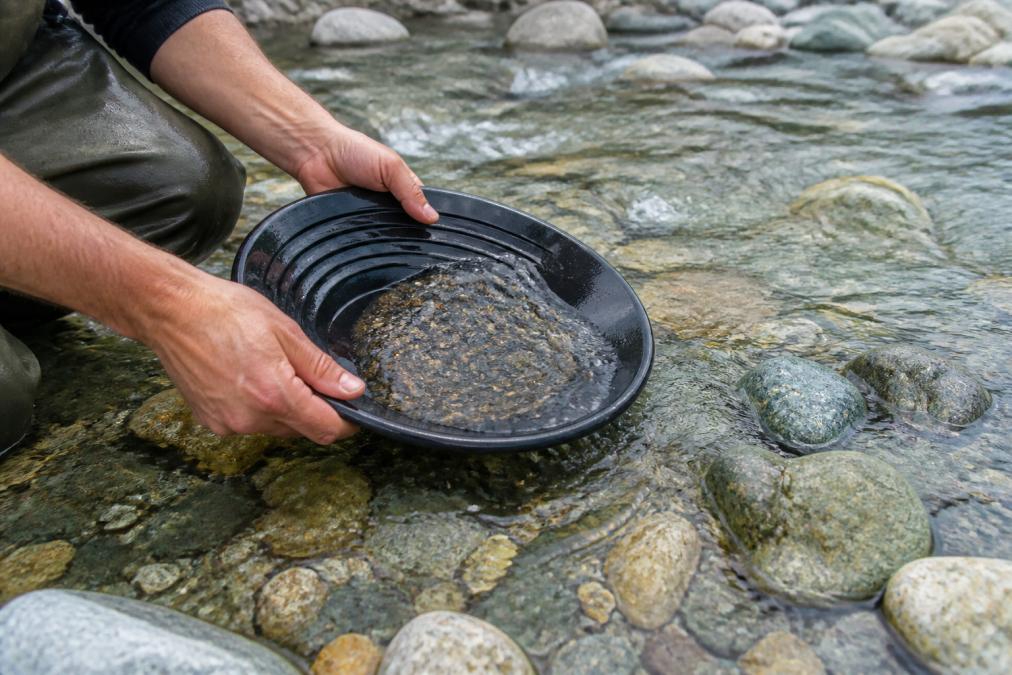
Tilt the pan slightly forward and use a gentle circular swirling movement to suspend lighter material while keeping gold on the bottom. Work in stages: start with larger material, breaking apart clay and removing rocks by hand. Then transition to finer material, using the circular swirling motion to gradually wash away sand and silt.
As the pan becomes lighter, black sands will appear, signaling you're close to concentrating the gold. Continue the gentle swirling, letting water carry off the black sands gradually. In the final stages, use a small amount of water and a gentle rocking motion. Gold will concentrate in the bottom corner of the pan. Use a snuffer bottle to vacuum up the fine gold safely, preventing loss to water movement.
Practice the motion on material you know contains no gold first. Once the physical motion becomes automatic, you can focus on reading the stream and finding better locations.
How to Identify Placer Gold vs Pyrite and Other Minerals
Gold is soft and malleable. If you recover a particle and can dent it with a fingernail or a knife, it's likely real gold. Pyrite is brittle and will shatter or crumble under pressure. Gold is also magnetic-resistant; if a particle sticks to a magnet, it's not gold.
Gold is extremely dense, about 19 times heavier than water (peer-reviewed research). If you pan material and find particles that feel unusually heavy for their size, that's a strong indicator of real gold. Pyrite particles feel lighter in comparison.
Use a loupe or magnifying glass to examine particles closely. Real gold has a smooth, uniform appearance. Pyrite often shows cubic crystal structures or striations. Under magnification, the difference becomes obvious.
Reading the River: Where Gold Accumulates
Understanding where gold concentrates in a stream is the difference between productive prospecting and random panning.
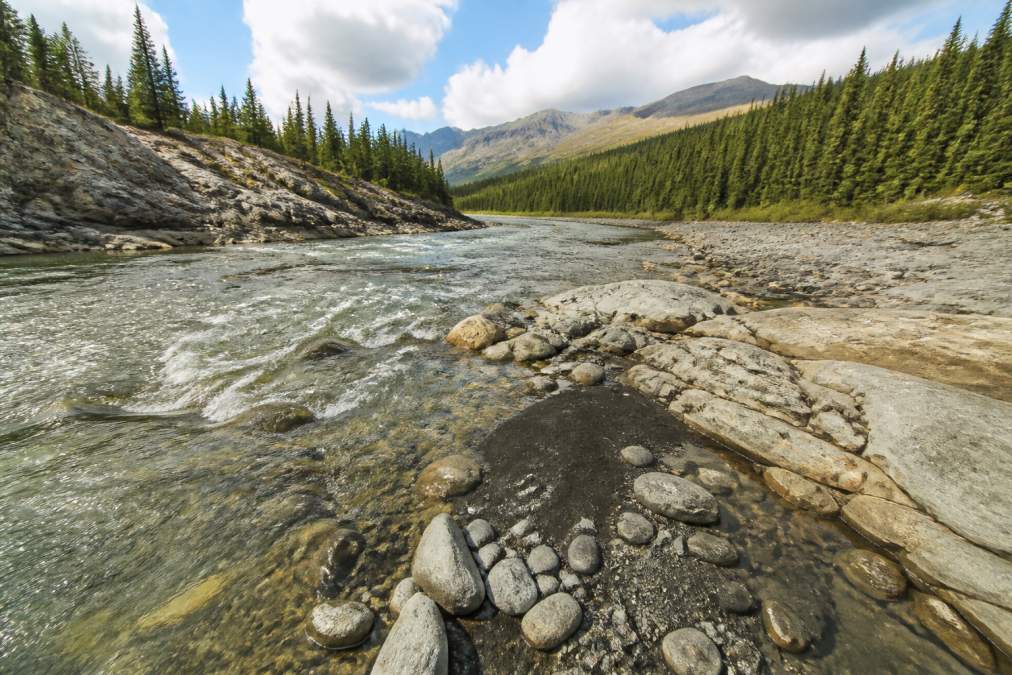
Inside bends are primary gold traps. As water flows around a curve, the current slows on the inside of the bend, where gold drops out of suspension. You'll often see black sand concentrations marking these spots.
Bedrock outcrops and cracks are gold magnets. When you find exposed bedrock with visible cracks and crevices, you've found a natural gold trap. Water flowing over bedrock creates eddies and slow zones where gold settles.
Behind large boulders, water flow creates a low-pressure zone where heavier materials accumulate. The paystreak, the richest concentration of gold in a stream, often runs along the bedrock at the base of the water column.
Below waterfalls and rapids, the turbulent water slows and spreads out, allowing gold to settle. These high-energy zones concentrate gold more efficiently than calm stretches.
Legal Regulations for Recreational Gold Prospecting
Before you start collecting placer gold, understand the legal landscape. Mining rights and regulations vary significantly by location.
Most states allow recreational gold panning on public lands under specific conditions (blm.gov). The U.S. Bureau of Land Management (BLM) administers millions of acres where casual prospecting is permitted. Check with your local BLM office for current regulations, as they vary by region and change periodically.
National Parks and National Forests typically prohibit all mining activity, including recreational panning. Private land requires explicit permission from the owner. Some states require mining claims for any prospecting activity, even recreational panning. A mining claim is a legal assertion of your right to extract minerals from a specific location. Verify your state's specific requirements before heading out.
Water rights are another consideration. Some states regulate what you can remove from streams. Check state Department of Fish and Wildlife regulations alongside mining rules.
Safety Precautions and Post-Collection Processing
Prospecting in streams presents real hazards: slippery rocks cause falls; cold water causes hypothermia; flash floods occur suddenly, especially in narrow canyons.
Never prospect alone. Tell someone where you're going and when you expect to return. Bring a whistle and a first aid kit. Wear a life jacket if you're working in deeper water or moving current.
Watch weather constantly. Storm systems can dump water upstream, creating flash floods in minutes. If the sky darkens or you hear distant thunder, leave the streambed immediately.
Dress appropriately for water temperature. Waders or water shoes protect your feet and reduce heat loss. Bring more water than you think you'll need and a dry change of clothes in your vehicle.
Once you've panned your material and concentrated the gold, remove any remaining fine sediment and black sands with a final gentle swirl using clean water. Spread recovered gold on a clean cloth or paper towel and let it air dry completely. Once dry, store it in a sealed vial or container away from moisture.
If you've recovered significant quantities, consider weighing and documenting your finds. Record the location, date, and amount recovered. This documentation becomes valuable if you decide to file a mining claim or sell your gold later.
For collectors seeking authenticated gold with verified provenance, certified precious metals dealers provide authentication services.
Collecting placer gold for beginners opens a door to genuine outdoor adventure and tangible discovery. Understand where gold concentrates, learn basic panning technique, and respect legal requirements. Persistence and attention to detail separate casual panners from serious prospectors.
If you want to own authenticated placer gold without the learning curve, Parker's Gold offers verified specimens directly sourced from proven operations. The Parker Schnabel Yukon Gold Flakes - Dominion Creek Collector Package provides genuine placer gold with a Certificate of Authenticity and professional presentation, perfect for collectors who appreciate the adventure without the fieldwork. Whether you choose to prospect yourself or acquire verified specimens, placer gold connects you to the genuine spirit of discovery that defines the Gold Rush legacy.

Frequently Asked Questions
Q: What is the difference between placer gold and pyrite, and how can I tell them apart when collecting?
A: Placer gold is soft, dense, and retains its color when scratched or bent. Pyrite (fool's gold) is brittle, will spark when struck with steel, and tarnishes to a dull yellow-brown. Real gold also sinks quickly in water due to its high specific gravity, while pyrite particles drift with lighter sediment. When panning, true gold flakes settle to the bottom of your panning dish, while pyrite particles drift with lighter sediment.
Q: Do I need a mining claim or permit to collect placer gold recreationally?
A: Legal requirements vary significantly by state and location. Most states allow recreational gold panning on public lands without a permit, but some require written permission. National Parks and protected areas typically prohibit prospecting. Private land requires the owner's permission. Before you start, check with your state's mining or geological survey office and local Bureau of Land Management offices for specific regulations in your area.
Q: What's the best equipment for a beginner just starting to collect placer gold?
A: Start with a basic 12-14 inch gold panning dish, a snuffer bottle for collecting fine gold, and a classifier screen to sort sediment by size. You'll also need a small vial to store your gold and a waterproof bag for transport. Quality matters here, invest in a sturdy panning dish with deep riffles that trap gold effectively. Many beginners find success with starter kits that bundle these essentials together at reasonable prices.
Q: How much placer gold can a beginner realistically collect in a day of panning?
A: Results vary widely based on location, technique, and the richness of the deposit. A beginner at a productive site might collect anywhere from a few specks of gold dust to several grams in a day. The best approach is to start at proven locations where others have found gold, focus on identifying gold traps in the riverbed, and practice your panning motion. Patience and proper technique matter more than effort, rushing through sediment wastes material.
Q: What should I do with placer gold after I collect it to preserve its value?
A: Store your collected gold in a dry, secure location away from moisture. Keep placer gold flakes and nuggets in small glass vials or archival-quality containers to prevent oxidation. If you plan to hold it long-term, consider a Certificate of Authenticity to document origin and purity. For those seeking investment-grade pieces with documented provenance, collectors often prefer authenticated samples like those from verified mining operations, which retain both sentimental and intrinsic value.
Q: Can I sell placer gold I collect, and how do I determine its worth?
A: Yes, you can sell placer gold to precious metals dealers, online buyers, or collectors. Value depends on current gold prices (typically quoted per troy ounce) plus a premium for rarity, size, or documented origin. Flour gold and small flakes sell at a discount to spot price, while larger nuggets command premiums. Having documentation of where your gold came from, especially if sourced from notable operations, can significantly increase collectibility and resale value.
Q: What geological indicators should I look for to find productive placer deposits?
A: Look for bedrock outcrops, ancient riverbeds, and areas where the river makes sharp bends or drops elevation, these are natural gold traps. Black sands (magnetite and other heavy minerals) often indicate gold is nearby, since they share similar specific gravity and settle in the same locations. Pay attention to alluvial deposits on the riverbank, particularly where water has slowed and allowed heavier materials to accumulate. Studying the geological formation of your target area helps you identify high-probability zones.
This article was written using GrandRanker