

Table of Contents
- Understanding Placer Gold Formation and Source Identification
- Step 1: Examine Gold Morphology and Physical Characteristics
- Step 2: Analyze Heavy Mineral Concentrates and Trace Elements
- Step 3: Assess Gold Purity and Composition Indicators
- Step 4: Use Geological Mapping and Digital Tools for Origin Verification
- Verifying Authenticity Through Professional Assay and Certification
- Common Mistakes to Avoid When Verifying Placer Gold
- Conclusion
Last Updated: August 13, 2026
Understanding Placer Gold Formation and Source Identification
Placer gold deposits form when lode gold breaks free from bedrock through weathering and erosion, then gets transported by water downslope into streambeds. Understanding how to verify placer gold origin requires knowledge of these geological processes and the physical characteristics that reveal where gold came from. This guide covers practical field verification techniques to confirm whether placer gold originated from a specific location, a critical concern for collectors seeking authentic material from verified sources like Parker Schnabel's legendary Dominion Creek operation in the Yukon.

When mineralization occurs in bedrock, hydrothermal fluids deposit gold within quartz veins. Over thousands of years, weathering breaks down surrounding rock and exposes the gold. Water transport then moves particles downstream, sorting them by size, weight, and density. By the time placer gold reaches its final resting place, it carries physical clues about its journey that let you trace its origin.
How Lode Deposits Become Placer Gold
Lode deposits represent the original ore body where gold formed through hydrothermal processes. As erosion exposes these deposits, weathering begins the transformation. Freeze-thaw cycles crack rocks, water dissolves binding minerals, and oxidation weakens the matrix. Gold, being chemically inert and physically dense, resists weathering and remains intact as host rock disintegrates.
Initially, gold stays close to its source in weathered bedrock and soil above it, called eluvial gold. As water runoff increases during snowmelt or heavy rain, it carries loosened particles downslope. The further gold travels, the more sorted it becomes. Fine flour gold and small flakes move easily downstream, while heavier nuggets settle closer to their source. This sorting process is your first clue when verifying placer gold origin.
Weathering, Transport, and Deposition Processes
Weathering frees gold from rock through chemical dissolution and mechanical breakage. In cold climates like the Yukon, freeze-thaw cycles are particularly effective. Water seeps into cracks, freezes, expands, and shatters rock. Over many seasons, solid ore becomes loose rubble.
Once freed, gold particles enter the fluvial transport system, streams and rivers that move material downslope. Water velocity determines what gets carried where. Fast-moving water in steep creeks transports larger material. As streams slow on gentler slopes, heavier particles settle first, creating a natural size gradient along the drainage.
Deposition occurs where water velocity drops suddenly, where streams widen, gradient decreases, or bedrock creates natural traps. The composition of material in a deposit, called heavy mineral concentrate, tells you about source rock and distance traveled. Local deposits near the source contain coarse, angular particles. Distant deposits contain fine, rounded particles.
Step 1: Examine Gold Morphology and Physical Characteristics
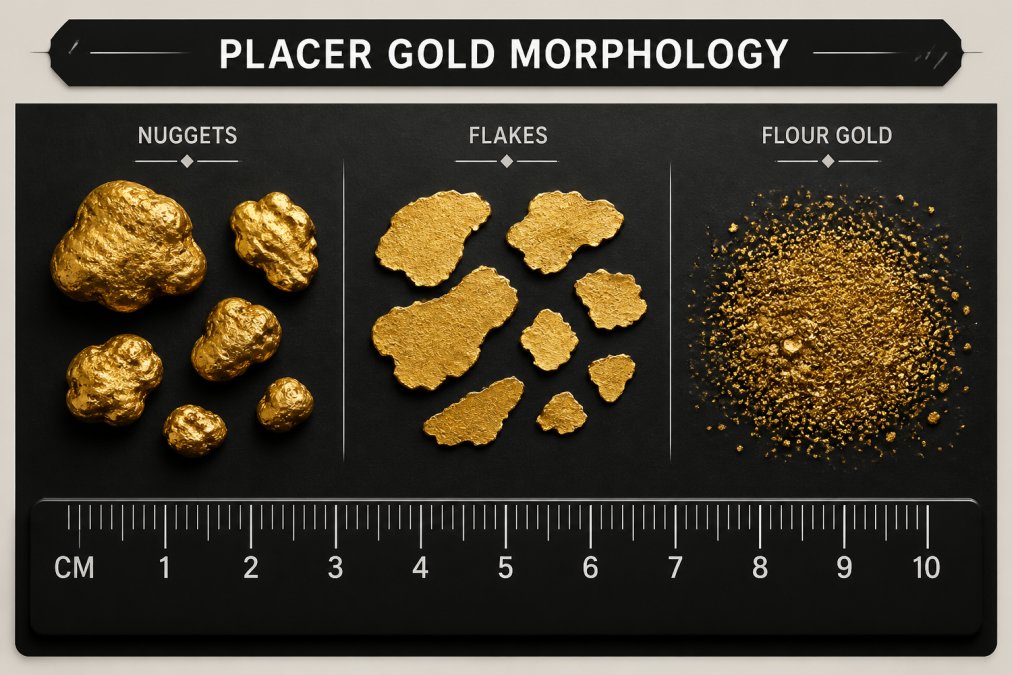
Gold morphology, the shape, size, and surface texture of particles, reveals how far gold traveled and how much it was abraded during transport. This is one of the most direct ways to verify placer gold origin because physical form changes predictably as gold moves downstream.
What Shape and Size Tell You About Distance Traveled
Angular, jagged particles indicate short transport distances and likely came from nearby lode deposits or eluvial sources. Rounded, smooth particles indicate longer transport distances, as gold tumbles in moving water over extended periods. Flat, disc-shaped particles form when gold gets caught between rocks in fast-moving streams, common in high-energy environments with steep, fast creeks.
Size distribution is equally informative. Deposits near the source contain mixed sizes, including coarse flakes and small nuggets. Deposits far downstream contain mostly fine flour gold because larger particles settled out earlier. High flour gold proportions indicate significant distance traveled; coarse flakes and visible nuggets suggest closer sources.
Identifying Nuggets, Flakes, and Flour Gold
Nuggets are gold particles larger than about 2-3 millimeters, rare and indicating either proximity to a rich lode source or extraordinary luck. Angular nuggets suggest nearby sources; rounded nuggets suggest longer travel.
Flakes are gold particles between roughly 0.5 and 2 millimeters, the most common placer form. A sample with mostly rounded flakes came from a well-established stream system. A sample with mostly angular flakes came from a recently exposed lode or steep, high-energy environment.
Flour gold consists of particles smaller than 0.5 millimeters, so fine they look like gold dust. It's the most mobile form and travels farthest, indicating material traveled a long distance or comes from a source producing very fine particles.
Step 2: Analyze Heavy Mineral Concentrates and Trace Elements
Heavy mineral concentrate analysis examines non-gold minerals that traveled alongside the gold. These minerals are diagnostic of source rock and weathering environment. When you pan for gold, the black sand left behind, magnetite, ilmenite, and other dense minerals, came from the same source as the gold.
Different rock types produce different mineral assemblages. Granitic rocks produce quartz, feldspar, and mica. Metamorphic rocks produce garnet and amphibole. Volcanic rocks produce magnetite and pyroxene. By examining heavy mineral concentrate, you can determine what bedrock type the gold came from.
Trace elements in gold itself also provide clues. Gold rarely occurs pure; it typically contains small amounts of silver and copper. The trace element composition varies by source rock and hydrothermal environment, allowing geochemical fingerprinting to confirm whether placer gold came from a specific source.
Using DIY Field Testing Kits for Quick Verification
Field testing kits allow quick checks without laboratory analysis. A basic kit should include a magnet for testing magnetic minerals, a streak plate for mineral colors, a hardness pick for mineral hardness, and a specific gravity bottle for gold purity estimation.
For gold purity testing, a simple acid test provides quick feedback. Nitric acid dissolves base metals but not gold. If your sample remains intact in nitric acid, it's genuine gold. More advanced DIY kits include specific gravity scales. Gold has a specific gravity of about 19.3, meaning it's about 19 times denser than water. If your sample is significantly less dense, it's either not pure gold or contains a high proportion of lighter minerals.
DIY kits provide qualitative or semi-quantitative results, not precise measurements. For definitive verification, professional assay is necessary.
Step 3: Assess Gold Purity and Composition Indicators
Gold fineness, the proportion of pure gold in a sample, varies by source and results directly from hydrothermal conditions that created the lode deposit. Gold formed in cooler, lower-pressure environments tends to be purer. Gold formed in higher-temperature, higher-pressure environments often contains more silver and other elements.
How Gold Fineness Reveals Source Rock Characteristics
Gold fineness is typically expressed in parts per thousand (e.g., 900 fine means 900 parts gold per 1000 total). Natural placer gold fineness ranges from about 600 (60% pure) to 999 (nearly pure).
High-fineness gold (900+) typically comes from lode deposits formed in low-sulfidation epithermal environments in younger volcanic rocks. Medium-fineness gold (800-900) is common in mesothermal lode deposits formed at moderate depths and temperatures, often in metamorphic rocks or older volcanic rocks. Lower-fineness gold (600-800) often contains significant silver and is called electrum, indicating formation in deeper, hotter environments or sulfide-rich lode deposits.
Fineness alone doesn't identify the specific source, but combined with morphology, mineral associations, and geological context, it narrows possibilities significantly.
Step 4: Use Geological Mapping and Digital Tools for Origin Verification
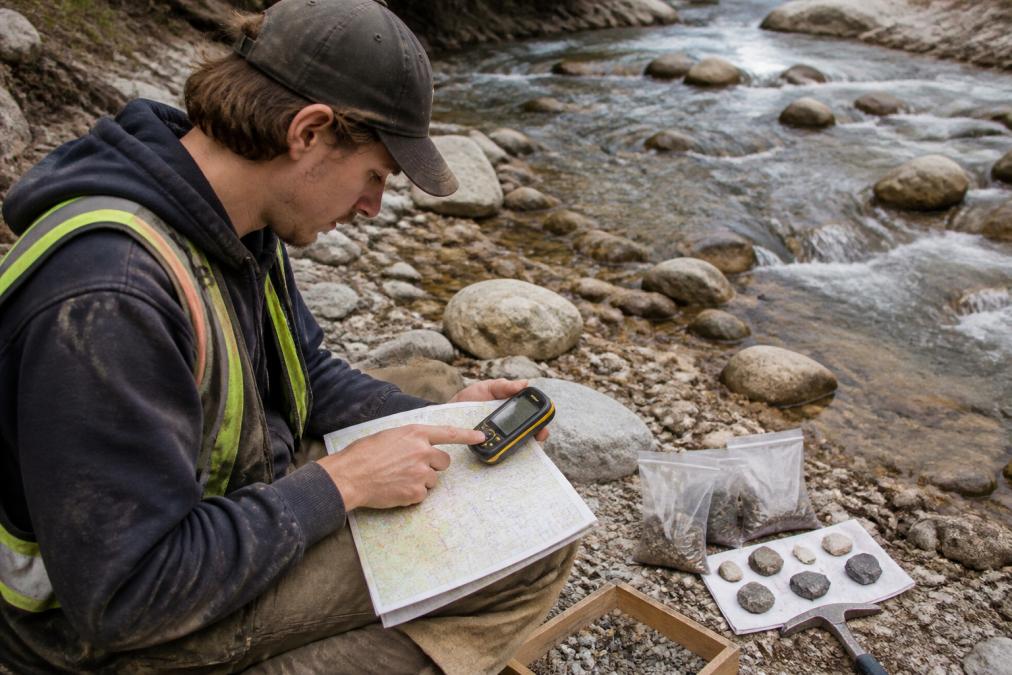
Modern prospecting combines field observation with digital tools. Geological maps, stream sediment surveys, and specialized software let you cross-reference physical samples against known geological features and previous exploration data.
Cross-Referencing Stream Sediment Data and Geological Surveys
The United States Geological Survey (USGS) maintains extensive geological maps and geochemical databases covering most of the country. These resources document known mineral deposits, geological formations, and previous exploration results. By consulting USGS maps for your area, you can identify known lode deposits that might be your placer gold source.
Stream sediment surveys are particularly valuable. Many areas have been surveyed for stream sediment composition, with samples analyzed for gold and other elements. If your placer gold came from a known drainage, you can compare your sample composition to published survey data. A match suggests the gold came from that drainage. Geological Survey reports document characteristics of known lode deposits: location, size, orientation, mineralogy, and gold fineness. If a known lode deposit matches your placer gold characteristics, that deposit is likely the source.
Digital Mapping Tools for Prospecting and Source Identification
Geographic Information Systems (GIS) software lets you layer geological maps, stream networks, elevation data, and geochemical survey results. Google Earth Pro provides free satellite imagery and elevation data to examine terrain around your sampling location, identify stream networks, and trace drainages backward to their sources.
Digital elevation models (DEMs) show terrain in three dimensions. By analyzing slope, aspect, and drainage patterns, you can understand how water moves across the landscape and where it concentrates gold. Steep slopes with fast water move coarse material. Gentle slopes with slow water concentrate fine material.
Geochemical databases compiled from stream sediment surveys and rock samples let you query by element composition. If your placer gold has distinctive trace elements, you can search the database for lode deposits with matching composition. This geochemical fingerprinting can narrow down the source significantly.
Verifying Authenticity Through Professional Assay and Certification
Professional assay provides definitive verification of gold purity, weight, and composition. An assay report from a recognized laboratory is the gold standard for authentication.
When you send gold for assay, the laboratory performs several tests. Fire assay determines gold purity by melting the sample and separating gold from other metals. Inductively coupled plasma (ICP) analysis identifies trace elements. X-ray fluorescence (XRF) provides non-destructive elemental analysis. These tests create a complete composition profile.
An assay report includes exact weight of gold in the sample, fineness (purity), and concentrations of trace elements. This information is objective and verifiable.
What a Legitimate Certificate of Authenticity Should Include
A legitimate Certificate of Authenticity from a reputable source like Parker's Gold should include exact weight of gold in the package, measured in grams or troy ounces, and specify the fineness or purity percentage. It should document the source location, Dominion Creek in the Yukon, and provide the date of recovery.
The certificate should reference an assay report from a recognized laboratory, with the lab's name, accreditation details, and assay date. This creates a verifiable chain of custody. The certificate should include a unique serial number tying it to the specific sample and preventing duplication.
A legitimate certificate should be signed by an authorized representative of the source operation and ideally notarized or verified by a third party. For collectible gold from known operations like Parker Schnabel's Dominion Creek, the certificate should reference the operation's official records and the specific season or year of recovery.
Parker's Gold provides each package with an official Certificate of Authenticity meeting these standards. The certificate documents that gold was recovered from Dominion Creek, specifies weight and purity, and references professional assay results. This documentation gives collectors confidence they're purchasing authentic, verified gold directly from Parker Schnabel's legendary operation.
Common Mistakes to Avoid When Verifying Placer Gold Origin
The most common mistake is relying on a single characteristic to verify origin. Morphology alone, fineness alone, or mineral associations alone don't prove origin. Legitimate verification requires multiple lines of evidence pointing to the same conclusion.
Another common mistake is assuming gold found near a known lode deposit necessarily came from that deposit. Placer gold can travel surprising distances. Gold found ten miles downstream might have come from a lode deposit fifty miles upstream.
Many people overestimate the reliability of visual inspection. The human eye is poor at estimating fineness, particle size, and morphology precisely. Quantitative measurements are more reliable than visual impressions.
Trusting unverified certificates is serious. Certificates can be forged or issued by unaccredited sources. A legitimate certificate should reference a recognized laboratory with contact information you can verify.
Ignoring geological context is another error. Gold doesn't appear randomly. If the geology of your sampling location doesn't match the source you're claiming, something is wrong.
Finally, many collectors skip professional assay believing field testing is sufficient. For high-value collectible gold, professional assay is the only way to obtain documentation satisfying future buyers or insurers.
Verifying placer gold origin requires patience, knowledge, and attention to detail. You're reconstructing its geological history and confirming its source. The techniques covered here work best when combined: examine morphology, analyze mineral associations, assess fineness, cross-reference geological data, and obtain professional assay. This layered approach gives you confidence that the gold is authentic and came from the source you believe.
If you're seeking verified, authentic placer gold with documented provenance, Parker's Gold offers collector packages directly sourced from Parker Schnabel's Dominion Creek operation. Each package includes genuine placer gold flakes presented in a handcrafted tri-fold display case and accompanied by an official Certificate of Authenticity documenting the gold's weight, purity, and origin. Secure, fully insured shipping and professional certification eliminate uncertainty from unverified sources. For collectors wanting assurance of authenticity and connection to legendary Gold Rush operations featured on Discovery Channel, Parker's Gold delivers both.
| Verification Method | What It Reveals | Time Required | Cost |
|---|---|---|---|
| Morphology Analysis | Transport distance and source proximity | 15-30 minutes | None (field observation) |
| Heavy Mineral Analysis | Source rock type and hydrothermal environment | 30-60 minutes | None to minimal (field kit) |
| Fineness Testing | Formation conditions and lode characteristics | 5-15 minutes | Low (field kit or simple assay) |
| Geological Cross-Reference | Known source deposits in the drainage | 1-2 hours | Free (USGS databases) |
| Digital Mapping | Terrain analysis and drainage patterns | 1-3 hours | Free to moderate (software) |
| Professional Assay | Definitive composition and purity | 1-2 weeks | Moderate to high ($100-500+) |
Frequently Asked Questions
How can I identify placer gold and verify it's authentic?
Authentic placer gold displays specific physical characteristics based on how far it traveled from its source. Rounded, smooth gold particles indicate longer transport through streams, while angular pieces suggest proximity to the original lode deposit. Genuine placer gold will be malleable, non-magnetic, and maintain consistent color when tested. Use a magnet test first, real gold won't stick. For definitive verification, request a Certificate of Authenticity that includes assay results confirming gold fineness and source documentation, as provided with Parker's Gold's Dominion Creek Collector Package.
What does gold morphology analysis reveal about placer gold origin?
Gold morphology analysis examines the shape, size, and surface texture of gold particles to determine how far they traveled from the original lode deposit. Heavily rounded, flattened gold flakes indicate extensive fluvial transport through streams and weathering processes. Angular nuggets suggest minimal transport. Fine flour gold typically represents material that traveled far. By analyzing these characteristics alongside trace element composition and heavy mineral concentrates found nearby, you can pinpoint whether the gold came from local bedrock mineralization or traveled from distant hydrothermal ore bodies.
Is placer gold worth anything as an investment or collectible?
Placer gold has value both as raw precious metal and as a collectible artifact. The intrinsic value depends on weight and purity (fineness), typically quoted per troy ounce. However, authentic placer gold with documented provenance, especially from historically significant operations like Parker Schnabel's Dominion Creek, commands premium prices among collectors. A Certificate of Authenticity significantly increases resale value and appeal to gift recipients and serious collectors. Unlike generic bullion, verified placer gold combines precious metal value with historical and sentimental worth.
What should I look for in a Certificate of Authenticity for placer gold?
A legitimate Certificate of Authenticity must include: the source location and operation name, the date of recovery, the weight and gold fineness percentage (usually expressed as parts per thousand), assay methodology used, and the issuing authority's credentials. It should reference specific geological or mineralization characteristics of the source area. Parker's Gold certificates include these details along with documentation of Parker Schnabel's Dominion Creek operation featured on Discovery Channel's Gold Rush, providing verifiable chain of custody and geological provenance that collectors and gift recipients can trust.
This article was written using GrandRanker