

Table of Contents
- Tip 1: Buy From Verified Sellers With Provenance
- Tip 2: Understand Raw Gold vs Gold Bullion
- Tip 3: How to Verify Raw Gold Authenticity Before You Pay
- Tip 4: Compare Pricing, Premiums, and Spot Price
- Tip 5: Check Shipping, Insurance, and Delivery Safety
- Tip 6: Tax Implications of Buying Gold Online
- Tip 7: Plan Your Exit Strategy Before You Buy
- Conclusion: Buying Raw Gold Online With Confidence
- Frequently Asked Questions
Last Updated: September 16, 2026
Tip 1: Buy From Verified Sellers With Provenance
Buying raw gold online starts with one rule: know who mined it and who is selling it. Provenance is the documented chain of custody connecting a parcel of gold to a specific operation, your strongest protection against counterfeits and misrepresented origin.
This is where first-time buyers get burned: a seller lists "natural gold flakes" with a stock photo and no paperwork, leaving no way to confirm origin. A verified seller documents the source, provides an assay certificate or Certificate of Authenticity, and stands behind the origin claim.
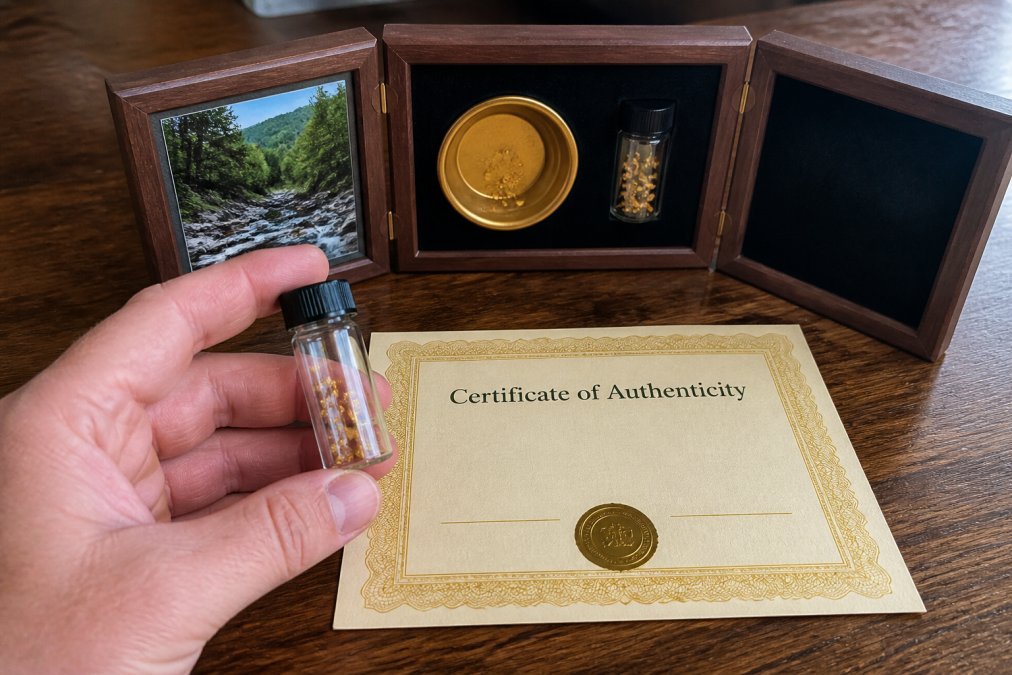
At Parker's Gold, every package ships with an official Certificate of Authenticity, a fact sheet listing the batch number and recovery information, and gold sourced directly from Parker Schnabel's Dominion Creek operation in the Yukon. That paper trail is what separates a collectible from a gamble.

Tip 2: Understand Raw Gold vs Gold Bullion
Raw gold and gold bullion are not the same product. Raw gold is unrefined material recovered from a placer deposit or hard-rock mine, flakes, dust, or nuggets that still contain natural impurities. Gold bullion is refined metal, typically .999 fine or higher, stamped with a purity mark and sold as bars or coins.
The practical difference matters for three reasons:
- Purity: Bullion carries a certified fineness. Raw gold varies widely and is rarely pure.
- Pricing: Bullion trades close to spot price plus a small dealer premium. Raw gold is priced on weight, character, and origin, not just metal content.
- Purpose: Bullion is an investment vehicle. Raw placer gold is a collectible, a display piece, or a gift with historical meaning.
If your goal is pure metal exposure, refined bullion coins and bars are the cleaner path. If your goal is owning something tangible from a real mining operation, raw gold is the category you want. For a deeper look at how the two compare on cost and resale, the U.S. Mint's bullion coin guidance explains how legal tender bullion is defined and priced.
Tip 3: How to Verify Raw Gold Authenticity Before You Pay
How to verify raw gold authenticity comes down to three layers: documentation, physical testing, and seller accountability. No single check suffices, and raw placer gold is harder to verify than a stamped bar, no mint mark, no standardized fineness, no uniform shape.
Layer 1: Documentation. A legitimate seller provides an assay certificate or Certificate of Authenticity tying the gold to a specific batch and source. Ask for the batch number before you pay, then confirm it matches the paperwork on arrival.
Layer 2: Physical testing. A stamped coin can be weighed against a published spec; a vial of flakes cannot. Work through these checks in order:
- Weight and density. Gold's specific gravity is about 19.3, roughly six times pyrite's. Real placer gold feels noticeably heavy for its volume; a parcel that feels light is a red flag.
- Magnet test. Gold is not magnetic. Flakes that jump to a magnet are iron-bearing or gold-plated base metal. This rules out fakes but does not confirm gold, non-magnetic fakes exist.
- Visual and streak checks. Raw placer gold has a warm yellow tone that does not tarnish and resists a fingernail scratch. Fool's gold (pyrite) is lighter, brassy, and brittle. On an unglazed ceramic streak plate, real gold leaves a gold-yellow streak; pyrite leaves greenish-black.
- Acid test kits. A jeweler's acid kit uses nitric acid and a touchstone to estimate karat. It is cheap and widely available, but destructive at the surface and only reads what it touches, a gold-coated fake can pass. Use it as one data point, not a verdict.
- Electronic metal verifiers. A sigma verifier measures resistivity and density non-destructively, flagging tungsten-filled or plated fakes that pass acid and magnet tests. Units cost several hundred dollars and up, so most buyers send a sample to a lab or buy only from sellers providing third-party assay documentation.
For raw placer gold, the most reliable path is a professional assay. A fire assay or X-ray fluorescence (XRF) reading from an independent lab gives an actual purity figure, not an estimate. A purity percentage with no assay behind it is a claim, not a measurement.
| Verification Check | What It Confirms | Red Flag If Missing |
|---|---|---|
| Certificate of Authenticity | Source and batch | No documentation provided |
| Assay certificate | Purity estimate | Vague purity claims |
| Weight and density check | Real gold weight | Flakes feel light for their volume |
| Magnet test | Absence of iron | Flakes react to magnet |
| Streak plate test | Distinguishes gold from pyrite | Greenish-black streak |
| Acid test kit | Surface karat estimate | Passes surface test but fails density |
| Sigma metal verifier | Plated or tungsten fakes | Seller refuses third-party assay |
| Seller return policy | Accountability | No returns, no contact |
Layer 3: Seller accountability. A verified seller offers a return window, answers sourcing questions, and does not pressure you into a same-day wire transfer.
Tip 4: Compare Pricing, Premiums, and Spot Price
Spot price is the current market value of one troy ounce of refined gold, set continuously on global commodities markets. It is the baseline every gold purchase is measured against, but not the price you pay for raw gold.
Parker Schnabel Yukon Gold Flakes →
- Get the weight in grams and convert to troy ounces (1 troy ounce = 31.1035 grams).
- Multiply by the current spot price to get the theoretical full-purity value.
- Apply the estimated purity range to get a melt-value floor and ceiling.
- Compare the asking price against that range. The difference is the premium you are paying for character and provenance.
- Decide whether the documentation and presentation justify that premium.
Tip 5: Check Shipping, Insurance, and Delivery Safety
Physical delivery is where online gold buying earns trust or loses it. A package of precious metals should never travel uninsured or unattended.
Look for four shipping safeguards before you buy:
- Full-value insurance covering the shipment from origin to doorstep
- Signature-required delivery so the package is never left unattended
- End-to-end tracking with a carrier you can monitor
- Tamper-evident packaging that shows if the seal was broken
Tip 6: Tax Implications of Buying Gold Online
Tax implications of buying gold online depend on what you buy, how long you hold it, and how you sell it. In the United States, the IRS treats physical gold as a collectible for capital gains purposes.
Two points matter most for raw gold buyers:
- Collectibles treatment: Raw placer gold generally falls under collectibles rules, not standard investment rules. Confirm your specific situation with a tax professional.
- Reporting thresholds: Certain sales of precious metals trigger reporting requirements for the dealer. The rules differ by metal type and quantity.
Tip 7: Plan Your Exit Strategy Before You Buy
Exit strategy is the tip almost no buying guide mentions, and it separates a considered purchase from an impulse buy. Before spending money on raw gold, answer one question: who will buy this from me later, and at what price?
Practical exit options for raw gold include:
- Selling back to the original seller, if they offer a buyback program
- Selling to a precious metals dealer, who will price it near melt value
- Selling to another collector through a marketplace, where provenance commands a premium
Conclusion: Buying Raw Gold Online With Confidence
The gap between a confident raw gold purchase and a regretful one comes down to verification. Documented provenance, a Certificate of Authenticity, insured shipping, and a clear exit plan turn a risky online transaction into a sound one.
Frequently Asked Questions
How can I verify the authenticity of raw gold before buying online?
Ask for a Certificate of Authenticity that includes the gold's origin, batch number, and weight. Reputable sellers like Parker's Gold provide a fact sheet detailing gold characteristics and recovery information. You can also request third-party assay or use a jeweler's loupe to inspect for natural irregularities. Avoid sellers who cannot provide documentation or pressure you to buy without verification.
What are the tax implications of buying raw gold online?
The IRS treats raw gold as a collectible. Keep detailed records of your purchase price and any associated fees. Consult a tax professional to understand how your specific situation applies, especially if you plan to sell later.
Is raw gold a better investment than gold bullion?
Raw gold offers a direct connection to mining history and can be a unique collectible, but it lacks the standardized purity and liquidity of gold bullion. Bullion coins and bars are easier to sell and have tighter dealer premiums. Raw gold may appeal more to enthusiasts or those wanting a tangible piece of a specific operation, like Parker's Dominion Creek. Consider your goals before choosing.
How do I know my raw gold shipment won't get lost or stolen?
Choose sellers who ship fully insured with signature-required delivery and tamper-evident packaging. Parker's Gold, for example, uses USPS, Canada Post, or Purolator with end-to-end tracking. If your package goes missing, the insurance covers the full value. Always request a tracking number and monitor the delivery. Avoid sellers who ship without insurance or require no signature.