

Table of Contents
- Why Provenance Matters in Gold Rush Gold Flakes
- The 5 Best Authentic Gold Rush Gold Flakes for 2026
- How to Verify Authentic Gold Flakes Before You Buy
- Understanding Gold Rush Memorabilia Value: Souvenir vs. Specimen
- Where to Buy Raw Placer Gold Online Safely
- Preserving and Storing Your Gold Flakes
- Final Verdict: Choosing Your Piece of History
- Frequently Asked Questions
Last Updated: September 9, 2026
Why Provenance Matters in Gold Rush Gold Flakes
The market for gold rush gold flakes is flooded with vials that claim authenticity but offer no proof of origin. A genuine specimen carries a story tied to a specific claim, season, and operation, which separates a collectible from a commodity purchase.
Authenticity comes down to documentation and chain of custody. When you buy raw placer gold online, you trust that the seller can trace the material from the ground to your hands. At Parker's Gold, verifiable sourcing is the only standard that matters, which is why every package is directly tied to Parker Schnabel's Dominion Creek operation in the Yukon, the same ground featured on Discovery Channel's Gold Rush.

The value of these flakes is not purely tied to the spot price of precious metals. Collectors pay for provenance, the documented history of where the gold was found and who recovered it. A flake with a clear origin story and an official Certificate of Authenticity holds its value differently than an anonymous vial from a dealer who cannot name the creek it came from.
The 5 Best Authentic Gold Rush Gold Flakes for 2026
Finding verified gold rush gold flakes requires filtering through hobbyist sellers and craft suppliers to identify operations with documented recovery sites. The list below represents the standards buyers should look for, with provenance and authentication leading every evaluation.
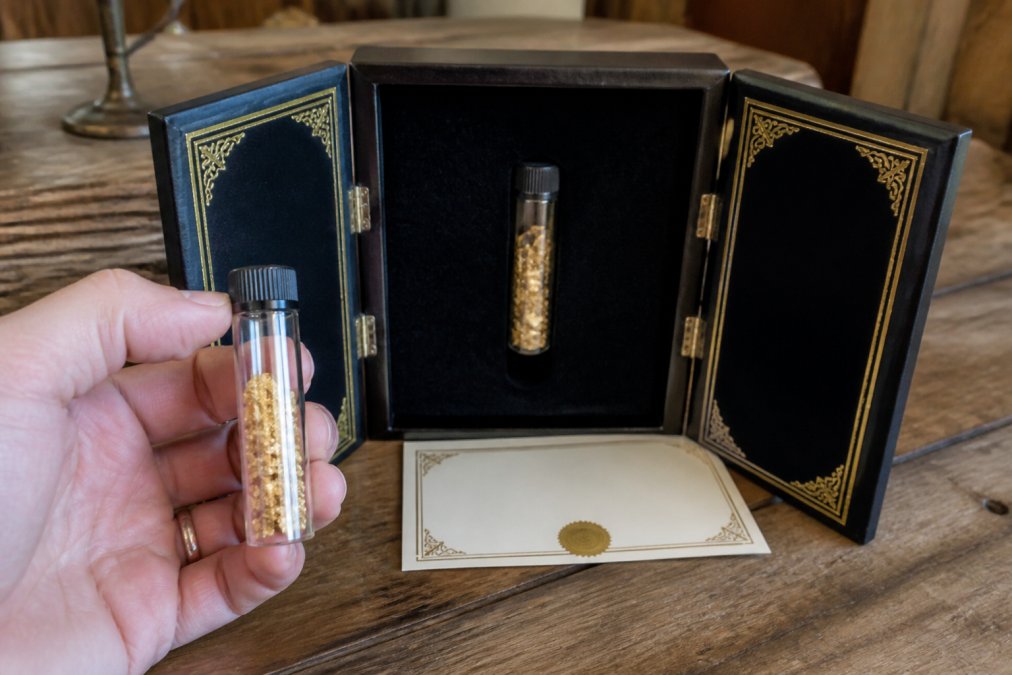
1. Parker Schnabel Yukon Gold Flakes - Dominion Creek Collector Package
Our top pick for 2026 is the Parker Schnabel Yukon Gold Flakes - Dominion Creek Collector Package, priced at $199.00. This limited-edition offering features genuine raw placer gold recovered from Parker Schnabel's Dominion Creek operation, the legendary goldfields featured on Discovery's Gold Rush.
Each package includes authentic gold rush gold flakes presented in a handcrafted tri-fold display case with embossed gold detailing, ready to gift or showcase. The collection is accompanied by an official Certificate of Authenticity that verifies the origin and value of the material, providing the documented provenance that serious collectors demand.
Parker's Gold ensures secure, discreet delivery with fully insured, tracked, and signature-required shipping, addressing the two biggest concerns in the market: authenticity and secure transport. With 319 reviews backing the product, it stands as the most trusted entry point for new collectors.
| Feature | What It Means for You |
|---|---|
| Source | Parker Schnabel's Dominion Creek, Yukon |
| Authentication | Official Certificate of Authenticity |
| Presentation | Handcrafted tri-fold display case |
| Shipping | Fully insured, tracked, signature required |
| Price | $199.00 |
How to Verify Authentic Gold Flakes Before You Buy
Most online guides tell you to "check for a certificate" or "buy from a reputable dealer," but that doesn't help when the vial is already in your hand. This section is a practical, at-home verification protocol that tests the physical properties of the material.
Step 1: The Density Test (Water Displacement)
Gold has a density of 19.3 grams per cubic centimeter, roughly twice that of pyrite (5.0 g/cm³) and nearly three times that of brass (8.5 g/cm³) (usgs.gov). A kitchen scale and a graduated cylinder can confirm whether your flakes are genuine.
- Weigh your flakes dry. Use a digital scale accurate to 0.1 grams. Record this weight.
- Fill a graduated cylinder with a precise volume of water. Use a narrow cylinder (10 ml or 25 ml works best) so the water level change is measurable.
- Submerge the flakes. Gently drop them in and record the new water level. The difference is the volume in milliliters, which equals cubic centimeters.
- Divide weight by volume. If the result is between 15 and 19 g/cm³, you are likely holding real gold. If it falls below 10 g/cm³, you are almost certainly holding pyrite, brass, or gold-plated copper.
Step 2: The Nitric Acid Scratch Test
Nitric acid is the standard field test used by prospectors and pawnbrokers, available in commercial gold testing kits from major jewelry supply retailers. The procedure is simple:
- Scratch the flake against an unglazed ceramic tile (a streak plate) to leave a visible metallic mark.
- Apply a single drop of 22-karat nitric acid to the streak.
- Observe the reaction. Genuine 24K gold shows no reaction whatsoever. Base metals, brass, or gold-plated alloys will fizz, discolor, or dissolve within 30 seconds.
Step 3: The Magnet Test (and Its Limits)
A strong neodymium magnet will attract pyrite and most brass alloys, but not gold. If any material jumps or clings, it is not pure gold. However, this test has a critical blind spot: gold-plated tungsten (density 19.25 g/cm³) passes both the magnet and density tests, which is why documentation and chain-of-custody paperwork remain essential for high-value purchases.
Step 4: The Ceramic Scratch Test
Drag a flake across an unglazed ceramic plate. Real gold leaves a yellow-gold streak. Pyrite leaves a greenish-black streak, and chalcopyrite leaves a dark green streak. This is a quick, destructive-free screening method that takes seconds.
When to Send for Professional Assay
For specimen-grade flakes bought for investment, an independent assay is worth the cost. The U.S. Mint and major refineries use fire assay or X-ray fluorescence (XRF) analysis to determine fineness to within 0.1%. Commercial assay services charge between $50 and $150 per sample and return results within 5-10 business days. A professional assay report is the only verification that holds up when you later sell or insure the piece.
What Paperwork Should You Demand?
A Certificate of Authenticity is only as good as the information it contains. Demand documentation that includes all of the following:
- The specific mining claim name and coordinates (not just "Yukon" or "Alaska")
- The recovery date or season
- The name of the licensed operator who recovered the material
- A unique serial number that matches the vial or display case
- A statement of fineness (e.g., "23-24K naturally occurring placer gold")
If a seller cannot provide these specifics, the material is effectively unverifiable, regardless of how convincing the physical tests appear.
Understanding Gold Rush Memorabilia Value: Souvenir vs. Specimen
Gold rush memorabilia value depends on which category your purchase falls into. A souvenir is a memento of the show or region, valued for emotional connection and display appeal. A specimen is recovered gold valued for geological significance and precious metal content. Both have worth, but they appreciate differently.
Souvenir-grade gold rush gold flakes are typically sold in small vials or display cases, emphasizing the connection to mining history and popular culture. These make excellent gifts for fans of the Discovery Channel series or those interested in Yukon history. The value sits in the story and authentication, not the weight of the metal.
Specimen-grade material, by contrast, is weighed and priced per troy ounce based on current market conditions. Collectors focus on natural formation, flake or nugget size, and purity as confirmed by assay. For investment, you want specimen-grade material with clear documentation of fineness and recovery location. For the experience and display, a souvenir package with strong provenance delivers more satisfaction per dollar.
Where to Buy Raw Placer Gold Online Safely
The single biggest source of buyer frustration is not counterfeit gold, it is the confusion between decorative metal flake (a craft product) and recoverable placer gold (a precious metal). A search for "gold flakes" returns thousands of listings for resin art supplies, automotive paint pigments, and cosmetic glitter. None contain a single atom of gold.
Decorative Metal Flake vs. Precious Metal Flake: Know the Difference
The table below is the fastest way to avoid wasting money on the wrong product:
| Feature | Decorative Metal Flake | Precious Metal Flake (Placer Gold) |
|---|---|---|
| Primary Use | Crafts, resin art, nail art, paint | Collecting, display, small-scale investment |
| Actual Gold Content | 0% (typically aluminum, brass, or polyester) | 85-95%+ (naturally occurring placer gold) |
| Price Point | $5-$20 per ounce | $150-$300+ per gram (depending on mesh size) |
| Density | Lightweight, floats in water | Heavy, sinks immediately |
| Magnetic Response | Often magnetic (aluminum or brass alloys) | Non-magnetic |
| Labeling | "Metal flake," "craft flakes," "mica powder" | "Placer gold," "raw gold," "gold nuggets" |
| Regulatory Oversight | None (cosmetic/craft product) | Subject to precious metals laws and sales tax |
Red Flags in Online Listings
Beyond the decorative flake trap, watch for these specific warning signs when evaluating precious metal sellers:
- Vague geographic sourcing. "From the Yukon" is not a claim. A legitimate seller names the creek, the claim number, and the operating company.
- No mesh size listed. Real placer gold is sold by mesh size (e.g., 10 mesh, 20 mesh, 40 mesh). If a listing does not state the particle size, the seller is not speaking the language of the industry.
- Stock photos instead of lot-specific images. A reputable dealer photographs the actual vial you will receive, not a generic image that could represent any product.
- Payment methods without buyer protection. Credit cards and PayPal offer dispute resolution. Wire transfers, cryptocurrency, or peer-to-peer payment apps leave you with zero recourse.
What a Legitimate Listing Looks Like
A safe purchase from a reputable operation will include:
- Exact weight in grams or troy ounces (1 troy ounce = 31.1 grams)
- Mesh size range (e.g., "10-20 mesh")
- Geological origin (specific claim name and region)
- Recovery method (e.g., "sluiced from Dominion Creek, 2025 season")
- Certificate of Authenticity with a unique serial number
- Insured, tracked, signature-required shipping
The Role of the U.S. Postal Service and Insurance
The U.S. Postal Inspection Service guidance on shipping valuables is unambiguous: any shipment of significant value should be sent with insurance and tracking. For precious metals, this is not optional. Legitimate dealers insure the full replacement value of the package, not just a nominal amount. If a seller offers "standard first-class shipping" for gold, they are either inexperienced or cutting corners, neither is acceptable.
The Bottom Line on Safe Purchasing
Buy only from operations that can name their mining claim, provide lot-specific photographs, price by weight, and ship with full insurance. If a listing checks all those boxes, you are almost certainly dealing with a genuine precious metals operation rather than a craft supplier or a middleman with no verifiable source.
Preserving and Storing Your Gold Flakes
Gold is one of the most stable elements, but storage affects display quality and long-term condition. Keep your gold rush gold flakes in their original vial or display case to minimize handling, as natural oils from fingers can dull the surface luster over time.
Store the display case away from direct sunlight and humidity. While gold does not oxidize or tarnish, the paper certificate, case lining, and adhesives can degrade with prolonged exposure to light and moisture. A cool, dry location with stable temperature protects both the gold and its documentation.
For handling specimens, use soft tweezers or cotton gloves. Dropping a vial of fine flakes can scatter material that is difficult to recover. If you sell the piece, keep the original packaging and certificate intact, as provenance documentation significantly impacts resale value.
Final Verdict: Choosing Your Piece of History
The decision comes down to what you value more: the weight of the metal or the weight of the story. For investment-grade material, you want assayed specimens priced per troy ounce with clear fineness documentation. For a tangible connection to the Gold Rush legacy, provenance-backed souvenir packages deliver something bullion cannot.
Authentic gold rush gold flakes with verifiable documentation represent a small but meaningful entry point into precious metals collecting. The U.S. Geological Survey mineral commodity summaries confirm that placer gold remains a finite resource, making each recovered flake genuinely scarce. When you buy from an operation with a documented recovery site, you own a piece of that scarcity with a clear story attached.
The Parker Schnabel Yukon Gold Flakes - Dominion Creek Collector Package from Parker's Gold offers the strongest combination of authentication, presentation, and secure delivery for most buyers. Each package includes the official Certificate of Authenticity, the handcrafted tri-fold display case, and fully insured shipping that protects your purchase from the Yukon to your door.
Frequently Asked Questions
How can you verify the authenticity of raw placer gold flakes?
Verification starts with provenance documentation. A reputable seller provides an official Certificate of Authenticity that traces the gold to a specific mining operation. Beyond paperwork, you can perform simple at-home tests: real gold is dense. For a definitive answer, send a sample to an independent assayer who can test purity and provide a report. Be wary of deals that lack clear origin documentation.
Are gold flakes from mining operations worth more than their weight in gold?
Yes, when they have verifiable provenance. The market value of the raw gold is based on its weight and purity, often measured against the troy ounce price. However, gold rush memorabilia value adds a significant premium. A flake from a famous operation like Dominion Creek, with a certificate and packaging, is a collectible specimen. This premium reflects its documented history and display quality, not just the metal content.
What is the difference between souvenir gold flakes and authentic placer gold?
Souvenir items are often gold-colored metal flakes or gold leaf used for decor. Authentic placer gold is natural, raw gold found in streams and river beds. You can tell the difference by examining the shape: placer gold has rounded, irregular edges from tumbling in water. Authentic pieces will also have a certificate and are sold by weight, not as a novelty item.
Collecting verified gold is about trust, and trust requires documentation you can trace from the mine to your display case. Parker's Gold delivers that confidence with gold sourced directly from Parker Schnabel's Dominion Creek operation, authenticated with an official Certificate of Authenticity and shipped with fully insured, signature-required delivery. Claim Yours and own a verified piece of the North that connects you to the enduring spirit of the Gold Rush.