

Table of Contents
- Why Collect Gold Rush Mining Memorabilia
- Yukon Gold Mining History Facts Every Collector Should Know
- Types of Gold Rush Memorabilia to Target
- How to Verify Authenticity and Provenance
- Understanding the Value of Raw Placer Gold Flakes
- How to Display Mining Collectibles Safely
- Preservation and Restoration: What to Avoid
- Start Your Collection with Authentic Yukon Gold
- Frequently Asked Questions
Last Updated: September 6, 2026
Gold rush mining memorabilia offers a tangible bridge to one of history's most transformative chapters, yet most collections focus only on mass-produced items. Serious collectors know that real value lies in authentic, documented artifacts with verifiable provenance. This guide from Parker's Gold covers identifying genuine pieces, preserving them, and why raw placer gold from active Yukon operations is a uniquely collectible asset.
The market for authentic artifacts remains strong because supply is finite while interest grows. Newcomers often prioritize volume over quality, filling shelves with unverified items. Below are the essential categories, authentication methods, and preservation techniques that separate serious collections from casual accumulations.
Why Collect Gold Rush Mining Memorabilia
Collecting gold rush mining memorabilia means acquiring and preserving physical artifacts, tools, documents, and raw materials, tied to specific mining operations. These pieces serve as primary evidence of a period that shaped settlement, economic policy, and industrial innovation. Unlike reproductions, authentic artifacts carry the wear and history that make them valuable to museums and private collectors.
Each item tells a specific story about individuals who risked everything on the promise of striking it rich. The social history of mining camps comes alive through the objects miners used and left behind. Holding a genuine carbide lamp or assay scale connects you directly to the daily reality of the gold rush era.
Yukon Gold Mining History Facts Every Collector Should Know
The Yukon gold rush, peaking between 1896 and 1899, stands apart due to extreme remoteness and brutal climate. The stampede began in August 1896 on Rabbit Creek when Skookum Jim Mason, Dawson Charlie, and George Carmack found rich placer gold. By the following summer, an estimated 100,000 set out, though only 30,000 to 40,000 arrived (nps.gov). Each prospector had to haul a year's supply of food, roughly 1,150 pounds, over the Chilkoot or White Pass, explaining why so many surviving artifacts are food-storage tools, not just mining implements (nps.gov).

This context matters because Yukon artifacts are scarcer and often in different condition than those from more accessible strikes. Permafrost and harsh winters meant equipment was abandoned in place when claims played out. Items recovered today frequently show freeze-thaw damage, cracked wooden handles and flaking metal, which authenticates their origin but demands specific preservation approaches.
Understanding the timeline helps date artifacts. Items from 1896-1898 are the most historically significant, representing the stampede's peak. After 1899, when gold was discovered in Nome, Alaska, many miners left and the region became a settled industrial operation. Later artifacts, dredging equipment and company tokens, reflect a different phase and are often more readily available.
Modern operations on Dominion Creek, about 50 miles south of Dawson City, continue this legacy with industrial methods. The gold recovered today is the same placer gold washing into creek beds for millennia, connecting contemporary material to the geological history that drew thousands north. Distinguishing historical artifacts from modern raw gold is essential, since both hold value but serve different purposes.
Personal items, letters home, playing cards, tobacco tins, and children's toys, offer a window into daily camp life and humanize the gold rush in ways tools cannot. Correspondence and diaries often provide the richest provenance, naming specific individuals, claims, and dates, transforming an ordinary object into documented social history.
The scarcity of well-documented Yukon pieces makes provenance verification critical. Many items sold online lack any chain of custody, diminishing authenticity and value. The Royal Canadian Mounted Police kept detailed, publicly accessible records of Yukon mining claims, offering a verification pathway that California collectors rarely enjoy. Cross-referencing an artifact's claimed origin against these archives adds credibility to any collection.
Types of Gold Rush Memorabilia to Target
Successful collections focus on specific categories rather than acquiring everything, allowing collectors to develop expertise and build a cohesive narrative around a region, era, or artifact type. The most collectible categories include tools, equipment, ephemera, and raw materials, each with distinct authentication challenges.
Tools and Equipment: Picks, Pans, and Ore Carts
Mining tools represent the most tangible connection to daily labor. Picks, shovels, gold pans, and ore carts were the workhorses of every operation. Authentic pieces typically show heavy use, worn handles, rust patina, and on-site repairs, while mass-produced reproductions lack these wear patterns.
Ore carts and larger equipment appeal to collectors with space for substantial displays and often carry maker's marks or claim identifiers that enhance provenance. Smaller tools like claim stakes, blasting cap tins, and assay scales offer entry points for those with limited space.
Ephemera, Tokens, and Badges
Ephemera includes mining claims, maps, company correspondence, and photographs documenting camp business and social life. Mining tokens, badges, fobs, and ribbons are sought for their intricate designs and limited runs. These items often survive in better condition than tools because they were stored indoors.
Ephemera requires careful handling. Documents should be kept in archival-quality sleeves away from direct sunlight, which causes fading and embrittlement. Condition dramatically affects value, with crisp, unmarked examples commanding substantial premiums.
How to Verify Authenticity and Provenance
Authentication is the single most important skill for collectors. A common mistake is trusting visual inspection alone, since modern reproduction techniques can convincingly age new items. Provenance, the documented chain of ownership, provides the strongest evidence of authenticity and directly impacts valuation.
Begin by examining the item for period-appropriate manufacturing marks and wear patterns. Research what authentic examples should look like, including materials and construction methods, and consult experts when uncertain. For high-value pieces, consider third-party authentication services.
Provenance documentation should include receipts, letters, or photographs linking the item to previous owners or specific operations. A documented connection to a named claim or company substantially increases authenticity confidence and market value. Be wary of vague or unverifiable origin stories.
Understanding the Value of Raw Placer Gold Flakes
Raw placer gold flakes offer a direct geological connection to the goldfields. Placer gold has eroded from its original source and settled in creek beds and rivers, precisely what the original prospectors sought. Unlike refined bullion, it retains its natural form, making each flake unique.
The value of raw placer gold extends beyond metal content to provenance and presentation. Gold from historically significant operations, such as Dominion Creek, carries a narrative premium that generic placer gold lacks. Documentation connecting gold to a named operation transforms it from a commodity into a collectible artifact.
For collectors seeking verified gold with clear provenance, the Parker Schnabel Yukon Gold Flakes - Dominion Creek Collector Package provides an accessible entry point. Each package includes genuine raw placer gold from Parker Schnabel's Dominion Creek operation in a handcrafted tri-fold display case with an official Certificate of Authenticity, providing a clear chain of custody from the mining site to the collector.
How to Display Mining Collectibles Safely
Proper display protects your investment. The primary threats are environmental: humidity, temperature fluctuations, UV light, and physical damage. Display cases with UV-filtering glass and climate control provide the best protection.
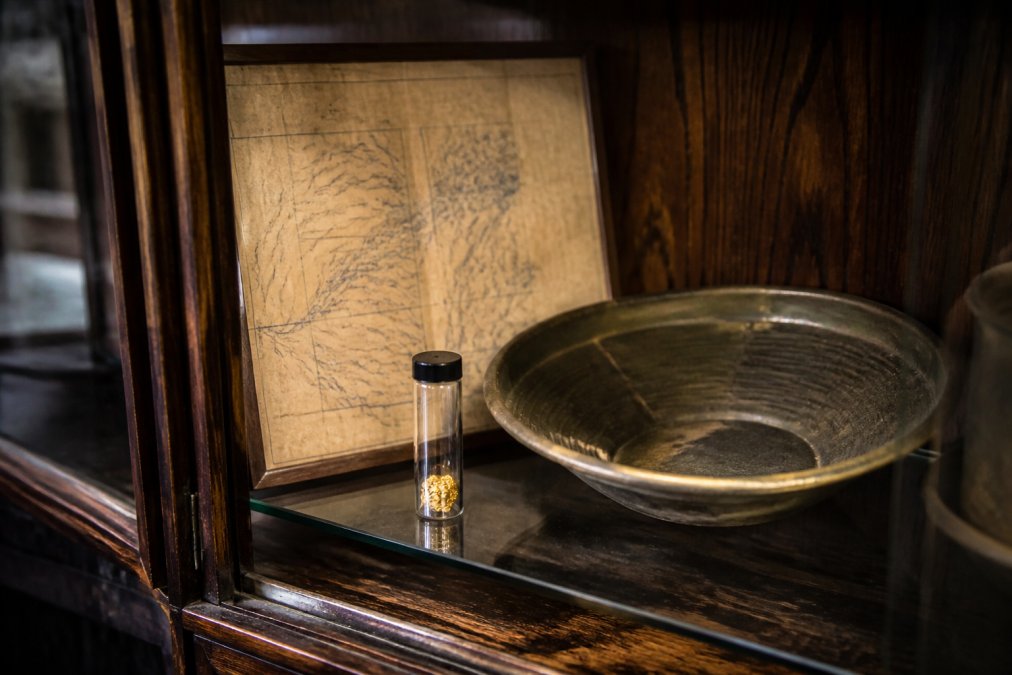
Group artifacts by theme or era to create a cohesive narrative. A display featuring a gold pan, claim document, and raw gold flakes from the same region tells a more compelling story than a random assortment. Label each item with provenance information for your records and visitors.
Insure valuable items individually or as a rider on your homeowner's policy, and photograph everything for documentation. For smaller items like gold flakes, lockable display cases provide peace of mind without sacrificing visibility.
Preservation and Restoration: What to Avoid
Preservation focuses on preventing deterioration; restoration involves repairing damage. For historical artifacts, preservation should always take priority, since aggressive cleaning or repair can destroy the qualities that make an item valuable. Patina and aging are evidence of history and should be preserved. This section addresses the specific environmental threats mining artifacts face, particularly iron and steel degradation, and provides a framework for slowing them.
The Rust Problem: A Primer for Iron and Steel Artifacts
The single greatest threat to ferrous artifacts is rust, an electrochemical process that continues as long as oxygen and moisture are present. Its porous nature draws in more moisture, accelerating degradation from the inside out. A seemingly stable tool can crumble within a decade of improper storage.
The first line of defense is environmental control. Ideal relative humidity for metal artifacts is 30% to 40%; above 50%, rust accelerates dramatically (canada.ca). A hygrometer provides a continuous reading, and a silica gel desiccant pack inside a sealed display case can maintain the proper microclimate. Avoid basements and attics, where humidity fluctuates and condensation forms on metal.
Stabilizing Active Rust Without Destroying Patina
When you acquire a piece with active rust, orange or reddish-brown flaking, the goal is stabilization, not removal. Stable surface rust (dark brown or black) is part of the artifact's history and should be left alone. Active rust will continue to eat through the metal and must be addressed.
Most conservators recommend mechanical removal of loose rust with a soft brass brush or fine steel wool (grade 0000), leaving stable patina intact. After brushing, apply a thin coat of rust-inhibiting oil, such as boiled linseed oil or microcrystalline wax like Renaissance Wax, to create a moisture barrier without altering the metal's visual character. Avoid spray paints, clear coats, or silicone-based products, which create a plastic-like sheen and can trap moisture.
What Never to Do: Common Mistakes That Destroy Value
Over-cleaning metal artifacts strips away authentic wear and can significantly reduce value. Electrolysis rust removal removes ALL oxidation, including desirable patina, and should only be used by professionals when structural integrity is at risk. Sandblasting or wire-wheel brushing will obliterate surface details, maker's marks, and claim identifiers, the very features that establish provenance.
Chemical rust converters react with rust to form a black, inert layer. While effective for industrial equipment, they alter the surface chemistry of historical artifacts and leave a difficult-to-remove residue. Mechanical removal followed by protective wax coating is the safest, most reversible approach.
Paper and Ephemera: A Different Set of Threats
Store paper documents flat in acid-free folders or sleeves, away from direct light. The archival standard is below 70°F and 30% to 50% relative humidity. Never use tape or adhesives on originals. If a document is folded, store it flat rather than refolding. For valuable documents, digitize for reference and keep the original in dark storage.
A Practical Preservation Checklist
To summarize, here is a practical checklist for preserving mining artifacts:
- Control humidity: Keep storage areas between 30% and 40% relative humidity.
- Stabilize active rust: Remove loose rust with a brass brush, then apply microcrystalline wax.
- Never polish to a shine: Patina is evidence of history and directly impacts value.
- Store paper flat: Use acid-free materials and keep away from UV light.
- Avoid chemical treatments: Rust converters, electrolysis, and sandblasting are for professionals only.
- Document everything: Photograph each item upon acquisition and record its condition.
Environmental preservation of the artifacts themselves is the most effective strategy for maintaining both historical integrity and market value. A piece that survives in stable condition for another century will only grow in significance as the supply of authentic gold rush artifacts continues to diminish.
Start Your Collection with Authentic Yukon Gold
Building a meaningful collection requires patience, research, and a commitment to authenticity. The most successful collectors focus on verifiable provenance over volume, understanding that a few well-documented pieces outweigh many unverified ones. As the supply of genuine artifacts diminishes, raw placer gold from active operations offers a way to own authentic, documentable mining history.
For collectors who want a verified piece of the Yukon goldfields, Parker's Gold provides a direct connection to Parker Schnabel's Dominion Creek operation, as seen on Discovery Channel's Gold Rush. Each Collector Package includes genuine raw placer gold with an official Certificate of Authenticity in a handcrafted tri-fold display case. Shipping is fully insured, tracked, and signature-required.
The tradition of gold rush collecting continues because each new generation discovers the appeal of owning something real from a period that shaped the modern landscape. Whether seasoned or just beginning, authentic, documented pieces offer the most satisfying and secure path forward.
Starting a collection presents the challenge of finding items that are both authentic and documented. Parker's Gold solves this by offering raw placer gold directly sourced from a legendary Dominion Creek operation, complete with an official Certificate of Authenticity and handcrafted display case. Every order ships fully insured with tracking and signature required. Get started with Parker's Gold and claim your authentic connection to the gold rush legacy.
Frequently Asked Questions
What are the most valuable types of gold rush mining memorabilia?
Items with strong provenance and historical significance command the highest prices. This includes tools like ore carts and assay scales from documented mines, safety lamps from specific companies, and ephemera like mining claim documents and company badges. Raw placer gold flakes in verified, documented packages are also highly sought after because they offer a direct link to a specific operation, such as the Dominion Creek site featured on Gold Rush.
How can you verify the authenticity of antique mining equipment?
Authentication relies on provenance, which is the documented history of an item. Look for original receipts, letters, or photographs linking the piece to a specific mine or owner. Examine the construction for period-appropriate techniques, like wrought ironwork or riveted metal. Be wary of items with overly uniform wear or modern reproductions. For gold, a Certificate of Authenticity from the source operation is critical, as it provides a traceable chain of custody.
What is the difference between placer gold and lode gold for collectors?
Placer gold is found in streams and rivers, having eroded from its original rock source. It often appears as flakes or nuggets with smooth, rounded edges. Lode gold is still in the original vein of quartz or rock. For collectors, placer gold flakes are popular because they are directly associated with the romantic image of prospecting and panning. They are also easier to display and require no extraction from a surrounding matrix.
How should you display and preserve delicate mining artifacts?
Protect items from direct sunlight, humidity, and extreme temperature swings, which accelerate corrosion and fading. Use archival-quality display cases and mounts to prevent chemical reactions with the artifact. For paper items like claim stakes or stock certificates, use UV-protective glass and acid-free matting. Avoid cleaning antique tools aggressively; remove loose dirt with a soft brush and leave the patina intact, as it is a sign of age and authenticity.