

Table of Contents
- Why Travelers Are Skipping the Standard Gold Rush Museum Tour
- Self-Guided Grounds Tours and Historical Mining Sites You Can Walk
- Gold Panning for Beginners: Where to Try It and What to Expect
- Is Buying Raw Gold a Good Investment Compared to a Tour Ticket?
- Guided Excursions vs. Self-Guided Visits: A Real Cost Breakdown
- Accessibility, Mobility Ratings, and Who Each Option Suits
- Best Time of Year, Crowds, and Multi-Day Itinerary Logistics
- Frequently Asked Questions
Last Updated: September 20, 2026
Why Travelers Are Skipping the Standard Gold Rush Museum Tour
The alternatives to gold rush museum tours have quietly become the better trip. A guided museum walk puts you behind glass, looking at artifacts someone else dug up. A self-guided grounds tour, a working gold panning creek, or a piece of verified raw gold in your hand does the opposite: it puts the history in your palms.
That shift is why so many travelers now build their itinerary around historical parks, state historic sites, and hands-on prospecting instead of a single ticketed exhibit. This guide from Parker's Gold breaks down what actually replaces the museum tour, who each option suits, and how to plan a multi-day route without wasting a day.
Here's the throughline: the museum tour is a starting point, not the destination. The real Gold Rush history is outdoors, on trails, in creeks, and in the small towns that grew up around the gold fields.
Self-Guided Grounds Tours and Historical Mining Sites You Can Walk
A self-guided grounds tour is a marked walking route through a preserved mining site where you move at your own pace, reading interpretive signs and exploring original structures without a guide. Most state historic parks with mining heritage offer these at low or no cost beyond a day-use admission fee.
What you typically find at a preserved mining site:
- Original headframes, stamp mills, and sluice remnants
- Interpretive center displays explaining mining techniques
- A trail map at the visitor center marking the walking tour
- Mineral collection and artifact exhibits indoors
The advantage over a guided excursion is control. You linger where you want. A common mistake is rushing the grounds to catch a scheduled tour, then missing the best part: the quiet corners where the geology and the pioneer history actually make sense.
National Park Service guidance on historic mining sites
Gold Panning for Beginners: Where to Try It and What to Expect
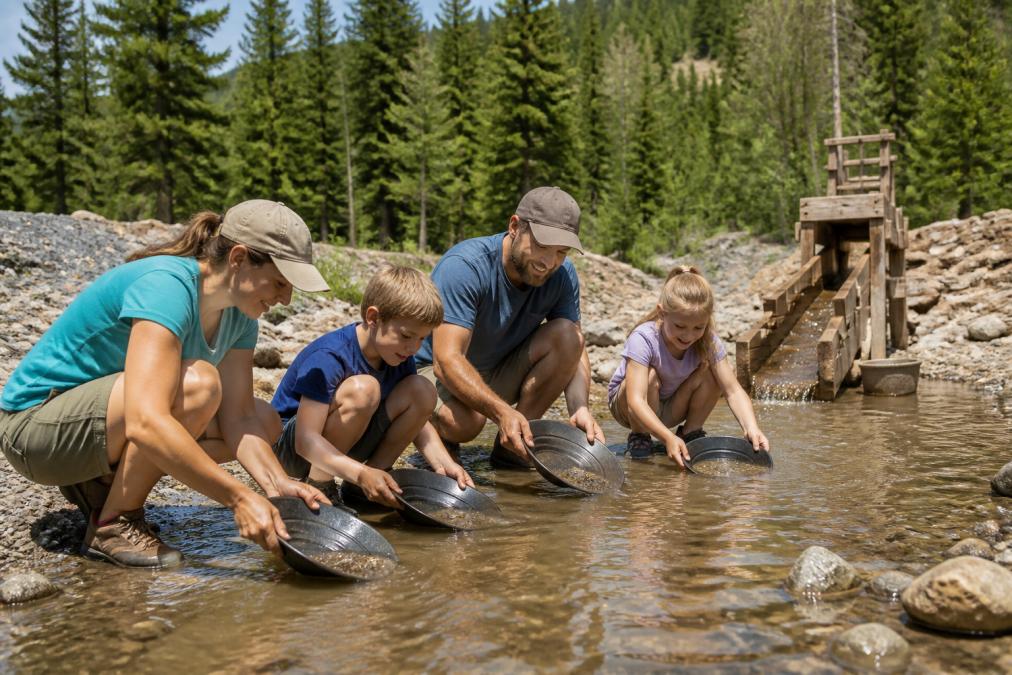
Gold panning for beginners is simpler than most people expect: scoop gravel from a stream bed, submerge the pan, and swirl it so lighter material washes away while denser gold settles at the bottom. The skill is in the swirl, not the strength.
Where to try it:
- Public prospecting areas inside state historic parks
- Creeks on federally managed land where recreational panning is allowed
- Fee-based panning experiences that supply equipment and instruction
Before you go, confirm two things: whether the land allows recreational panning, and whether a reservation is required. Seasonal availability varies, and some sites close sections during spawning season.
What to expect: most beginners find tiny flakes, not nuggets. That's normal. The value of the day is the experience, and a good guide will show you how to read a creek for where gold actually collects.
Bureau of Land Management recreational prospecting rules
Is Buying Raw Gold a Good Investment Compared to a Tour Ticket?
Is buying raw gold a good investment? It depends on what you're buying it for. Raw placer gold holds value as a precious metal, but collectible gold tied to a documented origin often holds more, because you're paying for provenance as well as weight.
A tour ticket buys a few hours and ends.
Guided Excursions vs. Self-Guided Visits: A Real Cost Breakdown
The cheapest option is rarely the best one, and the most expensive tour isn't automatically worth it. Here's how the main choices stack up on what you actually pay for, and what that money buys you in time and context.
| Option | Typical Cost Structure | Time Commitment | Best For |
|---|---|---|---|
| Self-guided grounds tour | Day-use admission fee (often $5-$15 per vehicle at state historic parks; free at many federally managed sites) | 1-3 hours | Flexible travelers, budget trips |
| Guided excursion | Per-person tour fee (commonly $15-$40 for a 90-minute ranger or docent walk; specialty underground mine tours run higher) | 2-4 hours | First-timers wanting context |
| Gold panning experience | Fee plus equipment (many parks loan pans free with admission; commercial panning outfits charge per person and include gear) | 2-5 hours | Families, hands-on learners |
| Verified raw gold keepsake | Varies by package and weight | Permanent | Collectors, gift givers |
National Park Service fees and passes
Accessibility, Mobility Ratings, and Who Each Option Suits
Accessibility is the factor most guides ignore, and it decides more trips than price does. Grounds tours at historic mining sites range from paved, wheelchair-accessible loops to steep, uneven trails with loose gravel and no handrails, and the difference between two sites an hour apart can be the difference between a great day and a wasted one.
Rate each option before you commit:
- Easy: Paved or firmly packed paths, benches, accessible visitor center and restrooms, grades generally under 5%. Suitable for wheelchairs, walkers, strollers, and visitors who tire quickly.
- Moderate: Packed dirt or gravel trails, mild slopes, some uneven footing, occasional roots or rocks. Manageable with a sturdy walking stick or a companion's arm.
- Difficult: Rocky, steep, or unpaved terrain, loose gravel, no handrails, and sometimes no shade. Not suitable for strollers or wheelchairs, and a real challenge for anyone with balance or heart conditions.
What to ask the visitor center before you go, and why each question matters:
- Trail surface and grade. "Paved" and "accessible" are not the same thing. Ask for the maximum grade and whether the surface is asphalt, packed gravel, or loose rock.
- Distance to the nearest accessible restroom. At large historic sites, the accessible facilities are often at the visitor center, not out on the grounds.
- Shuttle or golf-cart availability. Some larger parks run accessible shuttles to key structures; many do not, and the walk is longer than the map suggests.
- Indoor alternatives. The visitor center mineral collection and artifact exhibits are frequently the most accessible part of the site, climate-controlled, seated, and fully wheelchair-accessible.
Who each option suits:
- Families with young kids: Easy, paved grounds and shallow panning creeks. Avoid difficult trails with drop-offs.
- Travelers with mobility needs: Prioritize accessible visitor centers, the indoor mineral collection, and any paved loop. Confirm restroom and seating locations in advance.
- Older visitors: Moderate grounds tours with benches work well; plan shorter walking segments and build in rest stops.
- Serious hikers: The difficult routes others skip, ridge trails, remote mill ruins, backcountry mining districts, are where the solitude and the best structures often are.
National Park Service accessibility guidance
Best Time of Year, Crowds, and Multi-Day Itinerary Logistics
Late spring and early fall give you the best combination of open trails, manageable crowds, and comfortable panning water. Peak summer brings school-holiday crowds and, in some regions, creeks running too high or too low for good panning.
For a multi-day route, cluster sites by region rather than zig-zagging. A workable three-day structure:
- Day 1: Arrive, visit the main visitor center, walk the easy grounds tour
- Day 2: Gold panning experience in the morning, nearby historic town in the afternoon
- Day 3: Second mining site, guided excursion if you booked one, then head home
Recreation.gov trip planning resources
Frequently Asked Questions
Are there active gold mines that offer public tours instead of museum exhibits?
A few working placer operations and state historic parks run seasonal public tours where you watch active digging and sluicing rather than static displays. Availability varies by state and season, and most require advance reservations. If you want a hands-on option, many sites also let visitors pan in a designated area after the tour. Check each site's visitor center page for current schedules, admission fees, and whether group tours are offered.
How can I learn about gold mining history outside of a museum setting?
Self-guided grounds tours at historical mining sites let you walk original trails, see mining equipment in place, and read interpretive signs at your own pace. Many state historic parks also run ranger-led walking tours and gold panning demonstrations. For a tangible connection, some collectors buy verified raw placer gold with a Certificate of Authenticity, which documents the source operation and gives you a physical piece of mining heritage to display.
Where can I go gold panning near Seattle or Sacramento?
Both regions sit near gold fields with public access. In Washington, several rivers and designated recreation areas allow panning with a valid permit. In California, Auburn and Sacramento-area sites offer family-friendly panning, often with equipment rental and instruction. Rules differ by state, so confirm permit requirements and seasonal availability before you go.
Is buying raw gold from a mining operation worth it for a casual fan, not an investor?
If you want a displayable piece of mining heritage rather than a bullion purchase, source-verified placer gold with documentation serves a different purpose than an investment-grade bar. You are paying for provenance, presentation, and authenticity, not just metal weight. Ask the seller how the Certificate of Authenticity is verified, and how shipping is insured before you buy.
The hard part isn't finding things to do; it's choosing between a dozen worthwhile sites with limited days. If you want the Gold Rush to come home with you rather than stay behind glass, Parker's Gold offers genuine raw placer gold from Parker Schnabel's Dominion Creek operation, presented in a handcrafted tri-fold display case with an official Certificate of Authenticity and fully insured, tracked, signature-required shipping. Claim yours and own a verified piece of the North.