

Table of Contents
- What Makes Authentic Yukon Gold Different
- Understanding Gold Nugget Certificates of Authenticity
- Yukon Gold Nuggets for Sale: What You're Actually Buying
- Purity, Weight, and Collector Value
- Gold Nugget Display Cases and Preservation
- Verifying Origin and Avoiding Counterfeit Claims
- Collector Value vs. Bullion Value: Where Your Money Goes
- Verifying Origin and Avoiding Counterfeit Claims
- Frequently Asked Questions
Last Updated: October 10, 2026
What Makes Authentic Yukon Gold Different
Authentic Yukon gold for collectors represents a tangible connection to North America's legendary mining regions. The distinction lies in provenance, purity, and documented origin, which separates genuine collector pieces from generic placer gold sourced anywhere in the world.
Yukon placer gold typically ranges in purity in its natural state, depending on the specific claim and recovery technique. This natural variation is a hallmark of authenticity; perfectly uniform gold often signals processing or blending.
Collectors value Yukon gold for its documented origin. A piece from Parker Schnabel's Dominion Creek operation carries historical weight beyond its metal content, connecting you to the Gold Rush narrative. That story is what separates a collector's piece from bullion.

Understanding Gold Nugget Certificates of Authenticity
A certificate of authenticity serves as proof of origin and purity. It should specify the exact source location, recovery date, weight, and estimated purity percentage. Without it, you're relying on the seller's word alone.
The strongest certificates include batch numbers linking your piece to a documented recovery event. This batch number becomes your verification trail for resale or independent assessment.
Many online sellers offer worthless in-house certificates. Meaningful ones come from operations with documented recovery processes and transparent sourcing, specifying the mining method and exact claim or creek.
A certificate doesn't guarantee resale value, but it guarantees you know what you bought. That transparency is the foundation of collector confidence.
Yukon Gold Nuggets for Sale: What You're Actually Buying
Yukon gold listings typically specify weight in grams, piece count, and mesh size. Weight determines bullion value, but collector value often exceeds that floor by 50% to 200%, depending on rarity and presentation.
Parker's Gold's Dominion Creek Collector Package offers all three weight options in a handcrafted tri-fold display case with embossed detailing.
You're buying a curated collection, not bulk metal. The presentation, display case, certificate, and batch documentation transform raw gold into a finished collector's item. That's where the premium comes from.
Purity, Weight, and Collector Value
Yukon placer gold naturally occurs at various purities, reflecting each deposit's geological composition.
How Purity Is Measured
Three primary testing methods exist for verifying gold purity, each with different costs and accuracy levels:
Acid testing is the most common field method. A small scratch is made and nitric acid applied; the reaction indicates approximate purity. It's destructive and accurate only to within 2-3 karats, so reputable sellers use it as a preliminary check only.
X-ray fluorescence (XRF) testing is non-destructive and highly accurate, detecting purity to within 0.5 karats at $50-$150 per test. Many professional dealers use it as their standard verification method. If a seller claims to use XRF, ask to see the device or test report.
Assay laboratory testing is the gold standard for legal verification, using fire assay or ICP spectrometry to determine exact purity and weight at $75-$200. It's legally defensible and required for insurance or high-value resale. For collector packages under $300, assay is optional; for pieces over $500, it's recommended.
Interpreting Purity Claims
Natural placer gold contains trace elements, silver, copper, and other metals, that occur naturally in the deposit. A 20K rating means 20 parts pure gold and 4 parts other metals. This is normal and expected.
If a seller claims "24K" or "pure gold," that's a red flag. Natural placer gold cannot be 24K without processing. Ask for clarification and documentation.
Purity affects bullion value directly. For small collector pieces the difference is modest, but it compounds with larger quantities.
Collector Value vs. Purity
Higher purity doesn't automatically mean higher collector value. A well-documented 20K piece from Dominion Creek may command more than an undocumented 23K piece from an unknown source. Collectors value story and provenance as much as metal content.
Purity consistency matters when comparing pieces from the same source and batch. The higher-purity piece is objectively more valuable both as bullion and as a collector's item. Across different sources, provenance trumps purity.
Gold Nugget Display Cases and Preservation
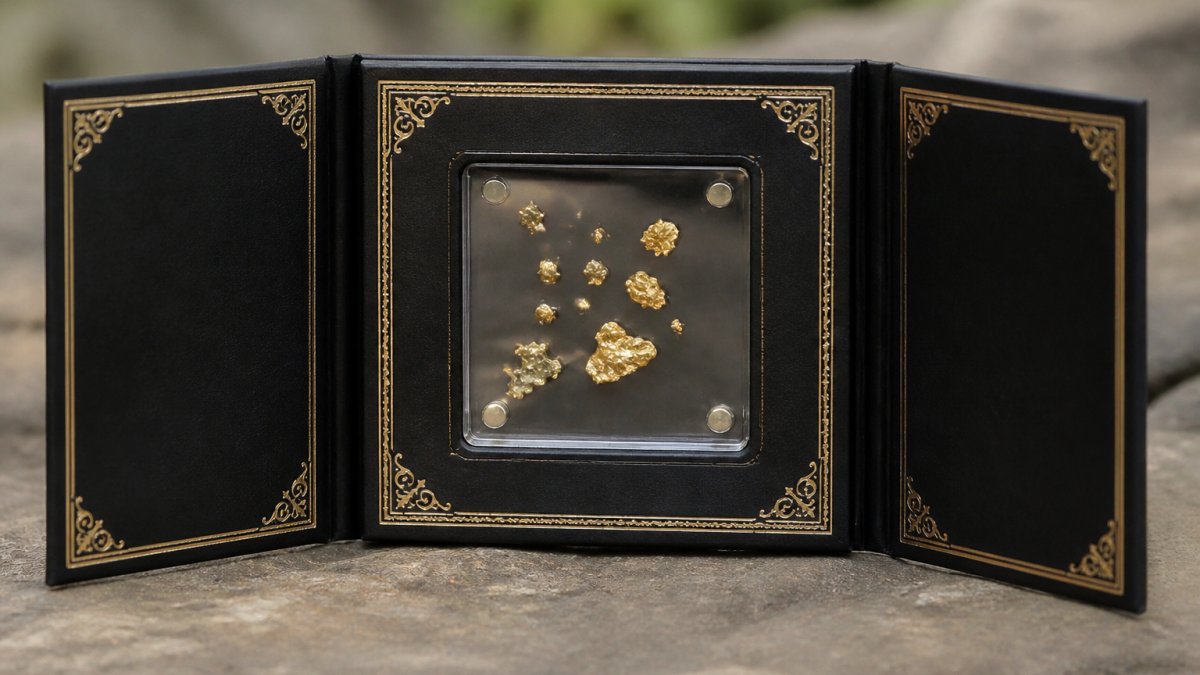
A proper display case protects your gold from handling damage, dust, and oxidation while showcasing it. The tri-fold design, three panels with a protective window, is the collector standard, allowing viewing without exposure.
Parker's Gold's handcrafted tri-fold cases include embossed gold detailing.
Verifying Origin and Avoiding Counterfeit Claims
Layer 1: Documentation and Batch Traceability
A legitimate seller provides a certificate including: batch number, exact recovery location (not just "Yukon"), recovery date, weight and purity estimate, and mining method. Without these details, you're buying on the seller's word alone.
Layer 2: Cross-Reference and Public Records
Parker Schnabel Yukon Gold Flakes – Dominion Creek Collector Package →
For gold from publicly documented operations like Parker Schnabel's Dominion Creek, cross-check claims against public information and episode air dates.
For smaller operations, ask the seller for the mining claim number, operation contact information, and references from other buyers. If a seller refuses or becomes evasive, that's a red flag.
Layer 3: Independent Testing
If a seller won't allow independent testing, that's a warning sign. Legitimate sellers welcome it.
Red Flags and Misrepresentation Tactics
Watch for: "Limited edition" without numbered certificates; vague origin claims ("Yukon gold" vs. "Dominion Creek, March 2024"); purity inflation ("24K" for natural placer gold); pressure to buy quickly; or no certificate or batch documentation.
The Verification Checklist
Before purchasing, confirm:
☐ The certificate includes a batch number, recovery location, recovery date, and purity estimate.
☐ The recovery location is specific (creek or claim name, not just "Yukon").
☐ You can cross-reference the batch or operation against public information or seller references.
☐ The seller can explain the mining method and how it affects the gold's appearance.
☐ The seller can provide contact information or references from other buyers.
If you can check all six boxes, you've done due diligence. If you can't, you're accepting risk in exchange for a lower price or faster purchase. That trade-off is yours to make, but make it consciously.
Collector Value vs. Bullion Value: Where Your Money Goes
Bullion value is the floor, the price you'd receive if you melted the gold and sold it as refined metal. Collector value is what someone will actually pay for the authenticated, presented piece.
The gap between bullion and collector value is where the premium sits. A $199 Dominion Creek package covers the certificate, the display case, the batch documentation, and the provenance story. That's not a markup, it's the value of authenticity and presentation.
This premium makes sense if you're buying to keep or gift. It makes less sense if you're speculating on gold prices. A collector who buys for the story and presentation won't be disappointed if spot gold prices drop. A speculator who overpaid for the premium will be frustrated.
Resale value depends on finding another collector willing to pay the same premium. A piece from a famous operation like Dominion Creek has better resale potential than generic placer gold. But you shouldn't expect to resell at full purchase price. Plan on recovering 60% to 80% of your collector premium if you sell to another collector, or just the bullion value if you sell to a refiner.
The distinction matters for your decision. If you're buying to own and display, collector value is legitimate. If you're buying as an investment expecting appreciation, you're competing with bullion dealers and spot price movements, where the premium becomes a liability.
Verifying Origin and Avoiding Counterfeit Claims
Verification of authentic Yukon gold starts with documented sourcing. The strongest pieces come from operations with public recovery records, like Parker Schnabel's Dominion Creek operation, which is documented through Discovery Channel's Gold Rush. That public visibility adds credibility.
Ask for specifics: the exact claim location, recovery date, and mining method. If the seller's story holds up under scrutiny, confidence increases.
Batch documentation is your verification anchor. Each batch should correspond to a specific recovery event with a date and location. That batch number should appear on your certificate. If you can cross-reference the batch to other pieces from the same recovery, you've confirmed the seller isn't mixing sources or inventing batches.
Buying authentic Yukon gold for collectors means prioritizing provenance and presentation over spot price. Parker's Gold's Dominion Creek Collector Package delivers both: gold sourced directly from Parker Schnabel's legendary operation, authenticated with a batch-numbered certificate, and presented in a handcrafted tri-fold display case. The combination of documented origin, professional presentation, and secure, insured delivery transforms raw gold into a collector's piece worth keeping or gifting. Claim Yours and own a tangible piece of Yukon history.
Frequently Asked Questions
How can I verify that my Yukon gold is actually authentic and from Parker Schnabel's operation?
Authentic Yukon gold comes with an official Certificate of Authenticity that includes a batch number, recovery details, and sourcing information. Parker's Gold certificates specify that gold was recovered directly from the Dominion Creek operation and include a fact sheet detailing gold characteristics. Verify the batch number against your certificate, check for tamper-evident packaging, and confirm the certificate includes specific recovery location and date information. Legitimate certificates from miner-sourced operations always link authenticity to verifiable provenance, not just weight or purity claims.
What's the difference between raw placer gold flakes and gold nuggets, and which should collectors buy?
Raw placer gold flakes are small, irregularly shaped pieces recovered from water-based mining, while nuggets are larger, more uniform specimens. Placer gold from established operations like Dominion Creek appeals to collectors who value authenticity and direct sourcing over size. Flakes are easier to display in presentation cases and offer flexibility in weight options (1g, 2g, 3g packages). Nuggets suit collectors seeking individual statement pieces. For authentic Yukon gold with verified provenance, placer flakes from documented mining operations often provide better authentication trails and collector appeal than generic nuggets.
Is paying $199 for a gold package worth it when I could buy raw gold cheaper from a bullion dealer?
Bullion dealers sell by weight and purity alone, typically at spot price plus a small markup. A collector package includes verified provenance, a handcrafted display case, an official certificate, and the story of its origin. You're paying for authenticity documentation, presentation quality, and the connection to a specific mining operation, not just the raw metal value. For casual fans and serious collectors alike, the certificate of authenticity and Dominion Creek sourcing create resale value and meaningful differentiation that raw bullion cannot match. The display case also eliminates separate costs for storage or presentation.
What should I look for in a gold nugget certificate of authenticity to ensure it's legitimate?
A legitimate certificate should include the specific mining operation name (Dominion Creek, for example), batch or lot number, recovery date, gold weight in grams, purity percentage or karat range, and miner sourcing details. It should be issued by the seller or an independent third party, not a generic template. Check for unique identifiers like batch numbers that can be cross-referenced. Avoid certificates that list only weight and purity without origin details. Parker's Gold certificates include recovery information, batch numbers, and fact sheets, details that distinguish verified miner-sourced gold from unmarked or generic specimens.