

Table of Contents
- Home Storage vs. Professional Vault Storage
- Choosing the Right Home Safe for Gold Storage
- How to Store Gold Nuggets to Prevent Damage
- Digital Inventory and Emergency Access Planning
- Insuring Gold Collections: What You Need to Know
- Common Storage Mistakes to Avoid
- Secure Your Gold With Confidence
- Frequently Asked Questions
Last Updated: September 7, 2026
Owning raw gold nuggets is a tangible connection to the earth, but protecting that investment requires more thought than a sock drawer. The best ways to store gold nuggets safely combine physical security, environmental control, and a documented inventory, whether you choose a home safe or a professional vault facility. In this guide from Parker's Gold, we break down the practical decisions collectors face, from choosing the right safe to planning for emergencies, so your specimen remains both secure and pristine.

Most collectors assume theft is the only threat, but improper storage can degrade the condition of your gold over time. Below, we'll show you exactly how to balance accessibility, preservation, and security, and where professional custody makes sense versus a well-executed home setup.
Home Storage vs. Professional Vault Storage
The central decision for any collector is whether to keep gold at home or pay for third-party storage. Home storage offers immediate access and full control, but it transfers the entire burden of security onto you. Professional vault storage shifts that responsibility to a high-security facility with insurance coverage, yet it introduces fees and requires travel to access your assets.
For most collectors, a hybrid approach works best. Keep a modest portion of your collection at home for enjoyment and quick liquidity, while storing the bulk of your investment-grade bullion in a professional vault. A dedicated home safe for gold storage is essential if you keep any significant value on your property, as common hiding spots offer little real protection against determined intruders.
Choosing the Right Home Safe for Gold Storage
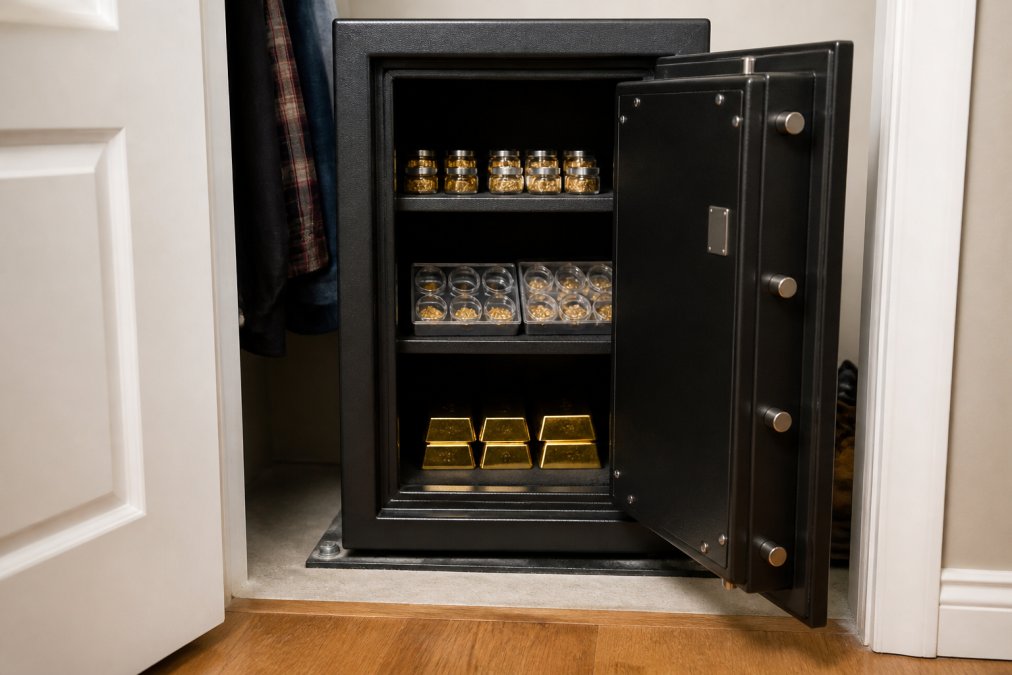
Selecting a home safe is the single most important security decision you will make. A common mistake is buying a lightweight "security" cabinet that a thief can carry out entirely. The best options are heavy, bolted to the structure, and rated for both fire and water resistance.
Fire and Water Protection Ratings
Fire ratings indicate how long a safe can withstand high temperatures before the interior exceeds a damaging threshold, typically measured in minutes at a specific temperature. Water resistance matters just as much, since firefighting efforts can flood a safe and damage your collection. Look for a safe that offers a combined rating, protecting your gold from both heat and water damage.
Bolting Your Safe to the Structure
A safe that is not bolted down is merely a heavy box. Secure it to a concrete floor or a reinforced wall using the manufacturer's anchoring kit and heavy-duty expansion bolts. This simple step prevents thieves from removing the entire safe and breaking into it later at their leisure, which is a leading cause of home safe theft.
How to Store Gold Nuggets to Prevent Damage
Physical gold is durable, but raw nuggets and high-purity flakes are softer than many people realize and can be scratched or deformed. Store each nugget in its own protective capsule or a small, sealed plastic sleeve to prevent abrasion. Keep pieces in original packaging when possible, as this preserves both condition and provenance for future resale.
Most guides stop at abrasion, but the deeper threat to a natural specimen is environmental degradation. While pure gold is inert, the material surrounding it is not. Placer gold often contains trace amounts of other metals like silver or copper, which can react to atmospheric sulfur compounds and develop a surface film. More critically, the quartz, iron oxides, or clay matrix attached to many nuggets is highly porous. In a humid environment, these materials can absorb moisture, leading to rust staining from iron content or the growth of microscopic mold on organic residues. Over time, this can dull the specimen's natural luster and compromise its aesthetic value.
To prevent this, treat your nuggets like the geological specimens they are. Maintain a stable relative humidity between 35% and 45% in your storage area (si.edu). A simple digital hygrometer costs under $20 and removes the guesswork. If you live in a humid climate, place a desiccant pack inside your safe, but never let it touch the nuggets directly, as silica gel can wick moisture unevenly and cause localized condensation. Silica gel also needs regular recharging; most practitioners find that baking it at 250°F for two hours every few months restores its effectiveness (the NIH).
Avoid storing nuggets in basements or garages where temperature swings cause condensation cycles. A climate-controlled closet on an upper floor is a better choice. For display purposes, use an airtight acrylic display case rather than an open shelf. This protects against airborne dust, which is abrasive at a microscopic level, and prevents handling oils from your fingers from transferring to the specimen. When you do handle nuggets, use cotton gloves or hold them by the edges only.
Finally, consider the chemical environment of your safe itself. Do not store gold nuggets near cleaning chemicals, gun cleaning solvents, or even certain types of foam padding that emit volatile organic compounds. A common pattern is for collectors to store their safe in a garage workshop, only to find their specimens develop a haze from solvent fumes. If your safe must share space with chemicals, seal the nuggets in airtight capsules and add an activated charcoal filter to the safe interior to absorb airborne contaminants.
Digital Inventory and Emergency Access Planning
A detailed inventory is your best defense against loss, theft, or insurance disputes. Record each nugget's weight, estimated purity, and a photograph, then store this information digitally in a secure cloud service. Keep a physical copy in a separate location, such as a safe deposit box, so you have a record even if your home is compromised.
But a list of weights and photos is only half the equation. The more urgent, and universally ignored, problem is access. If you are hospitalized, incapacitated, or pass away unexpectedly, how will your family find and retrieve your collection? Most collectors keep this information in their heads, which means it dies with them. A collection stored in a hidden safe with a combination only you know can become permanently inaccessible, or worse, accidentally discarded by heirs who have no idea what they are looking at.
Build an emergency access plan using a three-part system. First, create a secure document that contains the safe's location, combination or key location, and a list of all items stored inside. Do not rely on memory, write it down. Second, store a copy of this document in a sealed envelope with your estate attorney, your executor, or a trusted family member. Third, register the collection's existence in your will or trust, and name a specific beneficiary for the nuggets. Without explicit designation, the collection becomes part of your general estate, which can trigger probate delays and potential disputes among heirs.
For the inventory itself, go beyond basic weights. Include the date of acquisition, purchase price, current estimated value, and any provenance documentation. Photograph each nugget against a ruler for scale reference, and photograph the safe itself showing where it is located in your home. This documentation serves three purposes: it supports insurance claims, it helps law enforcement identify stolen items, and it provides your heirs with a clear picture of what they are inheriting.
Finally, schedule a periodic review of your access plan. A common failure point is that collectors update their inventory but forget to update their emergency contacts when relationships change. Review your plan annually, when you update your insurance policy or add new pieces to your collection, and confirm that your designated contact still has current information. A plan that is not maintained is no plan at all.
Insuring Gold Collections: What You Need to Know
Standard homeowners insurance policies often provide minimal coverage for precious metals, frequently capping payouts far below the value of a serious collection (iii.org). Insuring gold collections properly requires a dedicated rider or a separate policy specifically covering bullion and numismatic items.
Before purchasing coverage, have your collection professionally appraised and keep your inventory documentation current. Many insurers require an appraisal to establish value, and they will expect proof of loss, such as photos and receipts, when you file a claim. Ask your insurer whether coverage extends to items stored in a home safe versus a professional vault facility, as terms and premiums often differ significantly.
Common Storage Mistakes to Avoid
Several recurring errors undermine otherwise sound storage plans. The most frequent is telling others about your collection, which converts a private asset into a target. Discretion is a security feature in itself, so limit knowledge of your holdings to trusted family members.
Another common mistake is neglecting environmental conditions. Storing nuggets loose in a drawer or jar invites scratching and contamination. Similarly, failing to secure your safe to the structure defeats its purpose entirely, as a portable safe is a liability rather than a safeguard.
| Storage Decision | Best Choice | Primary Benefit | Key Trade-off |
|---|---|---|---|
| Primary location | Professional vault | High-security custody | Access requires travel |
| Home access | Bolted fire/water safe | Immediate availability | Upfront cost and setup |
| Individual pieces | Protective capsules | Prevents damage | Requires organization |
| Proof of ownership | Digital + physical inventory | Supports insurance claims | Needs regular updates |
Secure Your Gold With Confidence
Protecting your collection comes down to layering physical security, environmental care, and proper documentation. Whether you hold a few flakes as a memento or a substantial investment, the principles remain the same: bolt your safe, protect each specimen, and keep a verifiable record. For collectors who want an authentic, documented piece of Yukon history without the complexity of raw storage, Parker's Gold delivers genuine Dominion Creek placer gold in a handcrafted display case with a Certificate of Authenticity, shipped fully insured and signature-required. Claim yours and own a verified piece of the Gold Rush legacy with complete confidence.
Frequently Asked Questions
Is it illegal to store gold at home?
No, it is legal to store physical gold, including nuggets, at home in the United States. There are no federal laws prohibiting personal ownership or home storage of gold. However, you must report large cash transactions to the IRS, and any capital gains from selling gold are taxable. The main concerns with home storage are theft and damage, which is why a quality safe and proper insurance coverage are essential for protecting your collection.
What are the risks of storing gold nuggets at home?
The primary risks are theft, fire, and water damage. Unlike a bank vault, a home safe can be stolen or tampered with if not properly bolted down. Fire can destroy or devalue your gold, and water from firefighting efforts can cause damage. Additionally, raw nuggets are soft and can be scratched if stored loosely together. Using individual capsules or sleeves and maintaining a detailed inventory helps mitigate these risks.
Should I insure my gold nugget collection?
Yes. Standard homeowners or renters insurance policies typically cap coverage for precious metals at a low amount, often around $1,000 to $2,000. For a valuable gold nugget collection, you need a separate rider or a dedicated policy for insuring gold collections. This requires a professional appraisal and detailed inventory. Insurance costs are usually a small percentage of the collection's value annually, offering financial protection against theft or loss.
How should I prepare my gold nuggets for storage?
Store each nugget individually to prevent scratching, as placer gold is relatively soft. Use small, airtight plastic capsules, coin flips, or padded sleeves. Keep your nuggets in their original packaging if they came with a certificate of authenticity. Place them in a fireproof and waterproof safe, ideally in a discreet, bolted-down location. Maintain a digital inventory with photos and serial numbers to support insurance claims.