

Table of Contents
- Defining Bullion vs. Collectible Coins
- Is Buying Raw Gold a Good Investment
- Gold Coin Premiums Explained
- Liquidity, Marketability, and Exit Strategy
- Tax Treatment of Precious Metals
- Counterfeit Risks and Authentication
- Wealth Preservation: Which Wins for Long-Term Holding
Last Updated: August 25, 2026
Defining Bullion vs. Collectible Coins
Bullion is precious metal in bulk form, bars, ingots, or coins, valued primarily for weight and purity. Collectible gold refers to coins prized for age, rarity, mintage, condition, or historical provenance. This distinction determines how value is calculated, what risks you face, and how easily you can sell.
Bullion trades at or near spot price, the current market rate for one troy ounce of gold. A one-ounce gold bullion coin might trade at $2,050 if spot is $2,000. Collectible coins carry a numismatic premium: that same one-ounce coin, if rare or historically significant, might sell for $5,000 or more. The extra value comes from scarcity and collector demand, not the gold itself.
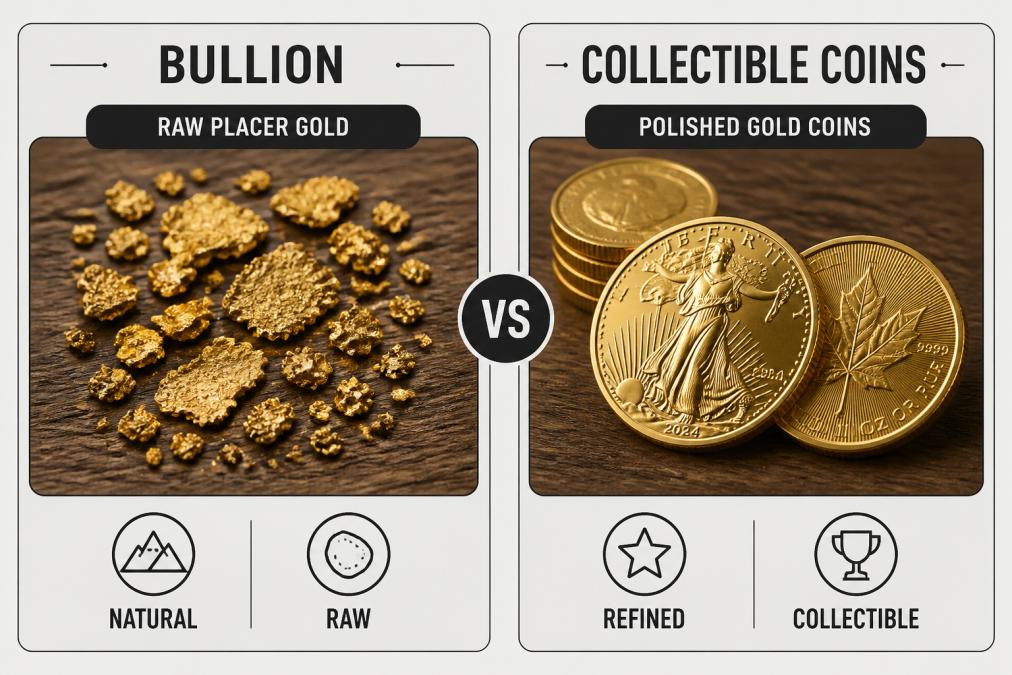
This creates two different investment profiles. Bullion investors hedge against inflation and currency risk. Collectible gold investors bet on rarity and market demand for specific pieces. Parker's Gold offers a middle ground: authenticated raw placer gold from Parker Schnabel's Dominion Creek operation, presented in a handcrafted display case. It bridges the tangibility of bullion with the authenticity collectors value.

Understanding which category fits your goals is critical. Bullion suits those seeking straightforward metal exposure. Collectible gold suits those wanting scarcity, historical connection, and appreciation potential beyond metal content.
Is Buying Raw Gold a Good Investment
Whether raw gold is a good investment depends on your objectives and risk tolerance. Raw gold provides direct exposure to precious metal price movements and serves as wealth preservation and inflation hedge.
The case for raw gold: it's liquid, universally recognized, and carries no counterparty risk. You own the metal outright with no company failure risk or ongoing fees. During economic uncertainty or currency devaluation, raw gold historically holds value when other assets decline.
The case against: raw gold generates no income, no dividends or interest. You're entirely dependent on price appreciation. Storage and insurance costs eat into returns. Poor timing can result in losses. Over long periods, raw gold has roughly kept pace with inflation but hasn't significantly outpaced it.
Raw gold works best as a portfolio diversifier, typically 5 to 15 percent of total assets, rather than a core holding (sec.gov). Many investors combine raw bullion with collectible pieces to balance liquidity with appreciation potential. Parker's Gold's Dominion Creek Collector Package at $199 offers authenticated, documented gold without complications of larger bullion purchases, making it accessible for those testing whether precious metals fit their strategy.
Gold Coin Premiums Explained
A premium is the difference between spot price and actual selling price. Understanding premiums directly impacts your entry and exit costs.
Bullion coins typically carry premiums of 2 to 8 percent over spot (usmint.gov). A one-ounce American Gold Eagle might trade at spot plus 4 percent. This premium covers production costs, dealer margins, and distribution.
Collectible coins carry much larger premiums driven by rarity, condition, and historical significance. A rare 1933 Double Eagle can sell for multiples of gold content value. A coin graded MS-65 might command a 50 percent premium over an identical coin graded MS-60, a single grade point can mean hundreds or thousands of dollars.
This creates a critical exit challenge: when you sell a collectible coin, you might buy at a 40 percent premium and sell at a 20 percent premium, locking in a loss despite rising gold prices.
Raw placer gold like Parker's Gold occupies a middle position. It carries a modest premium for authentication, presentation, and provenance, the Certificate of Authenticity and handcrafted display case add value beyond raw metal content, while avoiding extreme condition-grade volatility.
When evaluating any gold purchase, separate metal value from premium. Ask: if gold prices drop 20 percent, how much of my purchase price is at risk? For bullion, most of it. For rare collectibles, less. For authenticated raw gold, the premium is modest enough that metal price movements dominate returns.
Liquidity, Marketability, and Exit Strategy
Liquidity is how quickly you can convert an asset to cash without significant loss. It's the most overlooked factor in precious metals investing.
Bullion is highly liquid. Dealers will buy back one-ounce gold coins or bars within minutes at prices close to spot, with bid-ask spreads typically 1 to 3 percent. You can also sell online to dozens of dealers.
Collectible coins are far less liquid. Fewer buyers exist, prices vary wildly, and spreads between bid and ask can be 10 to 20 percent or higher. A rare coin worth $5,000 today might take months to sell.
Before buying any gold, ask: When will I sell? Why? At what price? How quickly do I need cash? If you're buying for a 20-year horizon, illiquidity is less concerning. If you might need to sell within five years, prioritize liquid assets.
Raw placer gold with authentication sits between these extremes. It's more liquid than rare coins because authentication reduces buyer uncertainty, yet less liquid than pure bullion. The modest price point ($199 for the Collector Package) means you're not tying up capital requiring emergency liquidation. It's better suited as a collectible keepsake than a liquid investment reserve.
For serious investors, exit strategy should drive the purchase decision. Bullion for liquidity. Collectibles for appreciation potential. Raw authenticated gold for authenticity and tangibility without either extreme's complexity.
Tax Treatment of Precious Metals
The IRS classifies gold as a collectible for tax purposes, creating significant implications for investors.
Physical gold held for investment is taxed as a collectible. When you sell at a profit, the gain is taxed at your long-term capital gains rate with a maximum of 28 percent, higher than the standard 15 or 20 percent applied to stocks and bonds (irs.gov). Holding for more than one year qualifies for long-term treatment, but the 28 percent ceiling still applies.
Short-term gains (sales within one year) are taxed as ordinary income at your marginal rate, which could be 37 percent or higher for high earners. This creates strong incentive to hold gold for at least one year.
You can hold certain gold coins and bars in an IRA, but rules are strict. Only IRS-approved coins and bars qualify, and storage must be through an approved custodian. The benefit is tax-deferral, not tax elimination.
Losses on gold sales can offset capital gains from other investments, useful for tax planning. Reporting requirements are strict: the IRS requires Form 8949 and Schedule D for any sale.
Parker's Gold's Collector Package includes a Certificate of Authenticity, creating a clear record of purchase price and date, essential documentation for tax reporting and establishing basis and holding period.
The tax disadvantage of collectible gold is real but shouldn't dominate your decision. If gold is appropriate for your portfolio, tax treatment is secondary. It reinforces the importance of holding long-term and considering gold as strategic allocation, not a trading vehicle.
Counterfeit Risks and Authentication
Counterfeit gold is a genuine risk, particularly in online markets. Fake coins, bars, and raw placer gold exist and can be difficult to detect without professional testing.
Common counterfeiting methods include tungsten-core bars, plated fakes, and misrepresentation of purity or weight. Some counterfeits are sophisticated enough to fool casual inspection.
Authentication requires multiple layers. Visual inspection catches obvious fakes, but professional testing is necessary for certainty. X-ray fluorescence (XRF) testing measures elemental composition. Acid testing checks purity. Weight and dimension verification confirm specifications. Reputable dealers use these methods before buying or selling.
Third-party certification adds credibility. Grading services like PCGS and NGC authenticate and grade coins, placing them in tamper-evident holders.
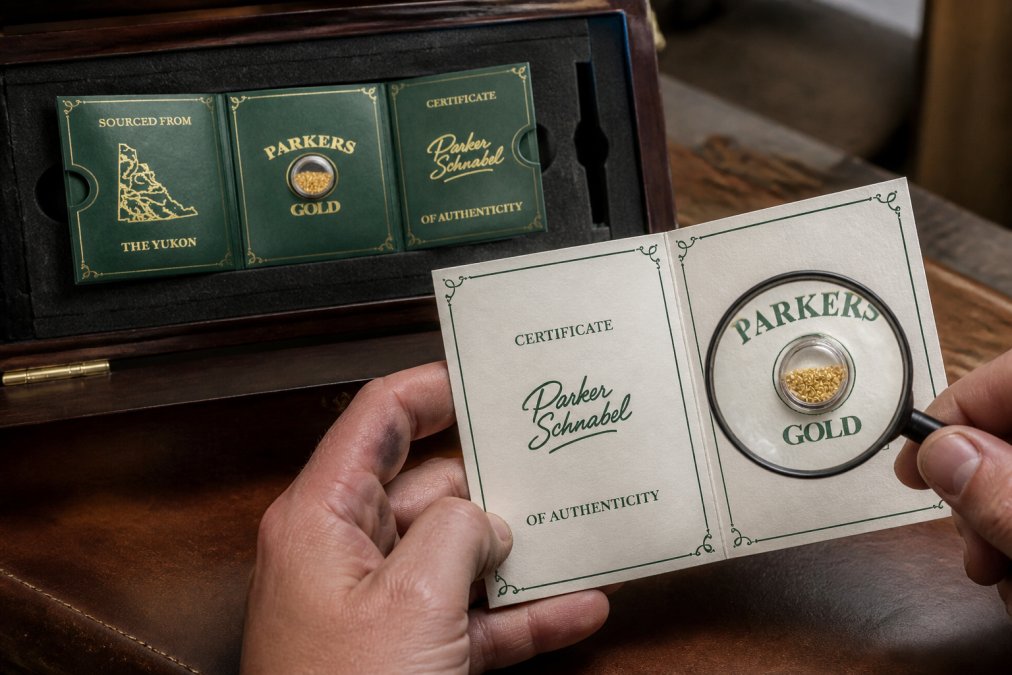
For raw placer gold, provenance becomes critical. Parker's Gold's offering includes an official Certificate of Authenticity verifying the gold was sourced from Parker Schnabel's Dominion Creek operation, a documented, verifiable source seen on Discovery Channel's Gold Rush. The certificate and handcrafted presentation case create a clear chain of custody protecting against fraud.
When buying gold, ask: Can the seller provide third-party authentication? Is there a money-back guarantee if counterfeit? What's the seller's reputation? Reputable dealers stand behind their products. If a seller resists authentication or can't provide documentation, walk away.
The counterfeit risk is manageable through proper sourcing, authentication, and documentation. Buying from established dealers with clear provenance dramatically reduces exposure.
Wealth Preservation: Which Wins for Long-Term Holding
Wealth preservation protects purchasing power over decades. Both bullion and collectible gold serve this purpose in different ways.
Bullion preserves wealth by maintaining intrinsic value. Gold has been a store of value for thousands of years. During inflation, currency devaluation, or economic crisis, gold historically holds purchasing power while paper currencies lose theirs. A one-ounce gold coin bought 30 years ago could still buy roughly the same goods today.
Collectible gold preserves wealth through scarcity. A rare coin's value is rooted in limited supply and historical significance. Over very long periods, 50+ years, rare collectibles have often appreciated faster than bullion. However, this appreciation is speculative and dependent on collector demand.
For most investors, a balanced approach works best. Allocate a core position to bullion, perhaps 70 to 80 percent of precious metals holdings, for stability and liquidity. Allocate a smaller portion to collectibles or authenticated specialty items for diversification and potential appreciation. Parker's Gold's Collector Package fits well in this framework. At $199, it's an affordable entry point for those wanting authenticated, documented gold with historical connection to the Gold Rush. It's an excellent addition to a diversified precious metals portfolio, combining tangibility and authenticity with a modest price point.
Long-term wealth preservation isn't about picking the perfect asset, it's about consistency, diversification, and choosing vehicles you'll actually hold through market cycles. Gold plays that role best when part of a broader strategy, not the entire strategy.
Precious metals investing requires balancing liquidity needs, tax efficiency, authentication certainty, and your investment timeline. The choice between collectible gold and bullion isn't binary, many successful investors hold both. If you're drawn to the authenticity, historical connection, and verified provenance that collectible gold offers, Parker's Gold's Dominion Creek Collector Package provides exactly that: genuine placer gold from a documented source, presented professionally with full authentication and secure delivery. Claim Yours and own a tangible piece of Yukon mining history backed by transparent documentation and expert curation.
Frequently Asked Questions
Q: What's the primary difference between numismatic value and melt value?
A: Melt value is the intrinsic value of precious metal content at the current spot price. Numismatic value is the premium collectors pay for rarity, condition, historical significance, and provenance. A rare coin graded by third-party certification can sell for 5-10 times its melt value, while bullion typically sells close to spot price plus a modest dealer spread. Raw placer gold like Parker's Gold Dominion Creek collection sits between these: it has intrinsic value plus collector appeal tied to its documented origin.
Q: Are collectible gold coins considered a good hedge against inflation?
A: Yes, both collectible coins and bullion hedge against inflation because their precious metal content maintains purchasing power as currency weakens. However, collectible coins offer dual protection: the underlying gold hedges inflation, while numismatic premiums often appreciate independently. Bullion provides simpler, more liquid inflation protection; collectibles add appreciation potential but require expertise to buy and sell at optimal premiums.
Q: How do dealer premiums differ between bullion bars and rare coins?
A: Bullion bars typically carry a 2-5% dealer spread over spot price, making them cost-efficient for pure metal content. Rare coins command 10-50%+ premiums depending on rarity, grade, and certification. Collectible gold with documented provenance, like Parker's Gold's Dominion Creek collection, bridges this gap, it carries a meaningful premium over spot price due to authenticity and origin story, but remains more accessible than rare numismatic coins. The premium reflects the Certificate of Authenticity, handcrafted presentation, and collector appeal rather than extreme rarity.
Q: What is the best form of gold to buy for long-term wealth preservation?
A: For pure wealth preservation, bullion offers simplicity and liquidity. For wealth preservation with appreciation potential, collectible gold with strong provenance and authentication wins. Parker's Gold's raw placer gold from Parker Schnabel's Dominion Creek operation combines both: it preserves wealth through intrinsic precious metal value while offering collector appeal tied to Gold Rush history and Discovery Channel credibility. The Certificate of Authenticity ensures you can document and verify the asset, critical for estate planning and future sale. Choose bullion if you prioritize easy exit; choose authenticated collectible gold if you want tangible historical value alongside metal content.
This article was written using GrandRanker