

Table of Contents
- The Essential Gold Prospecting Gear Every Hobbyist Needs
- How to Choose the Best Gold Panning Kit for Beginners
- Gold Prospecting Laws and Regulations You Need to Know
- Sluice Boxes, Classifiers, and Concentrate Processing
- Maintaining and Repairing Your Gold Prospecting Gear
- Ethical and Environmental Responsibilities for Prospectors
- Conclusion: Building Your Gear Collection Over Time
- Frequently Asked Questions
Last Updated: October 2, 2026
The Essential Gold Prospecting Gear Every Hobbyist Needs
Gold prospecting gear is the set of tools a hobbyist uses to find, separate, and collect placer gold from gravel and streambed material. The core kit stays small: a pan, a classifier, a snuffer bottle, and a good shovel. This guide from Parker's Gold covers what to buy first, what to skip, and how to keep it working.
Start with four items: a 14-inch pan, classifiers, a snuffer bottle, and a hand trowel. Everything else is an upgrade you earn by learning the basics.
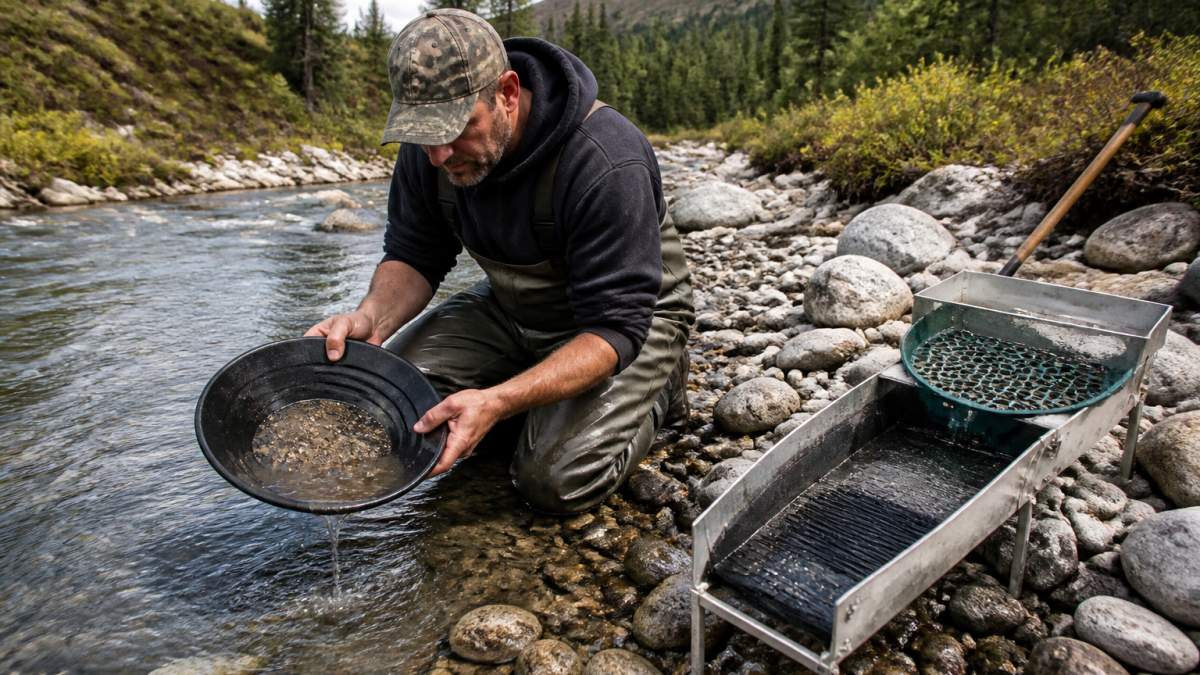
Core Tools You'll Use on Every Trip
Five tools do almost all the work on a hobby claim:
- Gold pan (14 to 17 inches) - your main separation tool
- Classifier set (1/2, 1/4, and 1/8 inch mesh) - screens out big rocks
- Snuffer bottle - sucks up fine gold and flour gold
- Hand trowel and utility shovel - moves paydirt into your pan
- Bucket and crevice tool - collects material and cleans bedrock cracks
A common mistake is buying a big kit with tools you'll never touch. Skip the trommel and dry washer until you know your ground.
Nice-to-Have Upgrades Worth Considering
Once the basics feel natural, three upgrades pay off. A sluice box processes far more material than panning alone. A recirculating system with a bilge pump lets you work away from running water.
Hold off on a PI detector. Those cost more and suit deep ground, not the shallow gravel most hobbyists work.
How to Choose the Best Gold Panning Kit for Beginners
The best gold panning kit for beginners includes a 14-inch pan, at least two classifiers, a snuffer bottle, and a scoop. Kits that skip the classifiers force you to pick out rocks by hand.
Look for these features:
- Pan size: 14 inches for general work, 10 to 12 for finishing
- Riffles: deep, sharp, and molded into the pan, not shallow bumps
- Material: plastic pans beat metal for fine gold recovery
- Color: black or green pans show gold better than yellow or red
- Classifier mesh: 1/2 inch for coarse work, 1/8 inch for concentrates
Most beginners do fine with a mid-range kit.
Gold Prospecting Laws and Regulations You Need to Know
Gold prospecting laws and regulations vary by state and land agency, and the most common reason a hobbyist gets a citation is working ground they assumed was open. Before you dig, confirm who manages the surface, whether the minerals are under an active claim, and what tools the state allows without a permit.
Federal Land: Which Agency Controls What
Most open federal ground falls under the Bureau of Land Management recreation and prospecting rules or the U.S. Forest Service. The two agencies treat hobby prospecting differently, and the rules can change between districts.
- Bureau of Land Management land generally allows casual, non-commercial prospecting with hand tools. A hand pan, shovel, trowel, and non-motorized sluice are typically fine. Motorized equipment usually triggers a notice or permit requirement.
- National Forest land usually allows panning and small-scale sluicing under district rules, but some forests restrict water work during fish spawning windows.
- National parks and monuments prohibit prospecting outright. So do most wilderness areas and national recreation areas with special designations.
- Military reservations, tribal land, and state trust land each have their own rules and often require written permission.
Pull up the agency's land status map before you go. In a patchwork of private inholdings, you can cross from open ground onto private ground without a fence or sign.
How to Check Whether Ground Is Under an Active Claim
This is the step most beginners skip.
Federal mining claims are recorded with the Bureau of Land Management and indexed in its public mining claim records system.
A practical field check:
- Identify the township, range, and section from a topographic map or GPS app.
- Search the BLM claim records for that section.
- Look for corner monuments, claim posts, or notices posted at access points.
- If a claim is active, find the holder and ask. Many claim holders allow recreational panning with a signed permission form.
A claim is not the same as a lease or a patented mining property. A patented property is private land and follows trespass law, not mining law.
State Rules: Permits, Seasons, and Tool Limits
States layer their own rules on top of federal rules, and thresholds vary widely. A few patterns show up across most states:
- Motorized equipment such as dredges, highbankers, and power sluices almost always requires a permit, and some states have banned suction dredging outright or restricted it to specific rivers.
- Sluice boxes are usually allowed without a permit at hobby scale, but some states cap the width or restrict use to certain seasons to protect fish habitat.
- Water work in salmon, steelhead, or trout streams is often closed during spawning and incubation windows, typically fall through spring.
- Quantity limits apply in some states. A common cap is a small number of ounces per year for recreational permits.
Check the state's department of fish and wildlife as well as the state geology or mining agency. Fish and wildlife rules govern the water; the mining agency governs the claim and equipment.
Claims, Permits, and Permission: A Quick Decision Path
- Open federal ground, hand tools only: usually no permit needed. Confirm no active claim.
- Open federal ground, sluice box: check state and district rules. Some require a free or low-cost notice.
- Open federal ground, motorized equipment: expect a permit, a fee, and a bonding requirement in some states.
- Active claim: get written permission from the claim holder.
- Private or patented land: get written permission from the landowner.
- Park, monument, or wilderness area: do not prospect.
Rules change and enforcement varies. Verify current requirements with the managing agency before you travel, and keep a copy of any permit or permission letter in your vehicle.
Sluice Boxes, Classifiers, and Concentrate Processing
A sluice box is a long, riffled channel that uses flowing water to catch heavy minerals while lighter gravel washes away. Classifiers are screens that sort material by mesh size before it hits the sluice or pan. Together they speed up gold recovery more than any other pair of tools.
Setting Up a Sluice Box for Maximum Gold Recovery
Set the sluice where water runs fast enough to move gravel but not so fast it scours your riffles clean. Angle matters more than most people think: too flat and material clogs, too steep and fine gold washes straight through.
A few setup rules:
- Level the box side to side before you adjust the angle
- Feed material slowly and evenly, never in big dumps
- Classify first so rocks don't block the riffles
- Check your riffles every 20 to 30 minutes
Why Classifiers and Mesh Size Matter
Mesh size decides what reaches your pan. Run everything through a 1/2 inch classifier first, then 1/4 inch, then 1/8 inch for concentrates. Fine gold and flour gold sit in the smallest mesh, so skipping the fine screens loses the gold that's hardest to recover and easiest to wash away.
Maintaining and Repairing Your Gold Prospecting Gear
Most gear guides stop at what to buy. The bigger gap is what to do when a pan cracks, a riffle mat tears, or a pump clogs mid-trip. A little repair knowledge keeps you digging instead of driving home and stretches a starter kit across multiple seasons.
A Field Repair Kit That Fits in a Daypack
You do not need a full workshop. A small pouch with these items handles most breakdowns:
- Self-fusing silicone tape for patching a cracked pan or sealing a leaking hose
- Two-part epoxy putty that cures underwater for sluice and pump repairs
- Stainless wire and crimps for reattaching riffle mat edges
- A multi-tool with pliers and a file for straightening and sharpening
- Spare riffle mat section cut to fit your sluice
- Spare snuffer bottle seal and a length of clear tubing
- Zip ties and a small roll of duct tape for quick fixes that buy you time
Experienced hobbyists carry a duplicate of the one or two parts most likely to fail on their specific setup, not a generic kit.
Repairing a Cracked Gold Pan
Plastic pans crack along the rim or at the base of a riffle where flex concentrates stress. A crack through a riffle will shed fine gold, so fix it before it grows.
- Rinse and dry the pan completely. Epoxy will not bond to wet or silty plastic.
- Roughen the area around the crack with sandpaper or a file.
- If the crack is short, apply self-fusing silicone tape under tension, overlapping the crack by at least an inch on each side.
- If the crack is structural, knead two-part epoxy putty and press it into the crack from both sides. Smooth the inside surface so it does not trap or shed gold.
- Let it cure per the package directions before use.
A pan with a crack longer than a couple of inches, or one that has cracked at the base of a riffle more than once, is usually worth replacing, a compromised riffle costs more in lost fine gold than a new pan.
Replacing and Reconditioning a Sluice Riffle Mat
Riffle mat is the working surface of a sluice and wears out faster than the box itself. Miner's moss, expanded metal over carpet, and rubber riffle mat all degrade differently.
Signs the mat needs attention:
- Riffles are flattened or rounded rather than sharp
- Carpet or moss is matted, torn, or shedding fibers
- Fine gold is washing out the end of the box even at correct angle and flow
- Mat has separated from the box and is lifting at the edges
Replacement steps:
- Remove the old mat and scrape the box clean. Adhesive residue prevents the new mat from seating flat.
- Cut the new mat to size with a small margin, then trim to fit. A mat that buckles will create dead zones where gold does not settle.
- Secure the leading edge under the flare or header box so water cannot lift it.
- Fasten the trailing edge with stainless wire or the manufacturer's clips. Avoid mild steel, which rusts and stains the mat.
- Run a test pan of known material to confirm the new mat is catching fine gold before you commit a full day to it.
A riffle mat typically lasts one to two seasons of regular use. Sharp, angular gravel wears it faster than rounded river gravel.
Pump and Recirculating System Care
Recirculating systems and highbankers fail most often at the pump intake. Silt, plant matter, and small gravel clog the strainer and starve the pump, which can burn out the impeller.
- Rinse the intake strainer after every use, not just at the end of the season.
- Flush the pump housing with fresh water to clear fine silt.
- Inspect the impeller for nicks and replace it if the pump loses prime or flow drops.
- Store the pump dry and indoors. Freezing water in the housing cracks the casing.
- Check hose clamps and fittings for cracks before each trip. A pinhole leak in the intake line causes the pump to suck air and lose prime.
End-of-Trip Routine That Prevents Most Failures
Rinse everything with fresh water before it dries. Salt, silt, and grit cause most of the wear hobbyists blame on cheap gear. A ten-minute routine after each trip prevents most of the repairs above:
- Rinse pan, classifiers, and snuffer bottle. Work the snuffer bottle seal with fresh water to clear grit.
- Rinse and dry the sluice mat and box separately. Do not stack wet mat on wet box.
- Flush the pump and dry the housing.
- Wipe metal tools with a light oil to prevent rust.
- Inspect riffle mat, seals, and hose fittings for wear. Note anything that needs replacing before the next trip.
Ethical and Environmental Responsibilities for Prospectors
Every prospector leaves a mark. The goal is to leave as little as possible. Fill your holes, don't cut banks, and never work spawning gravels during fish season.
A few habits that keep you welcome on public land:
- Refill every hole before you leave
- Stay out of streambanks and sensitive habitat
- Pack out all trash, including old gear
- Follow local seasonal restrictions on water work
- Never use mercury or chemicals on a hobby claim
The Environmental Protection Agency guidance on water quality sets the broader framework states build on, and most agencies expect hobbyists to follow the same care.
Regional gear needs are real, too. Desert prospectors rely on dry washers because there's no water. Northern prospectors need waders and cold-weather layers.
Conclusion: Building Your Gear Collection Over Time
The hardest part of prospecting isn't finding gold. It's resisting the urge to buy every tool before you've learned the ground under your feet.
Start with the four core tools. Add classifiers, then a sluice, then a detector only when your ground calls for one.
For collectors who want a real piece of the adventure, Parker's Gold offers genuine raw placer gold sourced from Parker Schnabel's Dominion Creek operation, presented in a handcrafted tri-fold display case with an official Certificate of Authenticity. Every package ships fully insured, tracked, and signature-required.
Claim yours and own a verified piece of Yukon gold history.
Frequently Asked Questions
What is the best gold panning kit for beginners?
A solid starter kit includes a 12- to 14-inch plastic pan with riffles, a classifier with 1/4-inch or 1/2-inch mesh, a snuffer bottle for fine gold, and a hand trowel. Look for kits that bundle these items together. Plastic pans are lighter and cheaper than metal, and they won't rust. Add a small vial for storing your concentrates. You can always upgrade individual pieces as you learn what works in your local creeks and rivers.
Do I need a permit for recreational gold prospecting?
It depends on where you're prospecting. Federal lands managed by the Bureau of Land Management generally allow recreational panning without a permit, but sluicing and dredging may require additional authorization. Many states have their own rules for state-owned waterways and parks. Always check with the federal agency or state office that manages the land before you go. Some areas are closed to prospecting entirely, and claim owners have exclusive rights to minerals on their claims.
What is the difference between a gold pan and a sluice box?
A gold pan is a handheld tool you swirl with water to separate heavy minerals from lighter material. It's slow but portable and works in almost any water source. A sluice box is a larger, stationary device that uses water flow and riffles to process far more material in less time. Most hobbyists start with a pan, then add a sluice box once they've identified a promising spot. You still need a pan to finish processing the concentrates a sluice box captures.
How do I choose the right gold prospecting gear for my budget?
Start with the basics: a quality pan, a classifier, and a snuffer bottle. These three items handle most recreational prospecting and cost relatively little. Add a sluice box if you plan to work larger volumes of gravel. Metal detectors are a bigger investment and make sense if you're hunting nuggets in dry or bedrock areas. Buy the best pan and classifier you can afford first, since those are the tools you'll use most. Upgrade other gear as your skills and interests grow.
The gear is the easy part. The hard part is knowing your gold is real. Parker's Gold solves that with raw placer gold from Dominion Creek, a Certificate of Authenticity in every box, and insured, signature-required delivery. Claim yours and add a verified piece of the Gold Rush to your collection.