

Table of Contents
- What Makes Raw Placer Gold Valuable
- Understanding Gold Purity and Fineness
- How Spot Price and Market Volatility Affect Value
- Nuggets vs. Dust: Why Size and Form Matter
- How to Value Gold Nuggets and Determine Weight
- Where to Buy Raw Placer Gold Online
- Tax and Legal Considerations for Raw Gold Ownership
- Conclusion
- Frequently Asked Questions
Last Updated: September 29, 2026
What Makes Raw Placer Gold Valuable
Raw placer gold valuable because it represents both tangible precious metal and historical significance. Unlike processed bullion, placer gold retains the story of its origin, the geological conditions that formed it, and the labor required to extract it from riverbeds and alluvial deposits. This combination of intrinsic metal value and collectible appeal drives prices well beyond simple spot price calculations.
The value of raw placer gold depends on several interconnected factors. First, there's the actual gold content measured in troy ounces or grams. Second, there's the premium buyers pay for authenticity and provenance. Third, there's market sentiment around precious metals and collector demand. When you hold a piece of placer gold in your hand, you're holding something that took geological time to form and human effort to recover, which commands respect in the marketplace.
Consider what separates a piece of authenticated placer gold from generic scrap gold. Scrap gold is melted down and loses its story. Placer gold, especially when it comes from legendary operations like those featured on Discovery Channel's Gold Rush, retains its narrative. Collectors pay substantially more for that narrative than for the raw metal alone. At Parker's Gold, we source directly from Parker Schnabel's Dominion Creek operation in the Yukon, which means each piece carries verified provenance that justifies premium pricing.

Understanding Gold Purity and Fineness
Gold purity describes how much pure gold exists in a sample, measured in fineness or karats. Fineness is expressed as parts per thousand, so 999 fineness means 99.9% pure gold. Karat measures purity on a 24-point scale, where 24 karat is pure gold. This distinction matters because placer gold is rarely pure, it typically contains trace amounts of silver, copper, and other metals from the host rock where it formed.
Raw placer gold from alluvial deposits typically ranges from 800 to 950 fineness, depending on the geological source. Gold recovered from Dominion Creek in the Yukon tends toward the higher end of this range because the specific geology of that region produces relatively clean gold. However, even high-fineness placer gold contains impurities that affect its refining value but enhance its collectible appeal.
Fineness directly impacts melt value. A 1-gram piece of 900 fineness gold contains 0.9 grams of pure gold. Multiply that by the current spot price per troy ounce, and you have a baseline value. But here's where collectors diverge from investors: they often pay premiums that exceed melt value because they value the natural form, the host rock still attached, and the authenticity of origin.
Testing fineness requires professional assay work. Hobbyists cannot reliably determine fineness by sight or simple testing methods. This is why certification matters so much. When Parker's Gold includes an official Certificate of Authenticity with each purchase, it documents the fineness and weight, removing guesswork from the equation.
How Spot Price and Market Volatility Affect Value
The spot price of gold sets the floor for any raw gold's value. Spot price fluctuates daily based on global market conditions, currency movements, geopolitical events, and central bank policy. A 1-gram piece of placer gold at 950 fineness will always be worth at least its metal equivalent at the current spot price, but often significantly more.
Market volatility creates opportunity and risk. When spot prices rise, all gold becomes more valuable, including placer gold. When prices fall, collectors sometimes step in because they're buying for reasons beyond pure metal value. They're acquiring a piece of history, a tangible connection to mining operations, and a displayable asset that works in conversation.
Placer gold has an advantage over bullion coins in volatile markets. Bullion's value tracks spot price almost exactly. Placer gold's value includes a collectible premium that doesn't move lockstep with spot price. This premium can remain stable or even increase when spot prices decline, because demand from collectors operates on different logic than demand from investors or refiners.
Understanding this split is crucial. If you buy raw placer gold purely as a precious metals investment, you're overpaying compared to buying standard bullion. If you buy it as a collectible with metal backing, the premium makes sense because you're acquiring something that cannot be duplicated. Parker's Gold positions placer gold in this second category, as a collectible first, with precious metal value as a floor beneath it.
Nuggets vs. Dust: Why Size and Form Matter
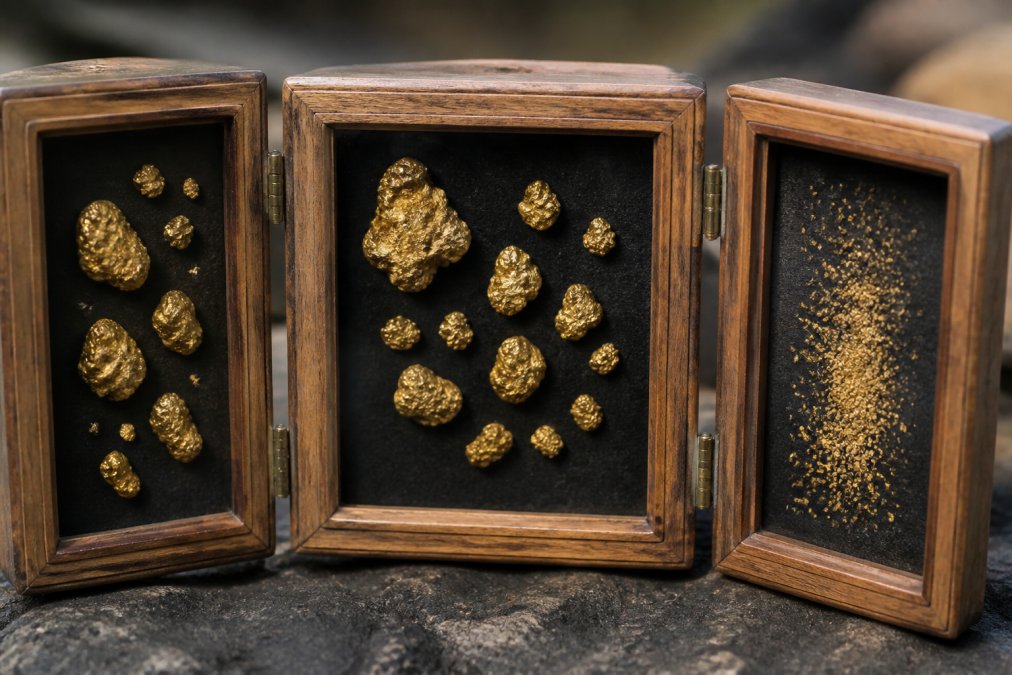
Gold nuggets command dramatically higher premiums than gold dust, even when the total weight and fineness are identical. A 1-gram nugget might sell for 2-3 times the price of 1 gram of gold dust because nuggets are rarer, more visually striking, and more collectible. Nuggets form under specific geological conditions where gold particles consolidate into larger masses rather than remaining as fine particles dispersed through sediment.
Parker Schnabel Yukon Gold Flakes →
Gold dust and gold flakes are the most common forms of placer gold. They're recovered from alluvial deposits through panning, sluicing, or small-scale mining operations. Dust particles are typically under 1 millimeter. Flakes range from 1 millimeter to several millimeters. Neither form is rare, which is why their value tracks closer to spot price with minimal collectible premium.
Nuggets, by contrast, are geological anomalies. They form when gold particles bond together over time, creating consolidated masses. Nuggets larger than 10 grams are genuinely scarce. A 10-gram nugget from a verified source like Dominion Creek becomes a conversation piece, a display item, and a serious collectible. The rarity premium reflects this scarcity.
Size also affects display value. A handful of gold dust in a vial looks like... gold dust. A visible nugget in a display case tells a story. This is why Parker's Gold packages placer gold in handcrafted tri-fold display cases with embossed gold detailing. The presentation transforms the gold from raw material into a displayable collectible. The form factor matters as much as the metal content.
How to Value Gold Nuggets and Determine Weight
Determining the accurate weight of placer gold requires a precision scale capable of measuring to at least 0.01 grams. Hobby scales are insufficient, they introduce error that compounds when calculating value. Professional assay scales, available from scientific suppliers, measure to 0.001 grams and provide the accuracy needed for fair pricing.
Once you have accurate weight, convert to troy ounces if you're comparing to spot price. One troy ounce equals 31.1035 grams. A 3-gram piece of placer gold equals approximately 0.0965 troy ounces. Multiply that by the current spot price per troy ounce, then adjust for fineness.
Where to Buy Raw Placer Gold Online
Buying raw placer gold online requires vetting sellers carefully. The market includes legitimate collectors, fraudsters, and everyone in between. Verified sources provide documentation, offer buyback guarantees, and maintain transparent pricing. Unverified sources often misrepresent fineness, overstate weight, or source gold from questionable origins.
Tax and Legal Considerations for Raw Gold Ownership
Owning raw placer gold in the United States carries tax implications you should understand before purchasing. The IRS classifies precious metals, including raw gold, as collectibles for capital gains tax purposes. This means if you purchase placer gold for $200 and later sell it for $300, the $100 gain is subject to capital gains tax.
Conclusion
Raw placer gold valuable because it bridges two worlds: the tangible, measurable world of precious metals and the intangible, emotional world of collecting and history. The metal content provides a floor value. The story, authentication, and rarity provide the premium that makes the purchase meaningful. When you own a piece of placer gold from Parker Schnabel's Dominion Creek operation, you own a verified fragment of Yukon mining history, presented in a display case that honors its significance and backed by documentation that protects your investment.
Frequently Asked Questions
What makes raw placer gold different from refined gold bars?
Raw placer gold is natural gold recovered from alluvial deposits, retaining its original form as nuggets, flakes, or dust. Refined gold bars have been processed, melted, and cast into standardized shapes. Raw placer gold often commands a premium because collectors value its geological authenticity, natural appearance, and connection to mining history. The spot price of both is based on troy ounce weight and purity, but raw gold's unique character and rarity can increase its collectible value beyond its melt value.
How do I verify the authenticity of raw placer gold?
Authentic raw placer gold should come with documentation proving its origin and recovery location. A Certificate of Authenticity from a reputable source is essential. You can also perform basic tests: genuine gold is non-magnetic, has high density (specific gravity around 19.3), and doesn't tarnish or corrode. For high-value purchases, consider third-party assay testing through a certified precious metals lab. Reputable sellers like Parker's Gold provide official certificates, batch numbers, and detailed fact sheets to verify authenticity.
Is raw placer gold a good investment for beginners?
Raw placer gold works better as a collectible than as a financial investment. Beginners should understand that value depends on purity, weight, and market spot price, but collectible premiums are subjective and harder to predict than bullion prices. If you're buying for investment purposes, focus on weight in troy ounces and current spot price. If you're buying for collecting, especially pieces with historical significance or unique provenance like gold from legendary mining operations, the emotional and historical value may matter more than financial returns.
Does the geological origin of placer gold affect its market value?
Yes, significantly. Placer gold from famous mining regions or legendary operations carries historical and collectible premiums beyond its melt value. Gold from documented sources with verified provenance, such as Parker Schnabel's Dominion Creek operation featured on Discovery Channel's Gold Rush, attracts collectors willing to pay more for authenticity and the story behind the gold. Host rock composition, alluvial deposit characteristics, and the rarity of the recovery location all influence collectible value, even though the spot price is based solely on weight and purity.