

Table of Contents
- Why Raw Gold Flakes Need Specific Storage Conditions
- Step 1: Clean and Dry Your Raw Gold Flakes Before Storage
- Step 2: Choose the Best Containers for Raw Gold Flakes
- Step 3: Control Moisture, Temperature, and Light in Your Storage Environment
- Step 4: Track and Document Your Gold Flake Inventory
- Step 5: Where to Buy Raw Placer Gold Online with Verified Authenticity
- Common Mistakes to Avoid When Storing Raw Gold Flakes
- Frequently Asked Questions
Last Updated: September 21, 2026
Why Raw Gold Flakes Need Specific Storage Conditions
Raw gold flakes are not inert like a gold bar. They are raw placer gold, and that difference matters for how to store raw gold flakes long term. This guide from Parker's Gold walks through the steps.
How Raw Placer Gold Differs from Refined Gold
Refined gold is melted and purified until almost nothing else remains. Raw flakes keep trace silver, copper, and iron from the ground.
The Role of Mineral Impurities and Moisture
Moisture is the main threat: water trapped against a flake slowly discolors it and leaves a dull film.
Step 1: Clean and Dry Your Raw Gold Flakes Before Storage
Never store raw gold flakes straight from the pan. Dirt, clay, and mineral residue will keep working on the metal inside the container.
Tools You Need for Safe Cleaning
Gather these before you start:
- A soft-bristle brush for loosening dirt
- Fine tweezers for moving individual flakes
- A small glass bowl for rinsing
- Distilled water, not tap water
- A lint-free cloth for blotting
Keep your tools clean between uses. A dirty brush just moves contaminants around.
Drying Methods That Prevent Trapped Moisture
Air-dry flakes on a lint-free cloth for several hours, spread out so air reaches every side.
Step 2: Choose the Best Containers for Raw Gold Flakes
The best containers for raw gold flakes are small borosilicate glass vials with screw-on caps and an inert gasket. Glass does not react with gold, and a tight cap limits humid air reaching the metal.
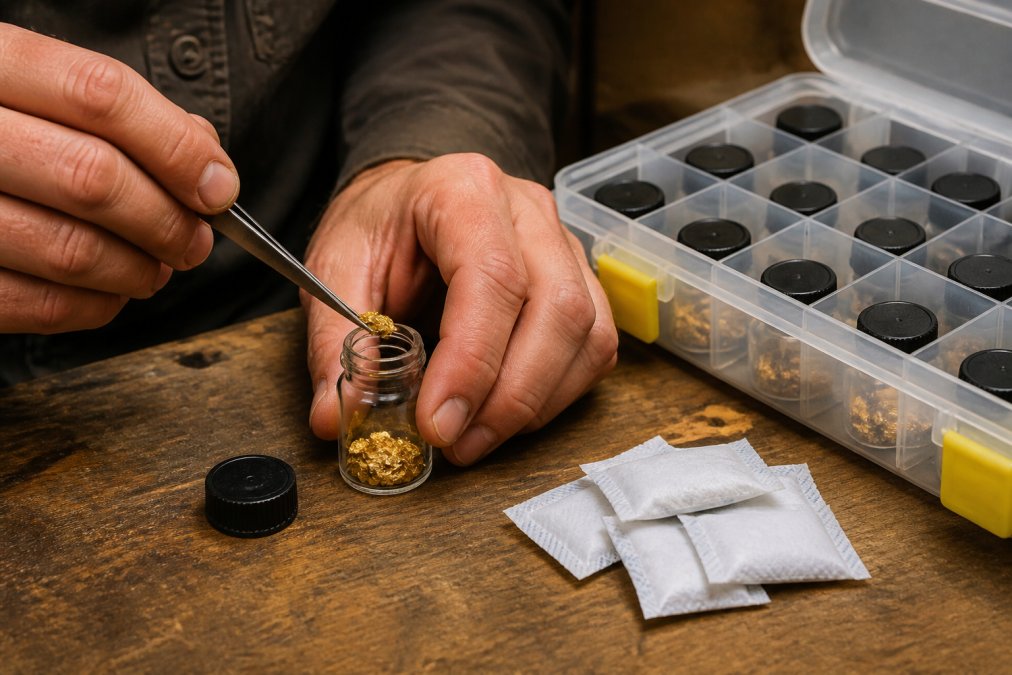
Look for these features:
- Borosilicate or clear flint glass body (borosilicate resists thermal shock if you ever move the collection between rooms)
- Screw-on cap with a PTFE-lined or silicone gasket, PTFE is the more inert of the two
- Small internal volume to limit trapped air
- Amber or dark glass if you want light protection without a separate box
- A cap that threads fully, not a push-in stopper that can pop loose in a safe
Glass Vials vs. Plastic Vials: Which Protects Better?
Glass wins for long-term storage: it is chemically inert, so it will not react with the gold or leach chemicals into the vial, and it resists scratching, scratches in plastic trap dirt and mineral residue that hold moisture against a flake.
Micro-Storage Solutions for Small Quantities
This matters most for fine flakes and gold powder. A large vial with a few flakes leaves too much air space, and every time you open the cap you exchange the dry air inside for room air.
- Glass screw-top micro-vials (roughly 1-4 mL): the standard for fine flakes and powder. Small internal volume means little trapped air and a short exchange every time you open it.
- Glass ampoules: sealed by flame, so they are effectively airtight. The trade-off is that you must break the glass to open them, which is a one-way decision. Reserve these for material you do not plan to touch.
- Coin capsules with foam inserts: useful for a single larger flake you want to display. The foam holds the flake in place, but foam can hold moisture, so pair it with a desiccant in the surrounding box.
- Double containment: a micro-vial inside a second, larger glass jar with a desiccant packet between them. This is the belt-and-suspenders approach for a collection you will not open for years.
Matching the Container to the Purity and Cleanliness of the Flakes
Raw placer gold is not uniform: some flakes come out of the pan nearly clean, others carry black sand, clay, or iron staining. That difference should drive your container choice.
- Uncleaned flakes: store them separately from cleaned material. Residual clay and salts can hold moisture and will keep working on the metal inside the vial. Clean first, then seal.
- Mixed purity levels: do not combine flakes of different purity in one vial. Trace metals in lower-purity flakes can tarnish at different rates, and if one flake develops a film, it can affect the flakes around it. Keep batches separate and labeled.
- Flakes with visible iron staining: these are the most likely to discolor over time. Give them their own vial and a fresh desiccant, and check them more often than clean material.
Step 3: Control Moisture, Temperature, and Light in Your Storage Environment
Moisture control is the core of long-term gold storage. Gold itself does not rust, but the trace metals in raw placer gold, silver, copper, iron, react with moisture and oxygen. Water vapor condenses on the flake, dissolves trace salts from panning, and forms a thin electrolyte film that lets those trace metals corrode, showing up as a dull or discolored patch.
Humidity: What to Aim For and How to Get There
A common target is below about 50% relative humidity, and lower is better as long as you avoid condensation swings. A cheap hygrometer in the storage box tells you what you are actually dealing with instead of guessing.
Temperature: Why Swings Matter More Than the Number
Temperature swings cause condensation: a vial that warms by day and cools at night pulls moisture from the air inside and deposits it on the flakes. Store your collection in a cool, dark spot away from windows and heating vents.
Light: What It Actually Damages
Gold itself does not fade in light. What light damages is everything around it: display cases, labels, paper certificates, and any foam or fabric. Ultraviolet light is the worst offender, which is why a display piece left in a sunny room can look tired after a few years even though the gold is fine.
A Simple Storage Environment Checklist
- Hygrometer in the storage box, checked periodically
- Silica gel packet in each box, replaced or regenerated on schedule
- Dehumidifier in basements and coastal homes
- Cool, dark location away from windows and vents
- Display case stored separately from the working stock
- Vials sealed, not opened just to look at the gold
Step 4: Track and Document Your Gold Flake Inventory
Documentation protects value. A labeled record proves what you have and where it came from.
Keep a simple log with these fields:
- Date acquired
- Weight in grams
- Source or seller
- Purity estimate if known
- Vial or box location
Step 5: Where to Buy Raw Placer Gold Online with Verified Authenticity
Buying raw placer gold online carries real risk. Placer gold is easy to fake, and paperwork is easy to forge.
Common Mistakes to Avoid When Storing Raw Gold Flakes
Most storage failures trace back to a few avoidable errors:
- Sealing flakes before they are fully dry
- Using plastic bags for long-term storage
- Skipping desiccants in humid climates
- Storing vials in direct sunlight
- Mixing different purity levels in one vial
- Throwing away certificates and receipts
- Handling flakes with bare fingers
| Mistake | Fix | Why It Matters |
|---|---|---|
| Sealing damp flakes | Air-dry 24 hours first | Prevents tarnish and dull film |
| Plastic bags | Switch to glass vials | Stops vapor transfer over time |
| No desiccant | Add silica gel packets | Controls humidity in the vial box |
| Sunlight exposure | Store in a dark box | Protects labels and display case |
| Bare-hand handling | Use fine tweezers | Stops skin oils from transferring |
| Lost paperwork | Scan and store copies | Protects resale value |
Frequently Asked Questions
Does raw gold degrade or tarnish over time?
Pure gold does not tarnish or corrode, but raw placer gold flakes can appear dull over time if stored improperly. The culprit is usually surface contaminants, mineral impurities, or moisture trapped in the container. Gold flakes with higher silver or copper content may develop a slight discoloration. Storing your raw gold flakes in airtight containers with desiccants and keeping humidity levels low prevents this. Clean your flakes before storage and inspect them every six to twelve months to catch any changes early.
Is it safe to store raw gold flakes in plastic vials?
Plastic vials work for short-term storage, but they are not ideal for long-term preservation. Some plastics release trace chemicals over time and are more permeable to moisture than glass. If you must use plastic, choose inert, archival-grade polyethylene or polypropylene vials with screw-on caps. For the best protection, glass vials with airtight screw-on caps and a silica gel packet inside the outer container keep your raw gold flakes stable for decades. Always verify the plastic is labeled inert and acid-free.
What are the best containers for storing small amounts of placer gold?
For small quantities, glass vials with screw-on caps are the top choice because glass is inert, does not react with gold, and creates a strong moisture barrier. Look for borosilicate glass vials with tight-sealing caps. Place the vial inside a larger airtight container with silica gel packets for extra moisture control. For display pieces, a handcrafted display case with a Certificate of Authenticity, like those from Parker's Gold, keeps raw placer gold both protected and presentable. Avoid bags or envelopes that allow particle loss.
Do I need a safe for storing raw gold flakes at home?
A safe is not required by law, but it is a practical choice if your collection has significant value. A home safe protects against theft, fire, and accidental loss. For smaller collections, a locked fireproof box stored in a cool, dark location works well. If you are storing gold flakes from a verified source like Parker's Gold, keep the Certificate of Authenticity with the gold. That documentation matters for insurance claims and future resale. Pair physical security with an inventory log listing weight, purity, and storage date.