

Table of Contents
- What You'll Need Before You Start Testing
- The Magnet Test: How to Tell If Gold Is Real With a Magnet
- The Water Displacement Test for Raw Gold Purity
- Using a Gold Acid Testing Kit Safely at Home
- The Ceramic Scratch Test and Touchstone Method
- Reading Hallmarks, Stamps, and Certificates of Authenticity
- When Home Testing Fails: Professional Appraisal vs DIY
- Frequently Asked Questions
Last Updated: October 1, 2026
What You'll Need Before You Start Testing
Testing raw gold purity at home starts with a simple truth: most "gold" that fails a home test was never gold to begin with. This guide from Parker's Gold walks through seven proven methods, ranked from safest to most aggressive.
Raw gold is unrefined metal found as flakes, grains, or nuggets. It is not the same as finished jewelry. Raw placer gold often sits between 70 and 95 percent purity, with silver, copper, and other metals making up the rest.
Gather these supplies before you begin:
- A strong neodymium magnet
- A digital scale accurate to 0.01 grams
- A graduated measuring cup or small beaker
- Unglazed ceramic tile or a black touchstone slate
- A gold acid testing kit with nitric acid
- Safety goggles, nitrile gloves, and a respirator
- A well-ventilated workspace near an open window
The Magnet Test: How to Tell If Gold Is Real With a Magnet
Gold is non-magnetic. If a magnet sticks to your piece, it contains iron or steel and is not pure gold.
- Place your gold on a flat, non-metal surface.
- Bring a strong magnet slowly toward the piece.
- Watch for any pull or jump.
Why Non-Magnetic Doesn't Guarantee Real Gold
Plenty of non-magnetic metals look like gold. Brass, copper, and tungsten all pass the magnet test. Tungsten is especially tricky because its density is close to gold's.
The Water Displacement Test for Raw Gold Purity
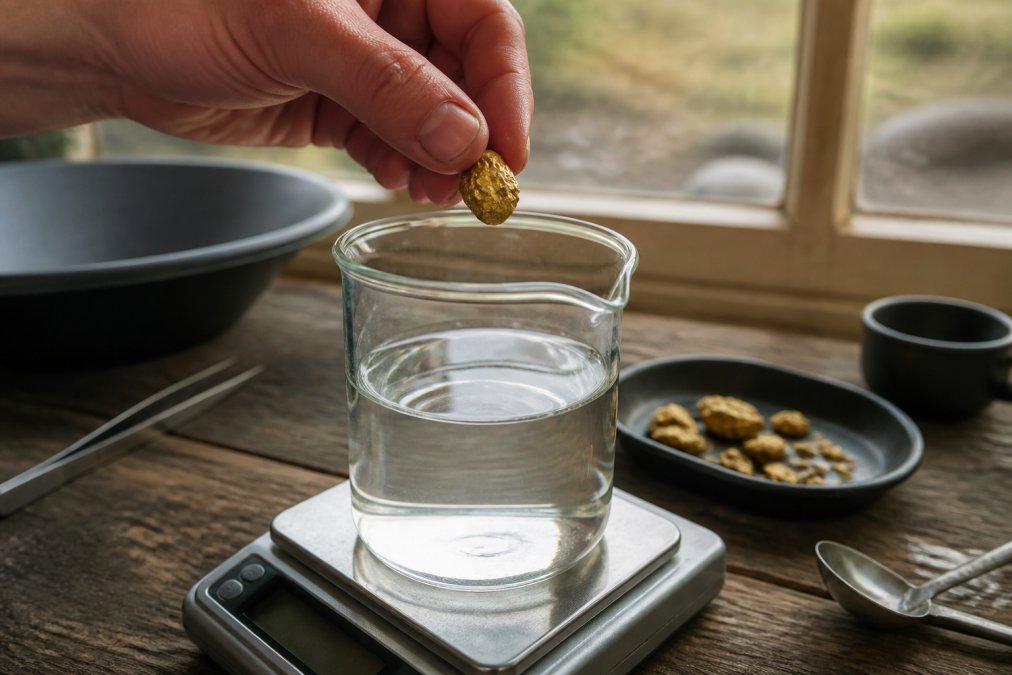
The water displacement test estimates purity by measuring density. Gold is dense, about 19.3 grams per cubic centimeter when pure, so a real piece feels noticeably heavy for its size. This is the single most useful non-destructive test for raw gold, because nuggets and flakes carry no hallmarks to read.
Step-by-Step: Weigh, Submerge, Divide
- Weigh your gold on a digital scale accurate to 0.01 grams. Record the dry weight in grams.
- Fill a graduated cylinder or narrow beaker with distilled water. Note the exact starting level in milliliters. A narrow container gives you a finer reading than a wide measuring cup.
- Submerge the gold fully. Tap the container gently or use a thin wire to dislodge air bubbles clinging to the surface, trapped air is the number-one cause of a false low reading.
- Record the new water level. Subtract the starting level. That difference is the volume in milliliters (1 mL = 1 cm³).
- Divide the dry weight in grams by the volume in milliliters. The result is your specific gravity.
Reading the Result
| Specific Gravity | Likely Composition |
|---|---|
| 19.3 | Pure (24K) gold |
| 17.0-18.5 | Roughly 90-95% gold, common for placer nuggets |
| 15.0-17.0 | 70-85% gold with silver or copper |
| 12.0-15.0 | Low-purity alloy or heavily mixed specimen |
| Under 10.0 | Gold plating or gold-filled over a base metal |
Raw placer gold commonly falls in the 15 to 18 range because silver and copper occur naturally alongside it. A reading in that band is normal, not a red flag.
Why Raw Gold Breaks the Standard Test
Jewelry is uniform and solid, so a single density reading is reliable. Raw gold is not. Nuggets are irregular, sometimes porous, and occasionally hollow. A porous specimen traps air and reads low. A nugget with a quartz inclusion reads low because quartz has a specific gravity near 2.65. Before you trust a low number, inspect the piece under a loupe for visible host rock and re-run the test after a short soak in water to displace trapped air.
Digital Density Testing: A More Accurate Alternative
Digital density testers automate the math. You weigh the piece dry, then weigh it suspended in water, and the device applies Archimedes' principle to display specific gravity directly. Some units also let you input an estimated alloy composition to output a purity estimate.
Using a Gold Acid Testing Kit Safely at Home
A gold acid testing kit gives the most reliable home result short of professional equipment. The kit uses nitric acid, and in some formulations hydrochloric acid, to see how the metal reacts. Different karat test solutions are calibrated to dissolve everything below a target purity, so the reaction itself tells you the karat range.
What's Actually in the Kit
A standard kit contains:
- A black touchstone slate for rubbing a streak
- Dropper bottles of test acid, typically labeled 10K, 14K, 18K, and 22K
- A bottle of nitric acid for base-metal detection
- Sometimes a bottle of aqua regia (a nitric and hydrochloric acid mix) for testing high-karat or refined gold
Each karat solution is designed to react only with metal below that purity. A 14K solution, for example, will not affect 14K or higher gold but will dissolve 10K and lower.
The Streak-and-Acid Method
- Rub the raw gold firmly on the touchstone to leave a visible streak. A thin, even streak reads more clearly than a thick smear.
- Apply one drop of the lowest test solution first, usually 10K. Watch for 30 seconds.
- If the streak holds, move up to the next solution. Repeat until the streak reacts.
- The last solution the streak survives tells you the approximate karat.
For raw gold, this is more reliable than dropping acid directly on the nugget, because a streak exposes fresh metal and the reaction is easier to read against the black slate.
Reading the Reaction
- No reaction, streak stays bright: purity at or above the solution's rating
- Streak fades or turns brown: purity below the solution's rating
- Streak fizzes or dissolves: the metal is not gold, or is heavily alloyed
- Greenish reaction: often indicates copper or a copper-heavy alloy
Always run a known real gold piece alongside your unknown sample. The side-by-side reaction tells you far more than the unknown alone, because acid behavior varies with temperature and streak thickness.
Ventilation and Safety Gear You Cannot Skip
Nitric acid is corrosive and its fumes can damage lung tissue. Hydrochloric acid is worse. Aqua regia, which combines the two, releases toxic fumes and must never be used indoors without serious ventilation.
The Ceramic Scratch Test and Touchstone Method
The ceramic scratch test checks for a gold streak. Rub the raw gold against an unglazed ceramic tile.
Reading Hallmarks, Stamps, and Certificates of Authenticity
A hallmark is a stamped mark that shows metal purity and maker. Common stamps include 10K, 14K, 18K, and 24K.
Here is what each stamp means:
| Stamp | Karat | Gold Content |
|---|---|---|
| 10K | 10/24 | About 42% gold |
| 14K | 14/24 | About 58% gold |
| 18K | 18/24 | About 75% gold |
| 24K | 24/24 | Nearly pure gold |
When Home Testing Fails: Professional Appraisal vs DIY
Home tests have real limits. They cannot confirm origin, and they struggle with gold-filled or vermeil pieces that mimic solid gold.
Get a professional appraisal when:
- The piece is worth more than your test kit cost
- You plan to insure or resell it
- The magnet or acid result is unclear
- You need documented proof of authenticity
Frequently Asked Questions
What is the easiest way to test if gold is real?
The magnet test is the fastest starting point. Real gold is non-magnetic, so if a strong magnet pulls your piece, it contains iron or another magnetic base metal. However, passing the magnet test only rules out certain fakes. Many non-magnetic metals like copper and brass will also pass. For a stronger signal, follow up with a density check using a digital scale and a measuring cup, or use a gold acid testing kit for a definitive answer on purity.
How does the magnet test work for raw gold?
Raw placer gold is non-magnetic because gold itself has no magnetic properties. When you hold a strong neodymium magnet near your nugget or flakes, nothing should happen. If the magnet sticks or the gold moves toward it, the piece contains iron, steel, or another magnetic alloy. Keep in mind that non-magnetic does not equal real gold. Copper, brass, and tungsten are also non-magnetic, so use the magnet test as a first filter, not a final verdict.
Can vinegar test gold?
Vinegar is too weak to react with gold or most gold alloys at room temperature. It will not confirm purity or authenticity. Some people use vinegar to clean tarnish and oxidation from gold surfaces, but that is a cleaning step, not a test. For actual purity testing, nitric acid in a gold acid testing kit is the standard chemical method. Vinegar simply does not have the reactive strength to distinguish gold from gold plating or base metal.
What are the risks of using DIY gold testing methods?
The main risks are damaging your piece and misreading results. Acid testing kits contain nitric acid, which burns skin and produces fumes that require ventilation and safety gear. The scratch test leaves a visible mark on your gold. Density tests can go wrong if your scale is not precise or if air bubbles cling to the gold in water. For high-value raw gold or items with collector significance, a professional jewelry appraisal or assay is safer and more reliable than any home method.
Testing raw gold at home gives you a solid first read, but it cannot replace documented proof. That is exactly why Parker's Gold ships every order with an official Certificate of Authenticity, a handcrafted tri-fold display case, and fully insured, tracked, signature-required delivery. Own a verified piece of Yukon history from Parker Schnabel's Dominion Creek operation. Claim yours and showcase gold you can actually trust.