

Table of Contents
- What Counts as a Raw Gold Specimen
- How to Identify Real Gold in Rocks
- Raw Gold Specimen Valuation: What Actually Drives the Price
- The Case for Collecting Raw Gold: Pros
- The Risks and Drawbacks: Cons
- Best Practices for Storing Gold Specimens
- Exit Strategy: How to Sell Raw Gold Later
- Conclusion
- Frequently Asked Questions
Last Updated: September 30, 2026
What Counts as a Raw Gold Specimen
A raw gold specimen is naturally occurring gold that has not been melted, refined, or reshaped into a bar or coin. It still carries the texture, host rock, or placer-worn surface it had when it came out of the ground.
Raw gold shows up in three main forms.
Placer Gold vs. Lode Gold vs. Gold Ore
Placer gold has broken free of its original rock and been moved by water, showing up as flakes, dust, and nuggets in streambeds. Tumbling rounds the edges and often brightens the surface.
| Type | How It Forms | Typical Appearance | Collector Appeal |
|---|---|---|---|
| Placer gold | Water-worn, freed from rock | Flakes, dust, rounded nuggets | High for display |
| Lode gold | Still in the host vein | Gold in quartz or rock | High for specimens |
| Gold ore | Gold locked in bulk rock | Dull, mostly rock | Low, mostly industrial |
How to Identify Real Gold in Rocks
Identifying real gold comes down to testing physical properties, not eyeballing color. Gold has a specific gravity near 19, far denser than almost anything else in a streambed.
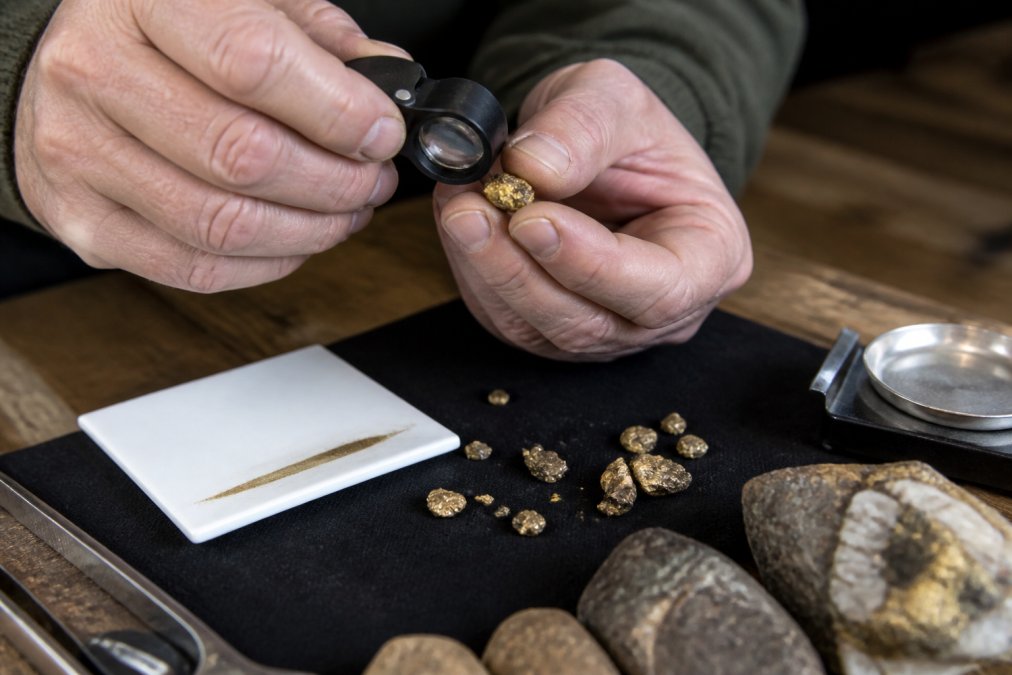
Field Tests: Streak, Specific Gravity, and Malleability
Three tests separate real gold from pretenders, none requiring a lab.
- Streak test: Rub the sample on an unglazed porcelain plate. Real gold leaves a gold-colored streak. Pyrite leaves a greenish-black one.
- Specific gravity: Weigh the specimen, then weigh it suspended in water. Gold's density is roughly 19 times that of water, so a real piece feels surprisingly heavy for its size.
- Malleability: Gold bends and dents without breaking. Pyrite is brittle and shatters or crumbles under pressure.
Raw Gold Specimen Valuation: What Actually Drives the Price
Raw gold specimen valuation rests on two numbers buyers constantly confuse: melt value (what the gold is worth if destroyed) and collector premium (what someone will pay to keep it intact). Knowing how each is calculated, and where they diverge, separates a fair price from overpaying for a story.
Melt Value: The Floor Under Every Specimen
Melt value tracks the spot price of gold, which moves daily. A dealer multiplies the weight of pure gold by the current spot price, a simple formula with tricky inputs.
- Weight is measured in troy ounces or grams, not standard ounces. A troy ounce is about 10% heavier than a standard ounce, and mixing the two units is one of the most common pricing errors in the hobby.
- Purity for raw gold is rarely 100%. Placer gold commonly runs 70-95% depending on the deposit, with silver, copper, and trace metals making up the balance. Lode specimens with visible quartz can be far lower in gold content by weight.
- Recovery loss matters too. A refiner does not pay for the host rock, packaging, or metal lost in processing. Expect a refining fee and a deduction for impurities.
Collector Premium: The Part That Is Subjective
Collector premium is everything above melt value, and it rewards specific, identifiable traits:
- Size. Large nuggets are rare. A nugget above roughly an ounce commands attention; multi-ounce pieces are genuinely uncommon and premium scales with rarity.
- Crystallinity. Well-formed cubic, octahedral, or wire gold crystals are prized because they show the metal's natural structure. A crystallized specimen can carry a premium many times its melt value.
- Matrix and contrast. Gold in white quartz or contrasting host rock displays better than gold in dull brown rock, and display quality drives collector demand.
- Shape. Intricate, recognizable, or unusually balanced shapes, sometimes called "character" pieces, sell above generic flakes.
- Provenance. A documented origin, especially a named mining operation or historically significant locality, adds a verifiable story that anonymous placer gold cannot match.
- Condition. Scratches, dents, cleaning damage, and glue residue all reduce premium. Original surface texture is part of the value.
The Premium-to-Melt Ratio: A Useful Mental Model
Experienced collectors think in a premium-to-melt ratio: a generic placer flake trades at or slightly above melt, a nice display nugget at two to five times melt, and an exceptional crystallized or documented specimen far higher, though those sales are infrequent and hard to benchmark.
Why Pricing Is Less Standardized Than Bullion
Bullion has a live, public, dealer-to-dealer market with tight spreads. Raw specimens do not. There is no single exchange price for a nugget. Pricing comes from auction results, mineral show sales, dealer inventories, and private transactions, sparse and inconsistent data points.
The Case for Collecting Raw Gold: Pros
Collecting raw gold specimens offers tangible value, historical connection, and genuine scarcity that mass-produced bullion cannot match. A gold bar is one of millions. A specific nugget is one of one.
The strongest arguments for collecting:
- Tangible scarcity. Natural specimens cannot be reproduced. Each one is unique.
- Historical weight. Placer gold from a named mining operation connects you to a real place and time.
- Dual value. You hold both a precious metal and a collectible, so the piece has two potential markets.
- Display appeal. Crystallized gold and well-formed nuggets look striking in a case.
- Gift potential. A documented specimen makes a far more memorable gift than a generic coin.
The Risks and Drawbacks: Cons
The drawbacks of raw gold are real, and the biggest is liquidity: raw specimens are harder to sell than bullion because the buyer pool is smaller and pricing is less standardized.
Liquidity, Taxes, and Market Volatility
Liquidity is the core problem. A bullion dealer will buy a standard coin in minutes. A raw specimen may sit for months until the right collector appears, and that collector may only pay melt value if the premium doesn't appeal to them.
The single biggest risk in raw gold collecting isn't fraud or price swings. It's illiquidity. Buy only what you'd be comfortable holding for years, because selling quickly usually means selling at melt value.
Best Practices for Storing Gold Specimens
Storing gold specimens properly protects both the metal and its collector value. Gold resists corrosion, but the host rock, packaging, and environment can degrade over time, where careless collectors quietly lose money.
Environmental Controls That Actually Matter
Gold is inert, but the materials around it are not. The goal is to slow chemical and physical change in the host rock, matrix minerals, and specimen surface.
- Humidity. Pyrite and other sulfide minerals in host rock oxidize with moisture and oxygen, producing acid that can pit the gold and crumble the matrix. Keep relative humidity low and stable; a sealed container with a desiccant pack is a simple, effective control.
- Temperature stability. Fluctuating temperatures drive condensation and can stress fragile matrix. A climate-stable interior closet beats an attic, garage, or basement.
- Light. Ultraviolet light fades labels, degrades some plastics, and can accelerate breakdown of certain minerals. Store specimens out of direct sunlight.
- Airborne contaminants. Household cleaners, aerosols, and even some woods and adhesives release vapors that can tarnish or etch. Avoid storing specimens near cleaning supplies or in unfinished wooden cabinets.
Packaging and Handling
Packaging choices affect both preservation and resale value.
- Use acid-free holders, inert plastic cases, or archival foam. Avoid paper, cardboard, and PVC-based plastics that can leach chemicals or off-gas over time.
- Handle with nitrile or cotton gloves. Skin oils and salts dull surfaces and can leave residues that are hard to remove without damaging the specimen.
- Do not clean specimens aggressively. Abrasive cleaning, acid dips, and ultrasonic cleaners can strip natural patina and destroy collector premium. When in doubt, leave it alone.
- Keep the Certificate of Authenticity with the piece, ideally in the same protected container, so provenance and object stay together.
Insurance: Why a Standard Policy Usually Falls Short
This is the gap most collectors discover only after a loss. A standard homeowner's or renter's policy typically caps coverage for precious metals, collectibles, or both, often far below the value of a serious collection. Raw specimens are frequently classified as collectibles or minerals rather than bullion, which changes how a claim is evaluated.
- Scheduled items. Each specimen is listed individually with an agreed value. This gives certainty at claim time but requires documentation and periodic updates.
- Blanket coverage. A single limit covers the collection. Simpler to maintain, but individual items may be subject to sub-limits and the burden of proof falls more heavily on you.
Appraisal: Melt Value vs. Collector Value
Insurers and buyers need a documented value, and raw specimens are typically appraised as minerals or art objects rather than precious metal. That means the appraisal should separate melt value from collector premium and explain the basis for the premium.
Long-Term Degradation: The Quiet Risk
Gold will not rust, but specimens are not pure gold. The failure modes to watch for:
- Sulfide oxidation. Pyrite, marcasite, and similar minerals in host rock can oxidize and crumble, sometimes producing visible acid damage. This is the single most common cause of specimen deterioration.
- Efflorescence. Some minerals leach soluble salts that crystallize on the surface, clouding the specimen and damaging the matrix.
- Physical damage. Soft gold surfaces scratch easily, and fragile matrix can crack under handling or vibration.
- Packaging failure. Adhesives yellow and fail, plastics become brittle, and labels fade, all of which can separate a specimen from its provenance documentation.
Photograph each specimen next to its Certificate of Authenticity and store the images separately from the piece. If a claim or a resale ever comes up, that pairing proves both what you owned and where it came from, and it is the fastest way to satisfy an insurer's documentation requirement.
Exit Strategy: How to Sell Raw Gold Later
Selling raw gold later works best when you plan the exit before you buy. The buyer pool splits into refiners who pay melt value and collectors who may pay a premium.
A few logistics that make the sale smoother:
- Keep original packaging and paperwork intact.
- Get a current appraisal before listing.
- Sell into strength, when spot price is high.
- Expect to negotiate; premium is subjective.
Conclusion
The pros and cons of collecting raw gold specimens balance on one question: do you want a liquid investment or a piece you enjoy owning? Raw gold wins on uniqueness, history, and display value; it loses on liquidity, tax treatment, and the patience required to sell well.
Frequently Asked Questions
Is collecting raw gold a good investment?
It depends on what you buy. Raw gold specimens carry both melt value, based on the current spot price, and a collector premium that can push prices well above the metal's weight. Investment-grade pieces from documented sources hold value better than generic placer gold. However, raw specimens are less liquid than bullion, so treat them as a long-term hold rather than a quick flip.
How do you verify the authenticity of raw gold specimens?
Start with documentation. A Certificate of Authenticity that names the source, batch number, and weight gives you a paper trail. For the gold itself, a streak test leaves a gold-yellow line on unglazed porcelain, fool's gold leaves greenish-black. Specific gravity testing can confirm density. For high-value pieces, a professional assay removes all doubt.
What is the difference between placer gold and lode gold specimens?
Placer gold is found in stream beds and gravel deposits, worn into flakes, nuggets, or dust by water over time. Lode gold is still embedded in quartz or host rock, extracted from veins. Placer gold tends to have higher purity and smoother shapes. Lode specimens often show crystallized gold structures that collectors prize for their intricate shapes, even when the gold content is lower.
How should raw gold specimens be stored and displayed?
Keep specimens away from moisture, extreme temperature swings, and household chemicals. A padded display case or sealed capsule prevents scratches and limits exposure to air, which can dull surface luster over years. If you display pieces openly, keep them out of direct sunlight and handle them with gloves. Store your Certificate of Authenticity separately in a fireproof safe or safe deposit box.