

Table of Contents
- Raw Gold vs Bullion: What's the Real Difference
- How Spot Price Works and Why It Matters
- Gold Bullion Premium Over Spot Price
- Raw Gold Purity and Fineness: Understanding Metal Content
- Raw Gold Value Per Gram vs Market Price
- How to Sell Raw Gold: Real Costs and Buyback Offers
- Making Your Choice: Raw Gold or Bullion
- Frequently Asked Questions
Last Updated: October 10, 2026
Raw Gold vs Bullion: What's the Real Difference
When comparing raw gold vs bullion, the distinction matters because the price you pay and receive depends on form, purity, and market conditions.
Raw gold refers to placer gold (flakes and dust from mining), scrap gold, or natural nuggets. Bullion is refined, standardized metal cast into bars or coins with guaranteed purity and weight. This shapes cost, liquidity, and recoverable value.
At Parker's Gold, we work directly with miners to source authentic raw placer gold from the Yukon. Understanding the real value of raw gold versus bullion helps collectors and investors make informed decisions about what to buy and why.

How Spot Price Works and Why It Matters
The spot price is the live market price for one troy ounce of pure gold, quoted in dollars per ounce and updated constantly during trading hours.
The spot price is theoretical, what you'd get for pure, refined gold delivered instantly to a major buyer. Your actual transaction price differs by a gap called the premium.
Raw gold premiums are wider: you pay more when buying (for extraction and processing) and receive less when selling (buyer must refine it). Bullion premiums are smaller because purity is already verified.
Gold Bullion Premium Over Spot Price
A bullion premium is the markup above spot price, covering production, distribution, and profit.
Premiums vary by form (bars lower than coins), size (one-ounce bars 3-5%, fractional bars 8-12%), and demand cycles.
Raw gold premiums reflect refining, assaying, and processing costs. Collectors pay for authenticity verification and provenance, not just metal content.
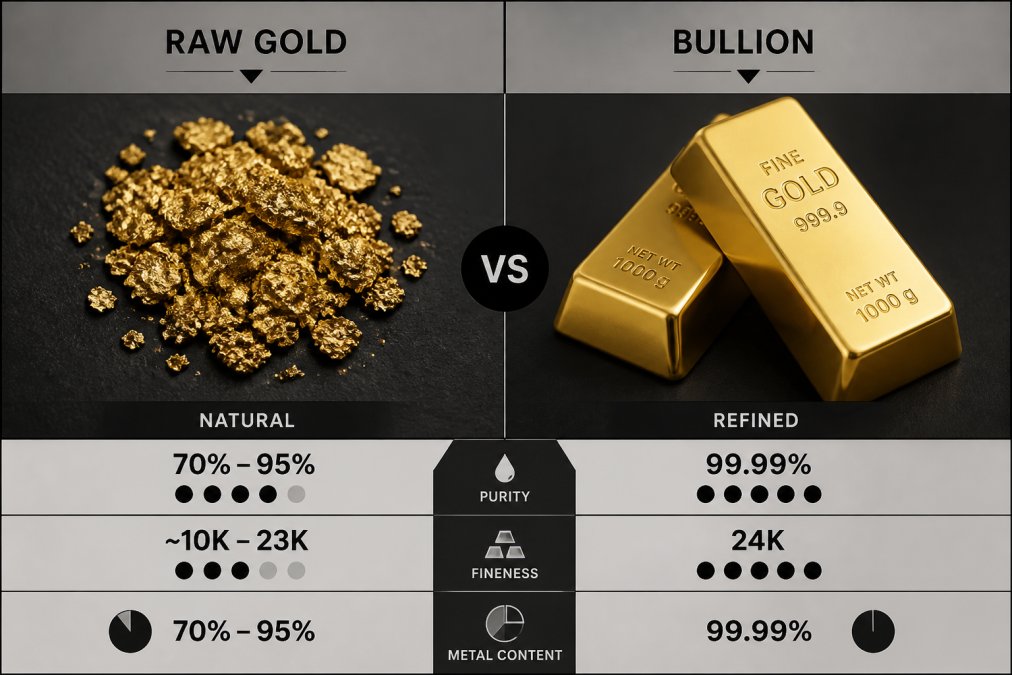
Raw Gold Purity and Fineness: Understanding Metal Content
Raw gold purity is expressed in fineness (0.999 = 99.9% pure) or karats (24 karat = pure, 18 karat = 75% pure).
Raw placer gold is typically 85-95% pure, containing silver, copper, and trace elements. You only own the gold fraction: a gram of 90% pure raw gold contains 0.9 grams of actual gold value.
Bullion is refined to 99.9%+ purity, making it easier to sell because purity is known. Raw gold requires assay verification, adding cost and complexity.
Always calculate based on actual gold content, not weight. One gram of raw gold at 90% fineness contains less recoverable gold than one gram of 99.9% bullion.
Raw Gold Value Per Gram vs Market Price
Gold is quoted per troy ounce (31.1 grams). At $2,000 per troy ounce, pure gold is approximately $64.30 per gram.
Your actual raw gold value depends on fineness, the percentage of pure gold in your sample. Weight alone doesn't tell you what you own.
Worked Example: Raw Gold Valuation
Let's say you have 10 grams of raw placer gold from a mining operation. An assay report shows it's 88% pure (0.88 fineness). Here's how to calculate its actual value:
- Calculate recoverable gold content: 10 grams × 0.88 = 8.8 grams of pure gold
- Convert to troy ounces: 8.8 grams ÷ 31.1 grams per troy ounce = 0.283 troy ounces
- Apply spot price: 0.283 troy ounces × $2,000 per troy ounce = $566 in pure gold value
- Subtract refining costs: Refiners typically charge 10-20% of the gold's value to process raw material, verify purity, and cast it into standard form. At 15%, that's $566 × 0.15 = $84.90
- Net value after refining: $566 − $84.90 = $481.10
This is what you might expect to receive if you sold to a refiner.
Worked Example: Bullion Valuation
Now compare that to a one-ounce gold bullion bar (99.9% pure):
- Weight in troy ounces: 1 troy ounce (by definition)
- Apply spot price: 1 troy ounce × $2,000 per troy ounce = $2,000 in pure gold value
- Subtract dealer spread: Bullion dealers typically buy at 1-3% below spot. At 2%, that's $2,000 × 0.02 = $40
- Net value at sale: $2,000 − $40 = $1,960
The bullion bar has no refining costs and no assay uncertainty. You know exactly what you own and what you'll receive.
Per gram of recoverable gold, raw gold nets ~$54.67 after all costs, while bullion nets ~$63 after dealer spread. Bullion outperforms because there are no refining fees or assay uncertainty.
How Purity Affects Your Bottom Line
Raw gold purity ranges from 70-95%, with lower purity meaning higher refining costs as a percentage of recovered gold. Bullion eliminates this variable at 99.9%+ purity.
Calculate based on actual gold content, not weight. Factor in refining costs, dealer spreads, and assay fees to determine which form offers better value for your timeline.
How to Sell Raw Gold: Real Costs and Buyback Offers
Selling raw gold is fundamentally different from selling bullion because raw gold requires verification before a buyer will pay.
The Dealer Spread and Why It Exists
When you sell raw gold to a dealer, the dealer faces several costs before they can resell or refine it:
- Assay cost: Testing purity and weight. Professional assay runs $15-$50 per sample depending on the testing method and the dealer's volume.
- Refining cost: Converting raw gold into standard bars or ingots. Refiners charge 10-20% of the gold's value, or a flat fee per ounce, depending on the refiner and the purity of the incoming material.
- Holding cost: The dealer must store and insure the gold while processing it, which takes time.
- Market risk: Between the time the dealer buys from you and sells the refined product, the spot price could move. The dealer builds in a buffer.
- Profit margin: The dealer needs to make money on the transaction.
These costs add up to a dealer spread of 15-30% below the calculated pure gold value. A dealer might offer you 70-85 cents on the dollar of the pure gold content you've verified.
Real-World Buyback Scenarios
Parker Schnabel Yukon Gold Flakes – Dominion Creek Collector Package →
Scenario 1: In-Person Sale to a Local Dealer
You bring 50 grams of raw gold to a local precious metals dealer. They:
- Weigh it: 50 grams
- Perform a quick assay (fire assay or XRF): 87% pure
- Calculate pure gold: 50 × 0.87 = 43.5 grams = 1.40 troy ounces
- Apply spot price: 1.40 troy ounces × $2,000 = $2,800 in pure gold value
- Apply dealer discount: 20% discount = $2,800 × 0.80 = $2,240 offer
You walk out with $2,240 cash. The dealer keeps $560 to cover assay, refining, storage, and profit.
Scenario 2: Mail-In Refinery Program
You send the same 50 grams to a refinery via insured mail:
- Refinery receives and weighs it
- Performs detailed assay: 87% pure (confirms your estimate)
- Calculates pure gold: 43.5 grams = 1.40 troy ounces
- Applies refining fee: 15% of value = $420
- Applies buyback discount: 10% = $280
- Sends payment: $2,800 − $420 − $280 = $2,100
You receive $2,100 after waiting 1-2 weeks and paying shipping (typically $10-$30 insured). The refinery processes the gold and sells it as refined bars.
Scenario 3: Selling Bullion for Comparison
You sell a one-ounce gold bar (99.9% pure) to the same dealer:
- Dealer verifies weight and purity visually (no assay needed)
- Applies spot price: 1 troy ounce × $2,000 = $2,000
- Applies dealer spread: 2% = $40
- Offers: $2,000 − $40 = $1,960
You walk out with $1,960 immediately. No assay, no refining costs, no delays.
Why Raw Gold Offers Are Lower
Compare the three scenarios:
- Raw gold (in-person): $2,240 received on $2,800 pure value = 80% of spot
- Raw gold (mail-in): $2,100 received on $2,800 pure value = 75% of spot
- Bullion: $1,960 received on $2,000 pure value = 98% of spot
The raw gold offers are lower because the dealer must assay, refine, and process the material. The bullion offer is tighter because the product is already standardized and verified.
How to Evaluate a Buyback Offer
When a dealer makes an offer on raw gold, ask for a breakdown:
- What assay method did they use? Fire assay is most accurate but slower. XRF (X-ray fluorescence) is faster but less precise for mixed alloys. Acid testing is quick but destructive.
- What purity did they find? Compare it to any previous assay reports you have.
- What is the refining fee? Ask if it's a percentage or a flat rate. 10-15% is reasonable; above 20% is high.
- What is the dealer spread? Subtract the refining fee from their offer. The remaining discount should be 5-15%. Anything above 20% suggests the dealer is taking excess profit.
- Is shipping and insurance included? For mail-in programs, confirm whether the dealer pays or deducts it from your payment.
Red Flags in Buyback Offers
- Dealer refuses to assay in front of you. Reputable dealers will test while you watch or provide a written assay report.
- Offer is significantly below comparable dealers. Get quotes from at least two dealers before accepting.
- Dealer pressures you to sell immediately. Legitimate dealers give you time to think and compare offers.
- No written offer. Always get the offer in writing with the purity, weight, and price clearly stated.
- Dealer claims they can't test certain forms. Legitimate dealers can assay placer gold, nuggets, dore, and scrap. If they refuse, find another dealer.
Bullion's Liquidity Advantage
Bullion sells faster and at tighter spreads because there's no assay step. A one-ounce gold bar or coin has a known purity and weight. Dealers can quote you a price in seconds.
If you need to convert your gold to cash quickly, bullion is the better choice.
Making Your Choice: Raw Gold or Bullion
Choose raw gold if you're buying for the narrative and authenticity. Parker's Gold's Dominion Creek collection offers exactly this: genuine placer gold from Parker Schnabel's legendary Yukon operation, presented with a Certificate of Authenticity and handcrafted display case.
Choose bullion if you're buying for pure metal value and liquidity. You want to know your exact holdings and sell quickly without assay costs or delays.
Consider your timeline. Bullion works for investors planning to buy and sell within months or years. Raw gold works for collectors planning to hold indefinitely or gift to others who value the provenance.
Consider your budget. The Parker Schnabel Yukon Gold Flakes Dominion Creek Collector Package starts at $199.00 for 1 gram, offering verified authenticity and presentation. Bullion bars of comparable weight cost less upfront but lack the collector story.
Consider your exit strategy. If you might need to sell quickly, bullion's faster liquidity and tighter bid-ask spreads matter.
Raw gold vs bullion isn't about which is objectively better. It's about matching the form to your purpose. Understand the spot price, the premiums, and the purity before you buy. Then decide whether you're buying metal or a story.
Frequently Asked Questions
What is the difference between raw gold and bullion?
Raw gold is unrefined placer gold or nuggets recovered directly from mining, containing natural impurities and varying purity levels. Bullion refers to refined gold bars or coins cast to a specific fineness (usually 99.9% pure) and standardized weight. Raw gold requires assaying to determine actual gold content, while bullion's value is immediately clear from its marked weight and purity stamp.
Is raw gold worth more than gold bullion?
No. Raw gold is worth less than bullion because it contains impurities and requires processing to extract pure gold. The spot price reflects refined gold value. Raw gold's actual worth depends on its fineness (typically 70-90% pure) and processing costs to recover the fine gold. Bullion trades at or near spot price plus a small premium, while raw gold trades at a discount reflecting refining expenses.
How do you calculate the raw gold value per gram?
Multiply the current spot price per gram by the gold's fineness percentage, then subtract estimated refining and assay costs (typically 5-15% of recovered value). Example: 1 gram of raw gold at 85% fineness, with spot price at $65 per gram, yields 0.85 × $65 = $55.25 in recoverable gold, minus $5-$8 in processing costs, for a net value around $47-$50 per gram.
How much less is raw gold worth than refined gold?
Raw gold typically sells for 10-20% less than refined bullion of equivalent fine gold content, depending on purity, processing costs, and market conditions. The discount reflects assay fees, refining labor, and time to process. A sample of raw placer gold at 80% fineness might net $52 per gram in recoverable gold value, while 1 gram of refined bullion at current spot price could be $60-$65, illustrating the real-world gap.
When you're ready to own a tangible piece of Yukon history, Parker's Gold delivers verified raw placer gold from Parker Schnabel's Dominion Creek operation. Each package includes an official Certificate of Authenticity, handcrafted display case, and fully insured, signature-required shipping. The gold is real. The story is real. Claim yours today.