

Table of Contents
- Why Unrefined Gold Is a Different Animal Than Bullion
- The 7 Biggest Risks of Buying Unrefined Gold Online
- How to Verify Raw Gold Authenticity Before You Pay
- Legal Requirements for Buying Gold Online
- What Legitimate Sellers Do Differently
- Frequently Asked Questions
Last Updated: September 25, 2026
Why Unrefined Gold Is a Different Animal Than Bullion
Buying unrefined gold online means purchasing raw placer flakes, doré bars, or nuggets that have not been smelted into standardized bullion, and the risks start with one uncomfortable fact: the price you pay rarely matches the metal's actual worth. This guide from Parker's Gold breaks down the seven biggest hazards and shows you how to verify raw gold authenticity before money changes hands.
Bullion is predictable: a one troy ounce minted bar carries a known purity, a recognized hallmark, and a spot price anyone can look up in seconds. Unrefined gold carries none of that certainty. Its purity varies wildly, its weight often includes embedded quartz or host rock, and its value depends on what a refiner can extract after smelting.
That gap between what you pay and what you actually own is where most online buyers get hurt.
The Refining Cost Breakdown Nobody Shows You
Raw gold rarely pencils out for a retail buyer because the price you pay reflects gross weight, while the value you receive reflects only the recoverable gold after a refiner takes its cut.
A refiner's economics typically stack several deductions on top of each other:
- Treatment or smelting charge. A flat fee per lot to melt, sample, and process the material, regardless of how much gold it contains.
- Refining charge. A per-troy-ounce fee, or a percentage of the contained gold, to purify the metal to a marketable standard.
- Assay fee. A charge to determine actual gold content, often billed separately from the refining itself.
- Metal loss allowance. A refiner may deduct a small percentage to cover gold that is unrecoverable during processing.
- Minimum lot thresholds. Many refiners will not process small quantities economically, which means a retail buyer's few ounces can be uneconomic to refine at all.
Stack those together and the effective cost of turning raw material into a sellable ounce of fine gold can run well above the premium on a minted bar. The buyer pays for gross weight, the refiner pays for net recoverable gold, and the difference is the buyer's loss.
There is also a purity reality to confront. Placer gold is rarely pure, commonly assaying in the range of roughly 70 to 95 percent gold, with the balance made up of silver, copper, and other metals, plus embedded rock and black sand. Until an assay is run, nobody, including the seller, knows the true number.
The raw-versus-bullion comparison is not really about spot price at all. It is about recoverable content versus gross weight, and about who absorbs the refining cost. On a minted bar, that cost is baked into a transparent premium; on raw gold bought online, it lands on you, usually after you have already paid.
Raw Placer Gold vs. Minted Bars: Spot Price Gaps and Liquidity
Raw placer gold and minted bars diverge on two critical measures: pricing transparency and how fast you can sell. A minted bar trades at a small premium over spot price, typically a few percent, and any dealer will buy it back the same day. Raw placer gold sells at a premium that can run far higher, and finding a buyer takes work.
Placer gold is recovered from stream beds and gravel deposits, often as small flakes or dust. Because it has not been assayed or smelted, its exact purity is unknown until a refiner tests it, and sellers price it on estimates that almost always favor the seller.
The liquidity problem compounds this.
The 7 Biggest Risks of Buying Unrefined Gold Online
The seven core risks of buying unrefined gold online are counterfeit product, stolen goods, market volatility, hidden premiums, resale difficulty, storage exposure, and legal exposure. Each can wipe out a purchase's value, and several tend to appear together.
Parker Schnabel Yukon Gold Flakes →
| Risk | What It Looks Like | How to Reduce It |
|---|---|---|
| Counterfeit | Tungsten-filled bars, gold-plated base metal | Demand assay results and weight verification |
| Stolen goods | No provenance, seller avoids documentation | Require chain of custody paperwork |
| Market volatility | Price drops between purchase and delivery | Buy only what you can hold long-term |
| Hidden premiums | Fees disclosed after payment | Get total cost in writing before paying |
| Resale difficulty | No buyer at your asking price | Buy authenticated, documented pieces |
| Storage exposure | Theft, loss, damage | Use insured, signature-required shipping |
| Legal exposure | Unreported transactions, tax gaps | Keep records and report properly |
Counterfeit and Stolen Goods
Counterfeiting is the oldest trick in precious metals, and unrefined gold is easier to fake than bullion because there is no standard to check against. A common method involves drilling out a gold bar and filling the cavity with tungsten, which has a density close to gold.
Market Volatility and Hidden Premiums
Gold prices move daily, and unrefined gold amplifies that movement because its true gold content is uncertain. A purchase priced on an optimistic purity estimate can lose value the moment a refiner's assay finds less gold than claimed.
Resale and Liquidity Problems
Reselling unrefined gold is harder than most buyers expect. Refiners buy raw material but charge for the privilege, deducting refining costs and applying their own purity assumptions. Individual collectors are a thin market, and without authentication paperwork, most will not touch raw gold at all.
How to Verify Raw Gold Authenticity Before You Pay
Verifying raw gold authenticity before payment is the difference between a sound purchase and an expensive lesson. Legitimate verification combines physical testing, documentation review, and seller scrutiny.
- Request assay documentation. An assay reports the actual gold content of a sample. Any serious seller provides one from an accredited lab.
- Check specific gravity. Gold has a density of roughly 19.3 grams per cubic centimeter (Composition of GOLD). A specific gravity test compares the sample's weight in air and in water to estimate purity. Tungsten-filled fakes often fail this test.
- Inspect for hallmark or batch marks. Legitimate operations stamp or log their output. A batch number ties a specific piece to a specific recovery run.
- Review chain of custody records. These documents trace the gold from recovery through storage to sale. Gaps in the chain are a red flag.
- Confirm dealer reputation independently. Check reviews, business registration, and whether the seller has a verifiable physical operation.
Legal Requirements for Buying Gold Online
Legal requirements for buying gold online center on dealer registration, reporting thresholds, and tax obligations. Dealers must comply with federal anti-money-laundering rules, and certain transactions trigger reporting requirements. Buyers should also understand that profits from selling gold may be subject to capital gains tax.
How Raw Gold Is Taxed Differently Than Bullion
This is where unrefined gold can quietly cost you more than bullion. The tax treatment of raw gold is not identical to that of minted bars and coins, and the difference cuts against the raw buyer.
What Legitimate Sellers Do Differently
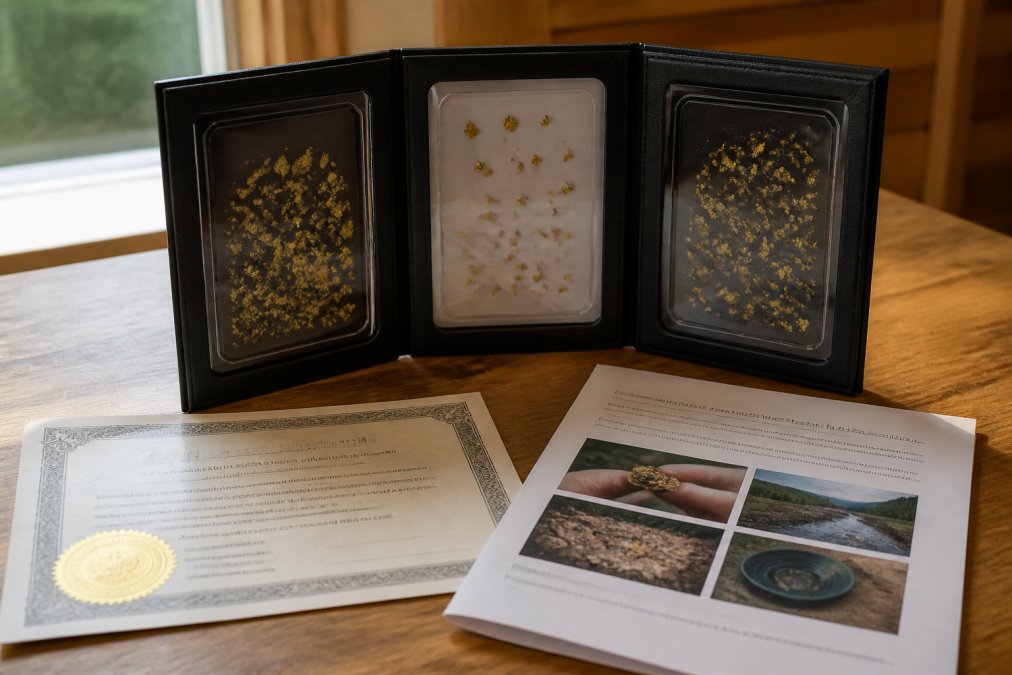
Legitimate sellers of raw gold separate themselves through documentation, shipping security, and transparency about what you are buying. They do not pressure buyers or dodge questions about provenance.
Frequently Asked Questions
What are the primary risks of buying raw gold online?
The biggest risks of buying unrefined gold online include counterfeit or altered material, stolen goods with no clean provenance, hidden dealer premiums that shrink your resale margin, and illiquidity if you need to sell quickly. Market volatility can also turn a purchase upside down between the time you pay and the time the package arrives. Without a verifiable Certificate of Authenticity and a documented chain of custody, you have little recourse if the metal turns out to be plated brass or diluted alloy.
How can you verify the authenticity of unrefined gold?
Start with the seller's documentation: a Certificate of Authenticity, batch number, and chain of custody record. At home, weigh the piece on a calibrated scale and compare it to the stated troy ounce weight. A specific gravity test using a graduated cylinder can flag obvious fakes, and a jeweler's acid test or XRF scan will confirm karat and purity. For high-value raw placer gold, an independent assay from a reputable lab is the only method that gives you defensible proof of purity and origin.
Does the IRS have specific reporting requirements for raw gold purchases?
The IRS treats physical gold, including raw and unrefined gold, as a capital asset. You are not required to report the purchase itself, but you must report any profit when you sell. Sales of certain precious metals that meet the IRS definition of reportable bullion may trigger a 1099-B from the dealer. Raw placer gold sold as a collectible may fall under the 28% collectibles capital gains rate rather than the standard long-term rate, so keep your receipts and Certificate of Authenticity on file.
What is the difference between placer gold and refined bullion?
Placer gold is naturally occurring raw gold recovered from streambeds and gravel deposits, usually 70 to 95 percent pure with visible impurities. Refined bullion has been smelted and purified to 99.5 percent or higher and stamped with a hallmark, weight, and purity. Bullion trades near the spot price and is highly liquid. Placer gold carries a premium for its origin and character but sells at a discount to spot on resale because it must be assayed and refined before it can enter the bullion market.