

Table of Contents
- What Authentic Gold Flakes Are Used For in Cooking and Plating
- Edible Gold Leaf Safety: What You Need to Know Before You Eat It
- Collecting Placer Gold Flakes: A Hobby With Real Value
- Step-by-Step: How to Apply Authentic Gold Flakes to Food
- Edible Gold vs. Craft Gold: Spotting the Difference
- How to Store Gold Flakes So They Keep Their Value
- Frequently Asked Questions
Last Updated: September 24, 2026
What Authentic Gold Flakes Are Used For in Cooking and Plating
Authentic gold flakes are edible pieces of pure gold, hammered until they are thinner than a human hair, and they are used mainly to decorate food and drink. Chefs press them onto desserts, cocktails, and savory plates to add shine and a sense of occasion. The gold adds no flavor. It adds attention.
So what are authentic gold flakes used for? Mostly two things: collecting and gifting. This guide covers both, plus how to spot real edible gold from the craft-store kind.
Garnishing Pastry, Confectionery, and Savory Dishes
Pastry chefs reach for gold leaf first. A single flake on a chocolate truffle turns a $3 candy into a $12 gift-box item. The same logic applies to:
- Wedding and anniversary cakes
- Macarons and chocolate bonbons
- Sushi and caviar service
- Cocktails and champagne
- Ice cream and plated desserts
Savory cooks use it more sparingly. A small piece on a steak or a spoon of caviar signals luxury without changing the recipe. The trick is restraint. Too much gold looks cheap fast.
Edible Gold Leaf Safety: What You Need to Know Before You Eat It
Edible gold leaf safety comes down to one fact: pure gold is biologically inert. Your body passes it through without absorbing it. That is why food-grade gold has been used for centuries without known harm.
The catch is purity. Real edible gold must be 23K or 24K, meaning 99% or purer. Lower-karat gold contains copper, silver, and other alloys that are not meant to be eaten.
The U.S. Food and Drug Administration lists gold under the name E175 as a permitted color additive for food.
How to Read a Gold Flake Label Like a Buyer, Not a Tourist
Most articles tell you to "buy edible gold" and stop there. The useful skill is knowing what a compliant label actually contains. A food-grade product sold in this market should carry, at minimum:
- The word "edible" somewhere on the package or the seller's product page, not "decorative," not "for craft use."
- A karat or purity statement, 23K or 24K, or a purity figure of 99% or higher.
- A color additive reference, the term "E175" or a line citing FDA color additive approval for gold.
- A net weight in grams or milligrams, edible leaf is sold by weight, not by sheet count alone.
- A lot or batch number, this is what lets a supplier trace a complaint back to a production run.
What "E175" Actually Tells You
E175 is the international food-additive code for gold. When a label carries it, the manufacturer is asserting the material meets the purity and identity standard for use as a color additive in food. That is a claim, not a guarantee, but it is a claim a legitimate supplier can back with documentation.
The Three Questions That Filter Out Bad Sellers
Ask these before you spend a dollar:
- What karat is it? Anything below 23K is not food grade.
- Is it labeled edible, and does the label carry E175 or an FDA color additive reference? Craft gold is not.
- Will you send documentation? A real supplier will. A reseller who dropships from a craft vendor will not.
If a listing dodges these questions, that is your answer.
Collecting Placer Gold Flakes: A Hobby With Real Value
Not all gold flakes end up on a plate. Placer gold flakes are natural pieces washed out of rock and settled in streambeds, and collectors prize them for their shape and origin. Unlike a stamped bar, every flake is unique.
Step-by-Step: How to Apply Authentic Gold Flakes to Food
Applying gold leaf is a skill of patience, not strength. The sheets tear if you breathe on them wrong, and they will jump off your tweezers if static builds up. Here is the process that works, including the static and clumping fixes most guides leave out.
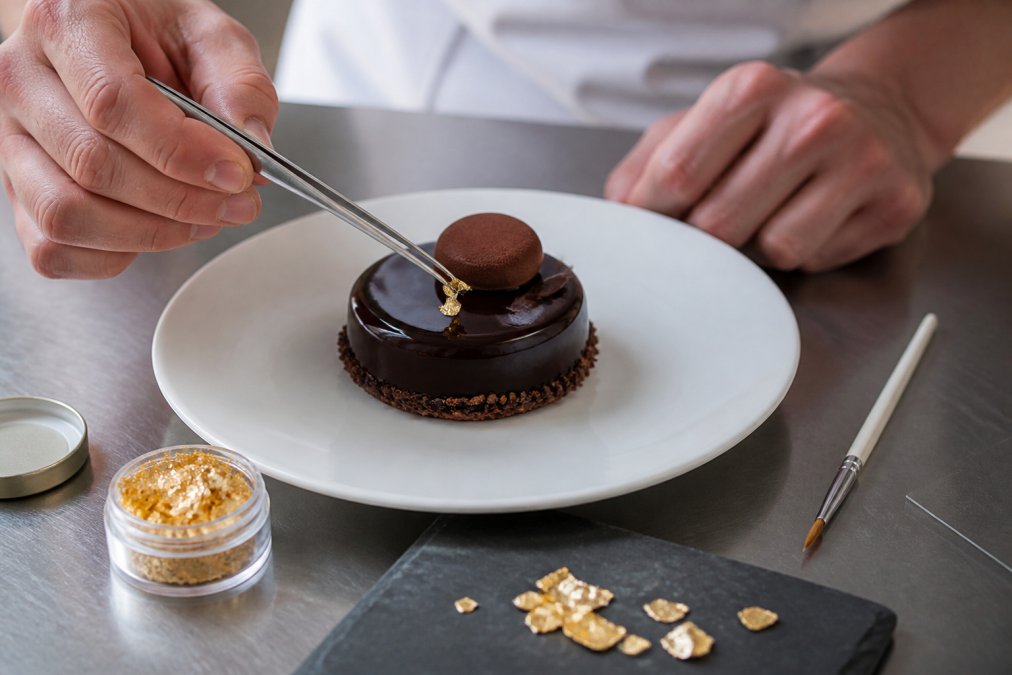
Total time: 10-15 minutes Difficulty: Beginner with steady hands
Tools You Need for Clean, Even Application
Gather these first:
- Fine-point tweezers (non-magnetic stainless or plastic-tipped)
- A soft, dry brush, a clean makeup brush or pastry brush works
- A small dish for the flakes
- A grounding surface, a metal tray or a sheet of parchment on a metal pan
- Gloves (optional, but they cut down on skin oils and static)
Why Gold Flakes Stick to Everything (And How to Stop It)
Gold leaf is thin enough that static electricity treats it like a feather. In a dry room, a flake will leap from your tweezers to your hand, your sleeve, or the ceiling of the box. Three habits defeat this:
- Work on a grounded metal surface. A sheet pan or a metal tray gives the static somewhere to go. Parchment on top of the metal keeps the gold clean.
- Breathe away from the gold, not at it. A slow exhale across a flake is enough to send it airborne. Turn your head, or work from the side.
- Touch the metal tray before you touch the gold. A quick tap discharges the charge you picked up walking across the room.
The Step-by-Step Application
- Work in a still room. Turn off fans, close windows, and turn off the range hood.
- Open the booklet flat and let the gold settle for a minute before you touch it.
- Pick up a flake with tweezers, never fingers. Skin oils dull the finish and leave fingerprints.
- Place it on the food and press gently with the dry brush, working from the center outward.
- For large surfaces, place flakes in a loose grid first, then press them down. Overlapping edges disappear once pressed.
- If a flake tears, do not try to reassemble it. Use the smaller pieces in a cluster or discard them.
Expected result: A clean, shiny finish with no torn edges and no stray flakes stuck to your hands.
Fixing Clumps and Crumbles
Gold leaf does not clump the way powder does, but it does crumble into flecks that stick together. If your flakes arrive as a clump:
- Do not pull them apart with your fingers. You will shred them.
- Lay the clump on the parchment and tease it apart with the tip of the tweezers, one layer at a time.
- If the clump is stuck to the booklet paper, slide a thin blade under the paper rather than pulling the gold.
Pairing Gold With the Right Dish
Gold reads as luxury on some plates and as gaudy on others. A few rules of thumb from working kitchens:
- It works on: dark chocolate, caviar, sushi, champagne cocktails, plated desserts with a matte base, and anything with a smooth, contrasting surface.
- It fights: busy plates with many colors, heavily sauced dishes, and anything already topped with silver or copper leaf.
- It disappears on: white plates with white food, and light-colored frostings where the shine has nothing to contrast against.
Edible Gold vs. Craft Gold: Spotting the Difference
Craft gold is the most common mistake buyers make. It looks identical in photos and costs a fraction of the price. The difference is what is inside.
| Feature | Edible Gold | Craft Gold |
|---|---|---|
| Purity | 23K-24K | Often 10K-18K |
| Additives | None | Copper, silver, alloys |
| Safe to eat | Yes | No |
| Labeling | "Edible" or "E175" | "For decorative use" |
| Typical use | Garnish | Art, frames, nails |
How to Store Gold Flakes So They Keep Their Value
Gold does not rust or tarnish, so storage is really about protecting the flakes from damage and loss.
A few habits protect your investment:
- Store away from moisture and direct sun.
- Keep the booklet flat, never folded.
- Handle only with tweezers.
- Keep the certificate with the gold.
Frequently Asked Questions
Are gold flakes worth any money?
Yes, authentic gold flakes carry real value based on weight and purity. A 1-gram package of raw placer gold from a verified mining operation typically sells for around $199 when presented as a collector's item with documentation. The gold itself has melt value tied to spot prices, but authenticated flakes from known operations like Dominion Creek often hold additional collector value beyond the raw metal.
What is the difference between edible gold leaf and raw placer gold?
Edible gold leaf is hammered into extremely thin sheets and is labeled food-grade with the additive code E175. Raw placer gold flakes are naturally occurring pieces recovered from streams and gravel deposits. They are much thicker and heavier than edible leaf. You would not eat raw placer gold flakes; they are collected, displayed, or traded as tangible assets.
How do you verify the authenticity of gold flakes?
Look for a Certificate of Authenticity that includes the source location, batch number, and weight. Reputable sellers like Parker's Gold provide documentation linking each package to a specific mining operation. You can also have flakes tested by a jeweler or assay service.
Are gold flakes healthy to eat?
Edible gold is biologically inert, meaning your body passes it through without absorbing it. The FDA permits gold as a food additive under the code E175 when it meets purity standards. However, only food-grade gold is safe to consume. Craft gold or gold mixed with other metals can contain impurities. If you plan to garnish food, always confirm the product is labeled edible and food-grade.
Gold flakes are easy to buy and easy to buy wrong. The safe path is simple: confirm purity, demand documentation, and store what you keep with care. Parker's Gold sources every flake directly from Parker Schnabel's Dominion Creek operation, backs each order with a Certificate of Authenticity, and ships fully insured with signature required. Claim yours and own a verified piece of Yukon history.