

Table of Contents
- Raw Placer Gold vs JM Bullion: Two Ways to Own Physical Gold
- What You Actually Get: Placer Gold vs Minted Bullion
- Is Buying Raw Gold a Good Investment Compared to Bullion?
- How to Verify Placer Gold Authenticity Before Purchase
- Pricing Breakdown: Collector Value vs Spot Price
- Storage and Tax Implications of Raw Gold vs Minted Coins
- Which Purchase Fits Your Goal?
- Frequently Asked Questions
Last Updated: September 8, 2026
Raw Placer Gold vs JM Bullion: Two Ways to Own Physical Gold
When you decide to hold physical gold, the first fork in the road is choosing between raw placer gold and refined bullion. Placer gold is the natural, unprocessed metal recovered from streams and alluvial deposits, while JM Bullion and similar dealers sell minted coins and bars refined to exacting standards.
The distinction matters more than most first-time buyers expect. A sealed gold coin is a financial instrument with a market spot price. Raw gold is a physical artifact with character, origin, and story. At Parker's Gold, we specialize in the latter, sourcing genuine placer gold directly from Dominion Creek.
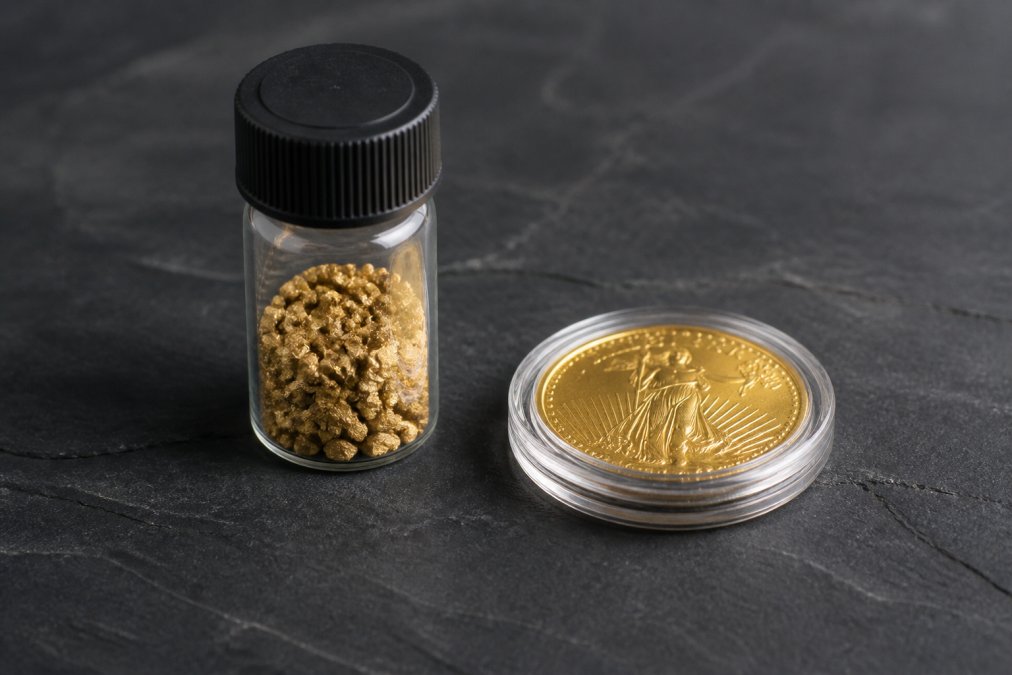
What You Actually Get: Placer Gold vs Minted Bullion
The core difference comes down to processing. Minted bullion from a dealer like JM Bullion is refined gold, typically 99.9% pure, stamped with a weight and fineness, and sold as a standardized financial product. Placer gold is natural gold in its original form, arriving as flakes or nuggets with variable purity, usually 70% to 90% gold content.
That variability is precisely why placer gold carries a different kind of value. It is not interchangeable in the way a coin is. Each flake is unique, and its worth is tied to both its gold content and its character as a specimen. For collectors, the mining origin and the story behind the recovery often matter more than the exact gram weight.
Is Buying Raw Gold a Good Investment Compared to Bullion?
The honest answer is that it depends on what you mean by investment. If your goal is pure financial growth tied to the market spot price, minted bullion is the more liquid and predictable choice. Raw gold does not trade on a simple spot price formula, and its resale market is narrower.
Many collectors find raw gold performs a different function: it is a tangible, physical asset with scarcity and historical significance. The IRS guidelines on collectibles and precious metals classify gains on physical gold as collectibles, which affects how it is taxed at sale. For fans of mining history or the Gold Rush era, the investment is as much about owning a piece of that narrative as it is about the metal itself. If you are buying strictly for portfolio diversification and easy liquidation, bullion wins. If you want a displayable artifact that holds intrinsic value, raw gold is the better fit.
How to Verify Placer Gold Authenticity Before Purchase
Verification is where raw gold purchases live or die. Because placer gold is unrefined, you cannot rely on a simple hallmark or stamp. The most reliable method combines visual inspection, density testing, and documentation of origin.
Step 1: Visual Inspection Under Magnification
Natural placer gold has an irregular, crystalline structure and a warm color that does not flake or tarnish. Magnification should reveal the characteristic "spongy" texture of alluvial gold, not the smooth surface of a cast imitation. Use a 10x jeweler's loupe and look for these markers:
- Irregular edges: Real flakes are jagged and uneven from tumbling in water. Fakes are often stamped or molded with rounded, uniform edges.
- Natural crystalline faces: Small, bright facets on the surface indicate the metal grew in place. Cast imitations lack these micro-structures.
- No green or black tarnish: Copper and silver impurities in placer gold can oxidize, but the gold itself never tarnishes. If you see green corrosion, the material is a copper alloy with a gold wash.
Step 2: The Density Test (Specific Gravity)
Gold is nearly twice as dense as lead and about 2.5 times denser than iron, making a specific gravity test one of the most reliable field checks. Here is the procedure:
- Weigh the dry sample on a precision scale accurate to 0.01 grams. Record this weight.
- Suspend the sample from a thin piece of thread or wire attached to the scale.
- Submerge the suspended sample in a container of distilled water, making sure it does not touch the bottom or sides. Record the submerged weight.
- Calculate specific gravity by dividing the dry weight by the difference between the dry and submerged weights.
Pure gold has a specific gravity of approximately 19.3. Natural placer gold, with its trace silver and copper content, typically measures between 15 and 18. A reading below 12 strongly suggests the material is not genuine gold, it may be pyrite or a tungsten-filled counterfeit.
Step 3: The Acid Test (For Advanced Buyers)
Jewelers' acid testing kits are available from most precious metal supply houses for under $30. The procedure involves scratching the gold on a testing stone and applying nitric acid solutions calibrated to different karat levels. Placer gold typically tests between 14 and 22 karat. A scratch that dissolves completely under 10-karat acid is not gold.
Step 4: Documentation and Chain of Custody
Visual and density tests confirm the material is gold, not that it is placer gold from a specific location. That requires documentation. A reputable seller will provide a documented chain of custody tracing the gold to a specific mining operation. At Parker's Gold, every package includes an official Certificate of Authenticity tied to the Dominion Creek operation.
Step 5: When to Request an Independent Assay
For purchases above a few hundred dollars, or when you plan to resell later, an independent assay is worth the cost. Fire assay is the industry standard, a destructive test that melts a small sample and separates the gold from other metals. X-ray fluorescence (XRF) is non-destructive and provides a full elemental breakdown in under a minute. Commercial labs typically charge between $50 and $150 per sample for XRF analysis.
Pricing Breakdown: Collector Value vs Spot Price
Pricing reveals the philosophical divide between these two products. Minted bullion is priced as a small premium over the daily market spot price, often 3% to 8% depending on the coin and dealer. The transaction is transparent, and the buyback market is deep.
Raw placer gold is priced differently. When you buy from a specialized source, you are paying for the verified weight, the documented mining origin, and the scarcity of the specimen. The Parker Schnabel Yukon Gold Flakes Collector Package, for example, is priced at $199.00, reflecting the curated presentation, the handcrafted tri-fold display case, and the authenticity documentation as much as the gold itself.

| Purchase Type | What You Pay For | Typical Premium | Best For |
|---|---|---|---|
| Minted Bullion Coins | Refined gold weight + small dealer margin | 3% to 8% over spot | Investment, easy resale |
| Raw Placer Gold (Collector) | Verified origin, natural form, display presentation | Varies by source and rarity | Collecting, gifting, memorabilia |
| Raw Placer Gold (Bulk) | Unverified gold content, no provenance | Negotiated by weight | Speculative buying |
Storage and Tax Implications of Raw Gold vs Minted Coins
The way you hold these assets matters as much as how you buy them. Minted bullion is durable, compact, and easy to secure in a safe deposit box or home safe. Raw placer gold requires more care, and the tax treatment has nuances.
Storage: What Works for Flakes and Nuggets
Raw placer gold is delicate. Flakes can bend, break, or stick to surfaces. Nuggets with attached quartz are fragile at the contact points. Storing them loose risks loss, abrasion, and contamination. Here is what experienced collectors use:
- Glass vials with cork or polycone liners: The standard choice for flakes. The liner prevents the gold from sticking to the cap and keeps moisture out. Avoid plastic vials, static electricity can make fine flakes jump and cling to the walls.
- Coin capsules or 2x2 cardboard holders: For larger nuggets, the same holders used for coins work well. They provide rigid protection and allow visual inspection without handling.
- Display cases with foam or velvet inserts: For collector pieces, a purpose-built display case protects the specimen while making it presentable. The Parker Schnabel Yukon Gold Flakes Collector Package uses a handcrafted tri-fold display case designed specifically for this purpose.
- Desiccant packs: Placer gold often carries trace amounts of other minerals. A small silica gel pack in your storage container absorbs humidity and prevents any non-gold components from tarnishing or degrading.
Home Safe vs. Safe Deposit Box
Both options work, but they serve different purposes. A home safe gives you immediate access and lets you display your collection, but it should be a UL-rated burglary and fire safe weighing at least 75 pounds. Expect to pay $300 to $800. A bank safe deposit box costs $50 to $150 per year and provides superior protection against theft and fire. The trade-off is access, you can only view your gold during bank hours.
Insurance: A Step Most Buyers Skip
Standard homeowners and renters insurance policies typically cap coverage for precious metals at $1,000 to $2,500. If your collection exceeds that, you need a scheduled personal property rider or a standalone precious metals policy. Companies like Jewelers Mutual and Travelers offer riders covering theft, loss, and damage at roughly 1% to 2% of the insured value per year.
Tax Treatment: What the IRS Actually Says
The IRS guidance on capital gains for precious metals classifies physical gold as a collectible under Section 408(m) of the Internal Revenue Code. This matters because collectibles are taxed at a maximum capital gains rate of 28%, while most other long-term capital gains are taxed at 0%, 15%, or 20% depending on your income bracket. Both refined bullion and raw placer gold fall under this collectibles classification.
There are two additional nuances that apply specifically to raw gold:
1. Valuation at sale is subjective. When you sell bullion to a dealer, the transaction is simple and the gain is easy to calculate, you sold it for X and bought it for Y. When you sell raw placer gold, there is no standardized spot price formula. The buyer and seller negotiate based on weight, purity, and specimen quality. To establish your cost basis and your sale price for tax purposes, you may need a written appraisal from a qualified precious metals appraiser. The IRS guidelines on charitable contributions of property require a qualified appraisal for donations of collectibles valued over $5,000, and the same logic applies when you sell to establish fair market value.
2. Precious metals IRAs exclude raw gold. IRS rules for self-directed precious metals IRAs require bullion to meet specific fineness standards, typically 99.5% for gold. Raw placer gold, with its variable 70% to 90% purity, does not qualify. If you are considering a precious metal IRA, minted bullion from a major dealer is the only option that meets the requirements.
The Bottom Line on Storage and Taxes
Raw placer gold is a hands-on asset requiring individual containers, careful handling, and a storage plan that balances access with security. Its tax treatment matches bullion, both are collectibles taxed at up to 28%, but raw gold adds complexity in valuation and disqualifies you from IRA accounts.
Which Purchase Fits Your Goal?
The right choice comes down to a single question: are you buying a financial asset or a physical artifact? If your priority is liquid, investment-grade exposure to the gold market with easy resale, minted bullion from a major dealer is the rational option.
If your goal is to own a piece of mining history, to hold the same type of natural gold that fueled the Gold Rush, or to give a gift that carries genuine provenance and story, raw placer gold is a compelling choice. The Parker Schnabel Yukon Gold Flakes Collector Package delivers verified placer gold from Dominion Creek, complete with an official Certificate of Authenticity and a handcrafted display case ready for showcasing. It is fully insured, tracked, and signature-required shipping, so your package arrives securely. The Discovery Channel's Gold Rush program introduced millions to the adventure of Yukon mining, and this collection lets you own a tangible piece of that world. For collectors and enthusiasts, that connection is worth more than the spot price alone.
Choosing between raw placer gold and minted bullion is not about which is objectively better; it is about which serves your purpose. Bullion offers clean, predictable investment exposure. Raw placer gold offers authenticity, character, and a direct link to the adventurous spirit of gold mining. If you are ready to own a verified piece of the Yukon with documented provenance, Parker's Gold provides the security of an official Certificate of Authenticity and insured delivery. Claim Yours and bring a piece of Dominion Creek home.
Frequently Asked Questions
Is JM Bullion selling fake gold?
JM Bullion is a reputable bullion dealer that sells refined and minted gold products, which are generally verified for authenticity. Raw placer gold, like the flakes from Parker Schnabel's Dominion Creek operation, is a different product entirely. Its authenticity depends on the source's verification process. Always check for a Certificate of Authenticity and documented mining origin when buying raw gold.
How much is 1 oz of placer gold worth?
The value of 1 oz of placer gold depends on its purity, which typically ranges from 80% to 95% for natural nuggets and flakes. A collector's piece with verified origin can carry a significant premium over the market spot price for its gold content. For comparison, the Parker Schnabel Yukon Gold Flakes Collector Package is priced at $199.00, reflecting its documented provenance and display case.
Is buying raw gold a good investment for beginners?
Raw gold can be a good investment for diversification, but it differs from buying minted bullion. Raw gold carries collector value beyond its metal content. However, it is less liquid than standardized bullion coins. Beginners should consider their goal: raw gold offers a tangible connection to mining history, while bullion offers a straightforward way to hold investment-grade gold.
What is the difference between refined bullion and raw placer gold?
Refined bullion is melted and purified to a set standard, typically 99.99% pure, and minted into bars or coins with a guaranteed weight. Raw placer gold is natural gold found in alluvial deposits, retaining its original shape and impurities. It has numismatic or collector value based on its origin and appearance, whereas bullion is valued almost entirely on its weight and purity.