

Table of Contents
- Alaska Mint vs Private Gold Sellers: The Core Trade-Offs
- Private Seller vs. Professional Dealer: A Direct Comparison
- How to Verify Gold Authenticity Before You Buy
- What to Know About Gold Bullion Tax Laws
- Is Buying Raw Gold a Good Investment for You?
- Buying Raw Gold: What You Should Look For
- The Verdict: Which Source Works Best for Collectors?
- Frequently Asked Questions
Last Updated: September 5, 2026
Alaska Mint vs Private Gold Sellers: The Core Trade-Offs
Selling gold is rarely as simple as walking into the first shop that advertises "we buy gold." The choice between a professional dealer like Alaska Mint and private gold sellers comes down to convenience and security versus the potential for a better price.
Private gold sellers offer the allure of cutting out the middleman, no dealer overhead, no staff to pay. In theory, that means more money in your pocket. The reality is more complicated, because private transactions carry risks that a professional dealer mitigates through established processes, authentication equipment, and transparent pricing tied to the spot price.
Before you commit to either path, understand that the market premium you can command depends on the form of your gold, its provenance, and the buyer's confidence in its authenticity. A private seller who cannot verify what they are buying will factor that uncertainty into their offer, often pricing your gold closer to melt value than its true worth.
Private Seller vs. Professional Dealer: A Direct Comparison
| Factor | Private Seller | Professional Dealer |
|---|---|---|
| Price potential | Higher ceiling, negotiable | Lower, tied to spot price |
| Payment speed | Variable, often delayed | Immediate upon agreement |
| Authentication | Buyer's burden | Built into the transaction |
| Fraud risk | Higher, limited recourse | Lower, regulated standards |
| Transaction fees | Often informal | Transparent, disclosed |
| Buy-back policy | Rarely exists | Often guaranteed |
| Security protocols | Self-managed | Established procedures |
Private transactions make sense when you have established relationships, verifiable provenance, and patience. Professional dealers make sense when you need liquidity, certainty, and fraud protection.
What most guides miss is that private party transactions often fail on verification. A buyer cannot easily test karatage, purity, or gold content without specialized equipment, and most individuals lack the assay tools that professional operations use routinely. That uncertainty suppresses the price you can realistically demand.
How to Verify Gold Authenticity Before You Buy
Most guides tell you to "verify authenticity" without explaining how. This section gives you the exact sequence of tests, tools, and red flags that professional dealers use, and that you can apply before meeting a private seller.
The 5-Step Verification Sequence
Step 1: Visual and Hallmark Inspection
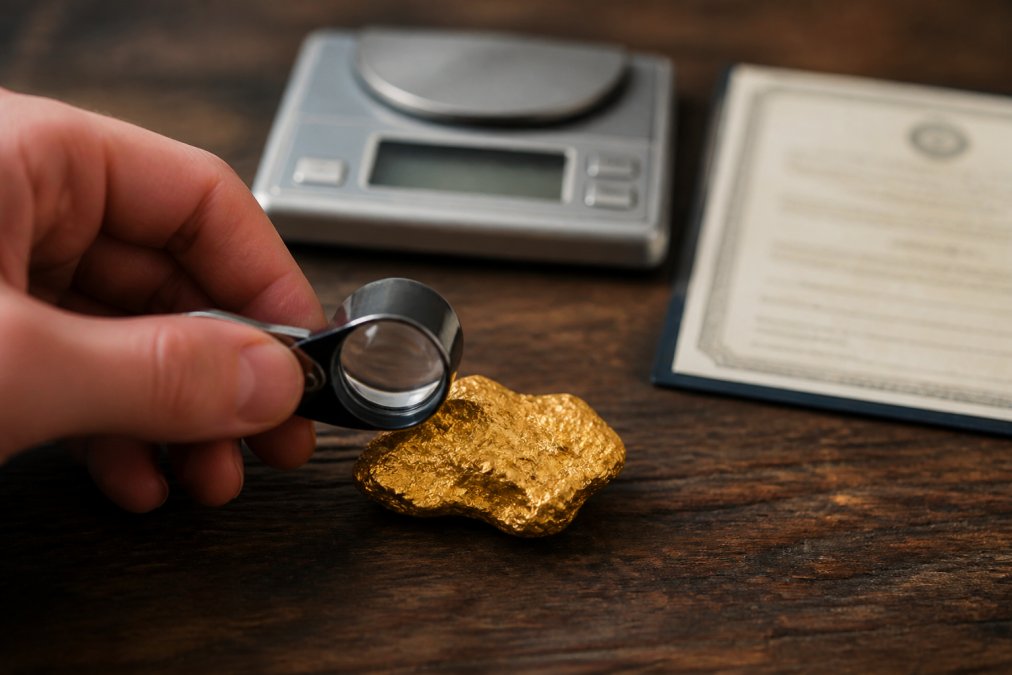
Start with a 10x jeweler's loupe (under $15 online). Examine the piece for a hallmark, 14K, 18K, 22K, or 24K for jewelry; .999 or .9999 for bullion. Look for crisp, even stamping. Check edges and surfaces for plating wear, which appears as a different color underneath. Gold does not tarnish, so any green or black discoloration signals a base metal core.
Step 2: Magnet Test
Gold is diamagnetic, it does not stick to a magnet. Use a strong neodymium magnet and pass it slowly over the piece. Any pull indicates ferrous metal. This test catches the crudest counterfeits but misses tungsten-filled bars and gold-plated copper, which are non-magnetic.
Step 3: Specific Gravity Test
This is the most reliable home test for raw gold and bullion. You need a digital scale accurate to 0.01 grams and a cup of water.
- Weigh the dry item. Record the weight.
- Suspend the item from a thin thread or use the scale's under-hook function. Submerge it fully in water without touching the cup's bottom or sides. Record the submerged weight.
- Calculate: Dry weight ÷ (Dry weight − Submerged weight).
Pure 24K gold has a specific gravity of approximately 19.3 (geology.com). 18K gold is approximately 15.5. 14K gold is approximately 13.5. Tungsten, a common counterfeit filler, has a specific gravity of 19.25, dangerously close to pure gold. If your result falls outside ±0.5 of the expected value, treat the item as suspect.
Step 4: Acid Test
Available as a kit with bottles of nitric acid at different concentrations (under $25). Scratch the item on a black testing stone, then apply the appropriate acid. 14K acid should not dissolve a 14K mark; if it dissolves, the item is lower karatage or fake. This test is destructive to a tiny surface area, so ask the seller's permission first.
Step 5: Electronic Tester
Handheld gold testers using electrical conductivity cost $50-$200 and provide instant karatage readings. They are not perfect, some report false positives on gold-plated items, but they add a useful data point. Professional dealers use X-ray fluorescence (XRF) analyzers costing $5,000-$15,000, which are non-destructive and highly accurate. If a private seller refuses to meet at a coin shop or pawnbroker with an XRF unit, treat that as a red flag.
Red Flags Specific to Private Sellers
- Refusal to meet at a neutral, public location, legitimate sellers welcome a bank lobby or a coin shop's premises.
- Pressure to complete the sale quickly, urgency is a hallmark of counterfeit merchandise.
- No documentation of origin, a seller who cannot describe where the gold came from often cannot verify its authenticity either.
- Price significantly below spot, a "deal" that is 15-20% under melt value usually means the seller knows the gold is not what it appears.
What to Do When You Find a Problem
If your tests indicate counterfeit gold, do not confront the seller on the spot. End the meeting politely, document what you observed, and report the incident to local law enforcement if fraud was intended. If you already purchased counterfeit gold from a private seller, your recourse is limited to civil court, which is why verification happens before money changes hands.
Professional dealers like Alaska Mint perform these same verifications internally with calibrated equipment and trained staff. When you buy from a dealer, the authentication burden shifts to them; when you buy from a private seller, you are the quality control department.
What to Know About Gold Bullion Tax Laws
Selling gold, whether to Alaska Mint or a private buyer, triggers the same federal tax obligation, but the paperwork and reporting requirements differ dramatically by channel.
The IRS treats gold bullion, coins, and raw gold as collectibles under IRC Section 408(m). That classification caps your long-term capital gains rate at 28%, not the 15% or 20% rate that applies to stocks or mutual funds held over one year. If you held the gold for less than one year, your gain is taxed at your ordinary income rate, which can reach 37% for high earners. State-level treatment varies; some states like California tax gold as tangible personal property, while others like Florida and Texas have no state income tax on the gain.
Your cost basis matters more than most sellers realize. For purchased bullion, your basis is the purchase price plus dealer premiums and shipping. For inherited gold, the basis is typically the fair market value at the date of the decedent's death. For placer gold you mined yourself, the basis is your extraction costs, equipment, fuel, claim fees, which can be surprisingly low, creating a larger taxable gain than you might expect.
Reporting Requirements by Channel
Professional dealers follow specific IRS reporting rules. Under IRS Form 1099-B guidelines, a dealer must issue a 1099-B when you sell:
- Gold coins (like American Eagles or Krugerrands) in a transaction exceeding $1,000
- Gold bullion (bars or rounds) in a transaction exceeding $10,000
These thresholds apply per transaction, not per calendar year. Selling $900 worth of coins to one dealer and $900 to another avoids the 1099-B trigger, though the obligation to report the gain remains yours regardless.
Private party sales rarely generate any IRS paperwork. That absence creates a dangerous illusion of invisibility. The IRS can still discover unreported gains through bank deposit patterns, cash transaction reports (Form 8300 for deposits over $10,000), or a buyer who later reports the purchase. The penalty for underreporting income is 20% of the underpaid tax, plus interest.
The Wash Sale Rule Does Not Apply
Unlike stocks, gold does not qualify for the wash sale rule. You cannot sell gold at a loss, repurchase identical gold within 30 days, and claim the loss. The IRS treats each gold transaction independently.
Practical Steps Before You Sell
- Calculate your basis, gather purchase receipts, mining cost logs, or inheritance documentation before negotiating.
- Estimate your gain, subtract basis from the expected sale price, then apply the 28% collectibles rate or your ordinary rate.
- Request a transaction receipt, even in private sales, a written receipt documenting date, weight, purity, and price protects both parties and supports your tax filing.
- Set aside funds, if your gain is substantial, reserve 25-30% of the sale proceeds for tax obligations rather than spending the full amount.
For most sellers, the tax difference between a dealer and private transaction is not the rate, it is the documentation trail. Dealers provide the paperwork that makes filing straightforward; private sales require you to create and preserve it yourself.
Is Buying Raw Gold a Good Investment for You?
Raw gold, in the form of nuggets, flakes, or dust, occupies a unique position in the precious metals market. Unlike bullion bars or coins, which carry a recognized face value and standardized purity, raw gold is valued primarily by its gold content and its premium as a natural specimen.
Whether buying raw gold is a good investment depends on your goals. If you seek a hedge against market volatility with straightforward resale, investment grade bullion offers lower transaction fees and a more predictable market. If you value the tangible connection to mining history, raw gold can carry a premium that exceeds its melt value.
Raw gold from a documented source adds another layer. A piece with verifiable provenance, such as gold recovered from a named mining operation, holds appeal for collectors that generic placer gold cannot match. That provenance supports a higher price when you sell, provided you maintain the documentation.
Buying Raw Gold: What You Should Look For
When evaluating raw gold, start with purity and gold content. Higher karatage means more gold and a higher melt value, which forms the floor for any reasonable offer. Ask whether the gold has been refined or appears as it was recovered, since unrefined placer gold contains natural impurities.
Documentation matters more than most buyers realize. A certificate of authenticity that traces the gold to a specific source, such as a named mining claim, transforms a commodity into a collectible and gives the next buyer confidence when you eventually sell.
Security protocols should factor into your decision. Meeting a private seller in an unsecured location with cash or gold invites risk. Professional dealers operate from established premises with security measures, and reputable online sellers offer insured, tracked, and signature-required shipping.
The Verdict: Which Source Works Best for Collectors?
For serious collectors, the answer is rarely either extreme. Professional dealers offer reliability, authentication, and established buy-back policies. Private sellers can offer unique pieces and negotiable pricing, but they shift the burden of verification and security onto you.
A hybrid approach often works best. Use professional dealers for investment grade bullion where purity and liquidity are paramount. Turn to documented private sources when you seek raw gold with provenance or a direct connection to a specific mining operation.
Parker's Gold occupies a distinct space in this landscape. Our raw placer gold comes directly from Parker Schnabel's Dominion Creek operation in the Yukon, the same goldfields featured on Discovery Channel's Gold Rush. Each limited-edition package includes an official Certificate of Authenticity verifying the gold's origin, presented in a handcrafted tri-fold display case ready to gift or showcase. Shipping is fully insured, tracked, and signature-required, so your purchase arrives securely.

This is collectible gold with documented provenance, not anonymous bullion. The Discovery Channel's Gold Rush series has documented the Dominion Creek operation for years, giving collectors a verifiable connection to a specific time and place in mining history. For fans of the show, gift givers seeking something distinctive, or collectors who value provenance, the Parker Schnabel Yukon Gold Flakes - Dominion Creek Collector Package offers exactly what generic dealers cannot: a story you can hold.
The choice between professional dealers and private sellers ultimately reflects your priorities as a collector. Dealers offer efficiency and assurance. Private sources offer uniqueness and potential savings. But neither provides what Parker's Gold delivers: authenticated raw gold from a legendary mining operation, documented and ready to display. If you want a piece of Yukon history with verified origin and secure delivery, Parker's Gold Collector Packages offers the confidence of a professional transaction with the soul of a genuine artifact.
Frequently Asked Questions
What are the risks of selling gold to private buyers versus established dealers?
Private buyers may offer faster cash, but they often lack the security protocols of established dealers. Risks include theft during the meeting, payment fraud, and a lack of professional authentication. Established dealers like Alaska Mint follow strict security measures and provide a documented transaction, which creates a clear record. For private party transactions, always meet at a licensed precious metals dealer's office or a police station lobby, and use a verified payment method like a wire transfer rather than cash or a personal check.
Does the IRS know if you buy gold?
The IRS does not require dealers to report most retail purchases of physical gold bullion or coins. However, reporting kicks in when you sell. Under current law, dealers must report certain bullion transactions to the IRS using Form 1099-B if the sale exceeds $10,000. This applies to specific products like 1-kilogram gold bars and certain rounds. For smaller sales, you are still responsible for reporting capital gains on your tax return, even if you don't receive a form.
Is Alaska Mint a real mint?
Yes, Alaska Mint is a legitimate, operational mint and refinery based in Anchorage. They produce commemorative coins, medallions, and bullion products, and they also buy scrap gold and bullion from the public. Unlike a private seller, they have a physical storefront, an assay lab, and established buy-back policies. Their status as a licensed dealer means transactions are documented and subject to standard precious metals regulations, which adds a layer of accountability that private party transactions do not offer.
How do I know if a private seller's gold is authentic?
You can verify gold authenticity by checking for a hallmark or stamp indicating karatage, like 24K or .999 fine. Weigh the item and calculate its melt value based on the current spot price. Perform a specific gravity test or use a magnet, as gold is not magnetic. For raw placer gold, look for natural shapes and textures rather than uniform cast bars. The safest step is to request a written appraisal from an independent assayer before finalizing a private party transaction.