

Table of Contents
- Start With a Safe, Step-by-Step Raw Gold Identification Workflow
- How to Tell Gold Flakes vs Pyrite Apart
- How to Tell Gold Flakes vs Mica Apart
- Raw Gold Identification Tests and Their Limits
- Gold Flakes in Quartz Identification: Reading Rough Specimens
- Panning Context: Black Sand, Gravel Deposits, and Stream Clues
- Flake Size, Thickness, and Shape: What Raw Gold Flakes Look Like
- When to Get a Professional Assessment (and How to Buy Verified Gold)
- Frequently Asked Questions
Last Updated: October 6, 2026
Start With a Safe, Step-by-Step Raw Gold Identification Workflow
Learning how to identify raw gold flakes starts with one rule: test gently, and never destroy a specimen. Real gold survives almost anything; most lookalikes do not.
Here are the same checks we use, ordered to keep a specimen intact.
Raw gold flakes are pieces of natural placer gold that have broken free from rock, then been tumbled and concentrated by moving water over thousands of years. That history leaves clues you can see, feel, and test.
Here's the workflow, in order:
- Look at color and shine in natural light
- Check the shape and edges
- Try the streak test on unglazed ceramic
- Press or scrape the flake gently
- Compare against known lookalikes
- Test embedded material in quartz separately
- Get a professional opinion on anything valuable
What You'll Need Before You Test Anything
Gather these items first. Most are already in your kitchen or garage.
- A bright flashlight or direct sunlight
- An unglazed ceramic tile or the bottom of a coffee mug
- A magnifying loupe or jeweler's loupe
Skip the acid test. It destroys specimens and creates a safety hazard; save destructive testing for a professional.
How to Tell Gold Flakes vs Pyrite Apart
Pyrite is the most common gold impostor, and it fools people for one reason: it sparkles.
Real gold never sparkles that way. It glows.
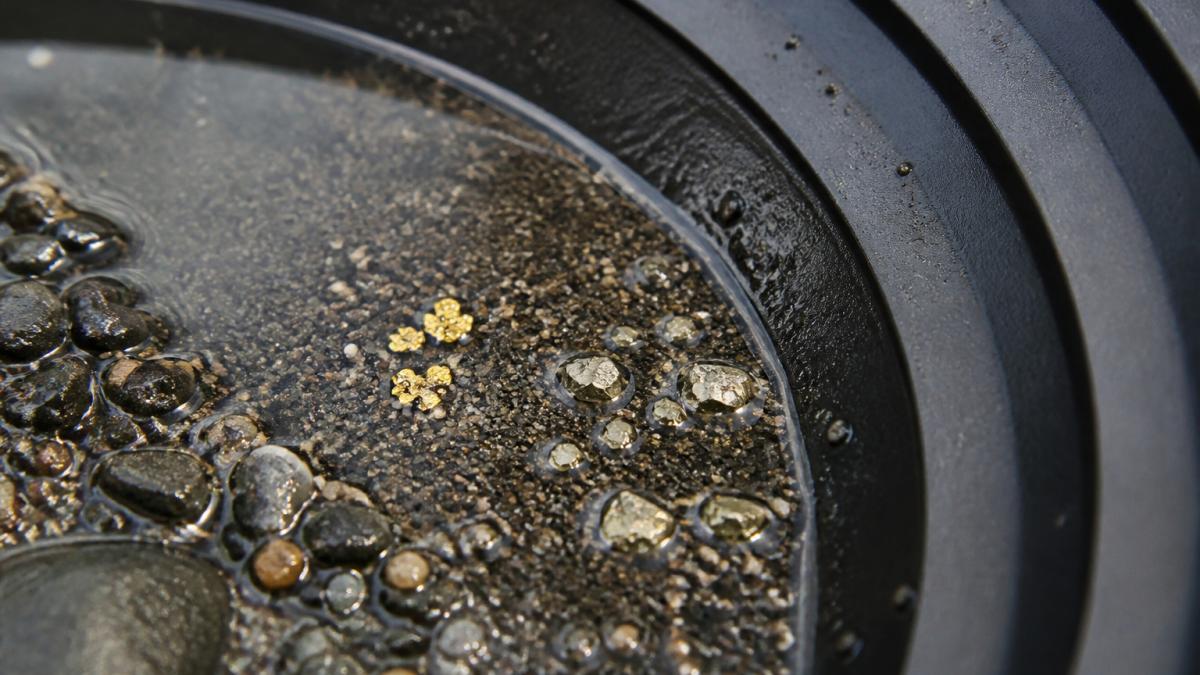
Here's the fastest way to separate the two:
- Color: Gold is warm and buttery. Pyrite leans green or brassy.
- Shape: Gold flakes are flat and rounded. Pyrite forms cubes and sharp edges.
- Streak: Gold leaves a yellow streak. Pyrite leaves a greenish-black streak.
The streak test settles most arguments: rub the grain across unglazed ceramic. Gold leaves its own color behind; pyrite leaves a dark powder. Pyrite also tarnishes outdoors within weeks. Gold does not.
The Other Lookalikes That Fool People
Pyrite gets the blame, but it is not the only mineral that mimics gold in a pan. Sort the common candidates before testing.
- Chalcopyrite: A copper iron sulfide that looks like a duller, more yellow-green pyrite. It streaks greenish-black like pyrite and is brittle, so a needle crumbles it rather than denting it. It often occurs alongside pyrite in the same host rock.
- Mica (muscovite and biotite): Sheet silicates that flash like mirrors when you tilt a pan. Mica is light, flexible, and springs back when bent. Gold is dense and stays bent. Mica also looks silver, black, or brown at different angles, while gold stays gold.
- Gold-colored glass or slag: Man-made material that can show up in tailings, old burn sites, and urban gravel. It may be yellow and shiny, but it is usually harder than gold, often has bubbles or a smooth conchoidal fracture, and does not dent under a needle.
A quick field sequence narrows the field fast: check color and luster in natural light, note whether the grain sparkles or glows, streak it on unglazed ceramic, press gently with a steel needle, then compare weight in water.
What Each Test Can and Cannot Prove
No single field test confirms gold. Knowing each test's limits keeps you from overclaiming.
- Color and luster: Good for ruling out obvious non-metallics, but light angle and weathering can mislead the eye.
- Streak test: Reliable for separating gold from pyrite and chalcopyrite, but it wears down soft specimens and does not distinguish gold from other yellow metals.
- Needle scratch: Shows malleability, which is a strong gold clue, but tiny flakes are hard to hold and brittle minerals can crumble in ways that look like denting.
When field tests point to gold and the value is meaningful, stop and get a professional assessment. A licensed assayer or reputable dealer can confirm identity without risking the specimen.
How to Tell Gold Flakes vs Mica Apart
Mica tricks people differently: it flashes. Tilt a pan in sunlight and mica catches the light like a mirror, then goes dark as you shift the angle.
Gold keeps its color from every angle.
The U.S. Geological Survey mineral resources program describes mica as a group of sheet silicate minerals that split into thin, flexible flakes. That structure explains the flash.
Quick checks for mica:
- Weight: Mica flakes feel almost weightless. Gold feels dense for its size.
- Flex: Mica bends and springs back. Gold bends and stays bent.
- Color shift: Mica looks silver, black, or brown at different angles. Gold stays gold.
That weight difference matters most in a pan: gold sinks fast, while mica washes away with the lightest swirl.
Raw Gold Identification Tests and Their Limits
No single field test proves a flake is gold, but together they build a strong case.
| Test | What It Tells You | Main Limitation |
|---|---|---|
| Color in sunlight | Warm yellow vs brassy or silvery | Light tricks the eye |
| Streak test | Yellow streak vs dark powder | Damages soft specimens |
| Needle scratch | Soft metal vs brittle mineral | Small flakes are hard to hold |
| Water swirl | Density and weight | Slow and needs practice |
| Magnification | Shape, edges, surface wear | Needs a loupe |
The streak test is the most reliable field check for raw gold identification, but it wears down the specimen. On a flake you plan to keep, use magnification and weight first. In water, gold settles to the lowest point and stays there when you swirl, while light material rides up and out.
Gold Flakes in Quartz Identification: Reading Rough Specimens
Gold locked in quartz needs a different approach. You cannot swirl a rock, and you should not crush a specimen that might be worth more whole.
Gold flakes in quartz identification comes down to three visual cues:
- Color contrast: Gold stands out hard against white or gray quartz.
- Edge contact: Real gold sits in the quartz as solid, sharp-edged blebs.
- Depth: Gold inside the stone looks solid at every angle. Pyrite in quartz tends to look flat and surface-bound.
Shine a light across the rock's face, not straight at it.
Parker Schnabel Yukon Gold Flakes – Dominion Creek Collector Package →
Do not crush the specimen to check. A 10x jeweler's loupe shows whether the yellow material has depth and solid edges. If it does, stop and get it looked at properly.
A Non-Destructive Inspection Workflow for Embedded Specimens
Most guides stop at "look at it with a loupe." A repeatable sequence gets you further without risking the specimen.
- Clean the surface gently. Rinse with water and a soft brush. Do not scrub with abrasives or acids. You want to see the natural surface, not polish it.
- Photograph the specimen dry and wet. Water can make gold pop, but it can also hide surface texture. Take both so you have a record of the original condition.
- Examine under magnification at multiple angles. Use a 10x loupe or a low-power USB microscope. Rotate the specimen and watch how the yellow material behaves as the light moves.
- Check edge contact. Real gold in quartz typically meets the host rock with a solid, sharp boundary. Pyrite and other sulfides often look like they are sitting on the surface or have a fuzzy, weathered rim.
- Look for depth and shadow. Gold blebs have volume. If the yellow material looks like a flat painted patch with no shadow or depth, suspect a coating or a surface mineral.
- Test hardness on an inconspicuous spot only if necessary. Quartz scratches gold, and gold does not scratch quartz. This can help, but it leaves a mark, so use it as a last resort on a specimen you do not plan to keep pristine.
- Do not extract the gold. Breaking the quartz can destroy value and context. If the specimen looks promising, stop and get a professional opinion.
A common pattern: gold in quartz stays warm and buttery as you rotate the stone, while pyrite shifts toward green or black and mica flashes silver or brown. If the yellow material changes character with the light angle, it is probably not gold.
When to Stop and Get a Professional Assessment
Stop testing and seek a professional when any of these apply:
- The visible gold is large enough to matter financially.
- The specimen has unusual crystal structure or a rare host rock.
- You plan to sell, insure, or gift the piece.
A jeweler, licensed assayer, or reputable dealer can confirm identity without risking the specimen, almost always the right call before any destructive test.
Panning Context: Black Sand, Gravel Deposits, and Stream Clues
Where a flake came from tells you almost as much as the flake itself.
Look for black sand, heavy minerals like magnetite and ilmenite that settle where gold does.
Stream clues that point to gold:
- Inside bends where water slows down
- Behind large rocks that block the current
- Bedrock cracks where heavy material drops and stays
The U.S. Geological Survey's guide to placer deposits explains that placer gold concentrates where stream energy drops enough for heavy particles to settle.
If your pan has no black sand, you are probably in the wrong spot, not missing the gold.
Flake Size, Thickness, and Shape: What Raw Gold Flakes Look Like
Raw gold flakes have a signature look: flat, irregular, and often slightly curled at the edges, pounded into that shape by water over a very long time.
Flake thickness usually runs thin, often paper-thin on small pieces. Larger flakes hold more body.
Shape tells a story too:
- Rounded edges mean the flake traveled far from its source
- Sharp, jagged edges mean it came from nearby rock
- Flat and smooth faces show heavy water wear
A true metallic luster is the final giveaway. Gold reflects light as a solid, warm surface. Nothing else in a pan does quite the same thing.
When to Get a Professional Assessment (and How to Buy Verified Gold)
Get a professional assessment any time the value might be meaningful. A jeweler, licensed assayer, or reputable dealer can confirm identity with tests you should not run at home.
Know when to stop testing:
- The piece is large enough to matter financially
- The piece has unusual crystal structure
- You plan to sell, insure, or gift it
For collectors who want verified material without the guesswork, provenance matters more than any field test. Our Dominion Creek Collector Package ships with an official Certificate of Authenticity, a fact sheet with batch number, and your choice of 1g, 2g, or 3g of raw placer gold in a handcrafted tri-fold display case.

Every order ships fully insured with signature required on delivery, so nothing sits unattended on a porch.
For guidance on how gold is classified and tested, the U.S. Mint's gold bullion information is a solid reference point.
Frequently Asked Questions
What does raw gold look like in a pan?
Raw gold in a pan shows a warm, buttery yellow with a metallic luster that stays bright even in shade. It settles at the bottom of the pan, often near black sand. Unlike pyrite, which has sharp edges and a brassy tone, raw gold flakes look rounded and soft. A gold pan is the best tool to see this behavior, as the swirling water separates heavy gold from lighter sediment.
How do you tell gold flakes from mica?
Mica flakes are flat, thin, and translucent, and they often appear as shiny specks that reflect light in flashes. Gold is opaque and heavy, so it sinks quickly in water while mica tends to float or wash away easily. Rub a suspected flake between your fingers: mica breaks into thin sheets, but gold stays solid. A streak test on unglazed ceramic also helps, as gold leaves a yellow streak while mica leaves none.
Can you test gold flakes with vinegar?
Vinegar is a weak acid and will not dissolve real gold, but it can tarnish or bubble on some lookalikes like pyrite. However, a vinegar test is not reliable for identifying raw gold flakes because many minerals also resist vinegar. Use it only as a quick, safe first check, then confirm with a streak test or by examining the flake's weight and luster. For definitive results, a professional assay is best.
What should you do if you find a gold-colored flake in quartz?
If you spot a gold-colored flake embedded in quartz, first check if it is metallic and reflects light evenly. Gold in quartz often appears as small specks or veins that do not flake off easily. Try a streak test on the exposed metal, but avoid crushing the specimen. If the flake is soft and flattens when pressed, it is likely gold. For valuable pieces, a professional assessment can confirm authenticity.
Field tests will get you close, but provenance is what actually protects your money. If you want raw gold flakes with verified origin, documentation, and insured delivery, Parker's Gold sources every piece directly from Parker Schnabel's Dominion Creek operation. Each package includes a Certificate of Authenticity, a handcrafted tri-fold display case, and fully tracked shipping with signature required. Claim yours and own a verified piece of Yukon history.