

Table of Contents
- Why Testing Gold Without Damage Matters
- The Gold Magnet Test: What It Can and Cannot Tell You
- Understanding Gold Density and the Water Test
- Visual Inspection: Hallmarks, Karats, and Surface Clues
- Nondestructive Gold Testing Methods That Professionals Use
- XRF Gold Testing: The Gold Standard for Verification
- When to Stop Testing at Home and Seek Professional Help
- Conclusion
- Frequently Asked Questions
Last Updated: October 4, 2026
Why Testing Gold Without Damage Matters
You've found a piece of gold and need to verify it's real. Most people reach for a magnet or acid test without thinking about the damage, scratching, etching, or staining a valuable piece isn't worth the certainty, especially when you can verify gold without scratching it using better methods.
At Parker's Gold, we include a Certificate of Authenticity with every piece. But if you're testing gold you already own or considering a purchase elsewhere, you need to verify gold without scratching it. This guide walks you through methods that protect your item while giving you real answers.
The challenge isn't finding a test. It's finding one that won't damage what you're testing.
The Gold Magnet Test: What It Can and Cannot Tell You
The magnet test is free and fast: real gold is non-magnetic. If a magnet sticks, your item contains magnetic metals like iron or nickel. If it doesn't stick, that's promising but not proof.
But stainless steel and copper are also non-magnetic. A magnet tells you what's NOT in your gold, not what IS. Gold-plated stainless steel would pass the test. It's a screening tool, not a verdict.
When the magnet test works best:
- Testing items you suspect might be brass or steel
- Quick screening before moving to other methods
- Ruling out obvious counterfeits
When it falls short:
- Gold-plated items (the plating is non-magnetic even if the base isn't)
- Mixed alloys that happen to be non-magnetic
- Determining actual gold content or purity
Understanding Gold Density and the Water Test
Gold is dense, about 19.3 times heavier than water (Composition of GOLD). The water test is often cited as a screening method, but it's far more limited than most guides suggest and carries real risks for certain items.
How the water test works: Drop your item in water. Real gold sinks quickly due to its high density. Fakes like brass or aluminum should float or sink more slowly. In practice, this screening works only under narrow conditions.
Why the water test fails for common fakes: Tungsten, a popular counterfeit material, has a density of 19.25 g/cm³, nearly identical to gold's 19.3 g/cm³. Lead sinks quickly as well. A gold-plated item with a heavy base metal will sink even if the gold layer is thin. The water test cannot distinguish between these scenarios. It tells you whether something is heavy, not whether it is gold.
Real damage risks: The water test is particularly risky for delicate or antique pieces. Gemstone-set jewelry (pearls, opals, turquoise) can absorb water, causing delayed damage. Thin chains and bracelets may bend or break. Water can seep under enamel or painted details. Even untouched pieces lose value to collectors.
When the water test might be useful: For raw placer gold or large, solid pieces with no gemstones, the water test is harmless but weak. A small piece of gold sinks, but so does tungsten or lead. The test works best as a negative indicator: if something floats, it's probably not solid gold. A positive result proves almost nothing.
Better alternatives: Hold the item and compare its weight to a similar-sized piece of known material. Gold feels surprisingly heavy for its size. This tactile test is safer than water and gives the same information.
Visual Inspection: Hallmarks, Karats, and Surface Clues
Hallmarks and karat stamps declare what you're holding. In the United States, gold jewelry is typically stamped: 10K, 14K, 18K, 22K, or 24K, indicating the fraction of pure gold in the alloy.
Understanding karat stamps:
- 24K = 99.9% pure gold
- 22K = 91.7% pure gold
- 18K = 75% pure gold
- 14K = 58.3% pure gold
- 10K = 41.7% pure gold (the legal minimum to call something "gold" in the U.S.)
A legitimate hallmark is stamped into the metal, not printed or glued on. It should be clear and consistent. Counterfeit items often have poorly executed stamps, uneven lettering, or stamps that look like they were added after the fact.
Look for signs of wear that match the piece's age. Gold doesn't tarnish like silver, but shows scratches, scuffs, and color variation from handling. A piece that looks brand new but claims to be antique is suspicious.
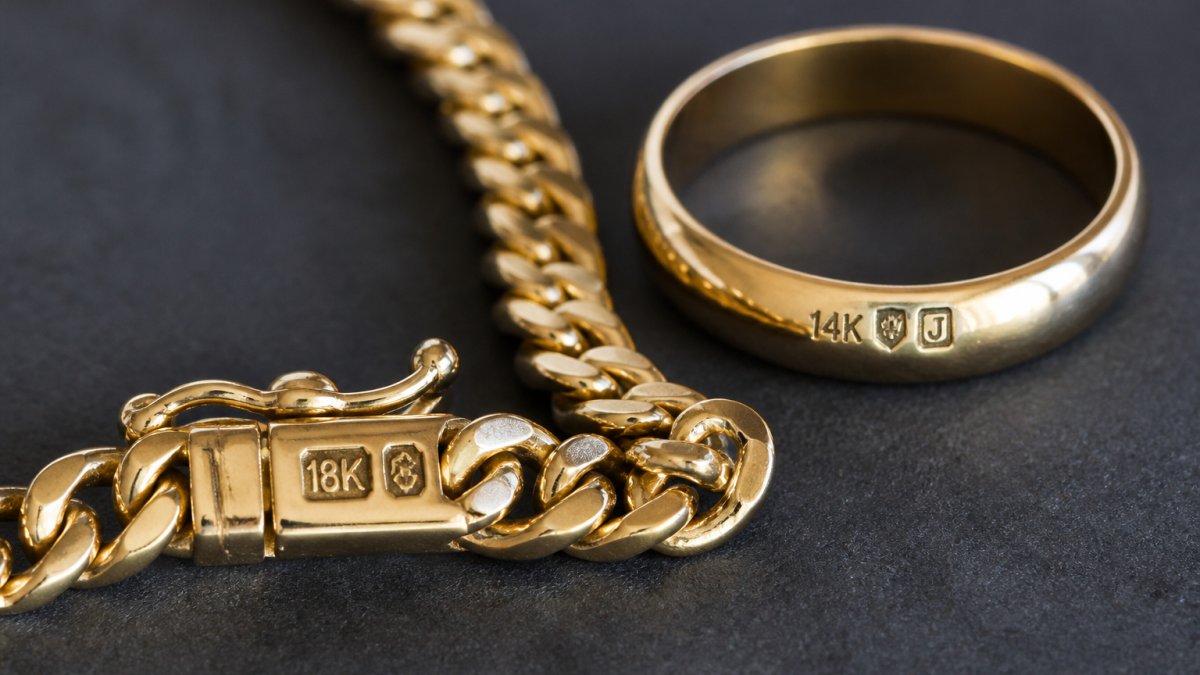
What to look for: Clear, consistent stamping at appropriate depth; maker's mark or assay office mark alongside the karat number; no signs of tampering. Red flags: Blurry or uneven stamps; stamps that look added; missing hallmarks; stamps that contradict appearance.
Nondestructive Gold Testing Methods That Professionals Use
When home screening methods leave you uncertain, professional nondestructive testing provides real answers without damage. Understanding what each method can and cannot tell you is essential.
Electronic gold testers (conductivity-based): Electronic testers measure electrical conductivity. Gold conducts electricity in a specific way that differs from other metals and alloys. The device sends a small current through the item and reads the response. Different metals produce different conductivity signatures.
Magnet-based permeability testers: These are more sophisticated than a simple magnet. They measure magnetic permeability, how a material responds to a magnetic field, with precision. Gold, gold-filled, and gold-plated items each have distinct magnetic signatures because the base metal and the gold layer interact with the magnetic field differently.
What it detects: Solid gold versus gold-plated or gold-filled items; can estimate plating thickness. Cost: $100-$400. Strengths: Highly accurate at distinguishing plated from solid; works on curved surfaces; detects thin plating (0.1 mm+). Limitations: Requires relatively flat contact surface; sensitive to base metal composition. Best for: Authenticating gold-plated and gold-filled jewelry; estate sales and secondhand purchases.
Ultrasonic thickness testers: Ultrasonic devices use sound waves to measure the thickness of material layers. When sound travels through gold plating into a base metal, the wave bounces back at a different speed. By measuring the time delay, the device calculates plating thickness.
Choosing the right method: For solid gold and quick confirmation, use an electronic tester. For items that might be gold-plated or gold-filled, use a magnet-based permeability tester. For plating durability, use an ultrasonic tester. For absolute certainty and exact elemental composition, use XRF testing.
Accuracy and false positives: All three methods can be fooled under certain conditions. A thick gold-plated item may read as solid gold on an electronic tester. A magnet tester may give inconsistent results on a heavily textured surface. An ultrasonic tester cannot work on items with curved or uneven surfaces.
Where to find these testers: Most jewelers and gold dealers own at least an electronic tester. Many have magnet-based testers. Ultrasonic testers are less common in retail settings but available through professional appraisers and high-end jewelry shops.
XRF Gold Testing: The Gold Standard for Verification
XRF stands for X-ray fluorescence. This is the method that serious collectors, jewelers, and authenticators use when they need absolute certainty. XRF machines shoot a small beam of X-rays at your item. The X-rays cause the gold atoms to fluoresce, and the machine reads the resulting signal to determine exactly what elements are present and in what proportions.
Here's what makes XRF different: it's completely non-destructive, it works on any surface (curved, textured, whatever), and it gives you a precise readout of gold content. If your item is 18K gold, the machine will tell you it's 75% gold. If it's gold-plated over copper, the machine will identify both the gold layer and the base metal beneath it.
The catch is access. XRF machines are expensive, tens of thousands of dollars, so you won't find them in most homes. But many jewelers, pawn shops, and gold dealers have them. A professional XRF test typically costs between $20 and $100 depending on the location and the complexity of your item.
For collectors who own multiple pieces or who plan to buy and sell gold, XRF testing is the gold standard. It's the method that establishes authenticity for insurance purposes and resale documentation. If you're considering a significant purchase or you own pieces valuable enough to insure, XRF testing is worth the investment.
Parker's Gold pieces come with a Certificate of Authenticity that documents the gold's origin and purity. That certificate is your verification. But if you're ever questioned about the authenticity of a piece you own, an XRF test provides independent, irrefutable proof.
Why XRF matters:
- Completely non-destructive
- Works on any surface condition
- Provides exact elemental composition
- Recognized as authoritative by insurance and resale markets
- Can identify gold-plated items and measure plating thickness
When to Stop Testing at Home and Seek Professional Help
There's a point where home testing stops making sense. If you've run a magnet test and a water test and you're still uncertain, that's your signal. Continuing to test at home risks damaging the item without getting closer to the truth.
Here's when to stop and call a professional:
Your item is delicate or valuable. Antique pieces, items with gemstones, thin chains, or anything you'd be upset to damage should go to a professional. The cost of professional testing is trivial compared to the cost of accidentally scratching a valuable piece.
You're considering a significant purchase. Before spending serious money on gold, get it tested by a professional. A $50 XRF test saves you from a $5,000 mistake.
You own gold-plated or gold-filled items. Home tests can't reliably differentiate between gold-plated, gold-filled, and solid gold. A professional can tell you exactly what you have and what it's worth.
You need documentation. If you're insuring your gold, selling it, or passing it on as part of an estate, you need professional verification. Insurance companies and buyers expect documentation from a qualified source.
You're uncertain about the results. If different tests give you different answers, or if one test seems off, that's confusion, not clarity. A professional settles it.
Finding a jeweler or gold dealer with an XRF machine takes a quick search. Most will test your item while you wait. Bring your item, ask about their credentials, and get a written report of the results.
Conclusion
Verifying gold without scratching it comes down to choosing the right method for what you're testing. Start with visual inspection and hallmarks. Use a magnet test as a quick screening tool. If you need certainty without risk, invest in an electronic or ultrasonic tester. For absolute proof, especially on valuable pieces, XRF testing is the answer.
At Parker's Gold, every piece comes verified with an official Certificate of Authenticity sourced directly from Dominion Creek. But whether you're testing our gold or pieces you already own, the principle is the same: protect what matters while getting the truth. Claim Yours and own a verified piece of authentic Yukon history with confidence and documentation.
Frequently Asked Questions
Can you verify gold without scratching it at home?
Yes. The safest at-home methods include the magnet test (gold is non-magnetic), the water or float test (gold's density makes it sink), and visual inspection of hallmarks and karat stamps. These tests do not damage your gold. However, they have limitations, gold-plated items may pass some tests, and false positives are possible. For definitive verification without any risk, professional testing using XRF analysis or electronic gold testers is more reliable.
How accurate is the magnet test for gold authenticity?
The magnet test is a useful screening tool but not definitive. Real gold is non-magnetic, so if your item is strongly attracted to a magnet, it is likely not pure gold. However, some gold alloys contain magnetic metals, and gold-plated items with magnetic bases will also attract a magnet. The test tells you what gold is not, but it cannot confirm what gold is. Use it as a first pass, then follow up with additional methods.
What is XRF gold testing and how does it work?
X-Ray Fluorescence (XRF) testing is a nondestructive method that uses X-rays to analyze the elemental composition of your gold without damaging it. The device emits X-rays that cause gold atoms to fluoresce, revealing purity and karat content in seconds. Jewelers, pawn shops, and precious metals dealers use XRF testers because they are fast, accurate, and safe for delicate or antique pieces. This is the professional standard for authentication.
How do I interpret karat stamps and hallmarks on gold?
Karat stamps indicate gold purity: 24K is pure gold, 18K is 75% gold, 14K is 58.3% gold, and 10K is 41.7% gold. Hallmarks are maker's marks or assay office stamps that verify authenticity and origin. Look for these stamps on the inside of rings, clasps of bracelets, or hidden surfaces of pendants. Legitimate gold items always carry these marks. Absence of stamps is a red flag, though some antique pieces may have worn markings. Professional verification can confirm if stamps are genuine.