

Table of Contents
- Unique Gifts for Gold Mining Fans: What Actually Lands
- Gifts for Gold Prospectors: Gear That Gets Used
- Gold Panning Gifts: Pans, Classifiers, and Accessories
- Gifts for Gold Rush Fans: Memorabilia and Show-Linked Finds
- Raw Gold Flakes Gift: What to Check Before You Buy
- Budget Tiers and Total Cost of Ownership
- Display, Safety, and Legal Basics for Gold Gifts
- Gift Bundles and Complementary Accessories
- Frequently Asked Questions
Last Updated: October 9, 2026
Unique Gifts for Gold Mining Fans: What Actually Lands
Shopping for unique gifts for gold mining fans comes down to one test: does the gift connect to the real thing, or just look like it?
The honest problem: most fans already own a pan, a classifier, and more gravel-stained gloves than they need.
The gifts that land fall into three groups: gear that upgrades what they already use, keepsakes tied to the history they follow, and authenticated gold they can display.
Gifts for Gold Prospectors: Gear That Gets Used
The safest gear gifts for gold prospectors are consumables and upgrades, not duplicates. Ask what they already have: a casual panner needs a classifier and snuffer bottle; a serious hobbyist needs better versions of what they use most.
Practical picks that almost always get used:
- A classifier set in 1/2-inch, 1/4-inch, and 1/8-inch mesh for breaking down material before panning
- A snuffer bottle for pulling fine gold out of a pan without losing it
- A magnet and crevice tool set for black sand and bedrock cracks
A common mistake is buying the biggest kit available. Oversized bundles include tools the recipient will never touch; the money goes further on one quality item.
Gold Panning Gifts: Pans, Classifiers, and Accessories
Gold panning gifts work best when they match the recipient's terrain and water access. A creek panner, a desert dry-washer, and a sluice operator need different accessories, so start from where they pan and work backward.
For most casual panners, the core kit is a pan, a classifier, a snuffer bottle, and a vial. Beyond that:
| Gift | Typical Cost Tier | Best For | Why It Works |
|---|---|---|---|
| Classifier set | Under $50 | Beginner to hobbyist | Speeds up every panning session |
| Snuffer bottle + vial | Under $50 | All levels | Fine gold recovery, always needed |
| Quality pan (new riffle style) | Under $50 | Casual panner | Upgrades without duplicating |
| Sluice or cleanup table | Mid tier | Serious hobbyist | Big throughput gain, bulky to store |
| Rock tumbler / gem polisher | Mid tier | Families, younger fans | Turns finds into finished pieces |
Pans: match the riffle style to the water
Pans are not interchangeable. The three main styles:
- Deep-riffle pans hold more material and forgive beginners learning the swirl, but are heavier and slower.
- Shallow-riffle pans move material faster for panners with technique down, but are less forgiving for learners.
- Finishing pans with fine riffles or a smooth side handle the last cleanup pass, when only a tablespoon of concentrate is left.
A practical gift is a pan in a style they don't already own. If you don't know their setup, a finishing pan is the safest add-on because almost every panner can use a second one.
Classifiers: mesh size is the whole point
A classifier is a sieve that breaks clumpy material down before it hits the pan. The standard set is 1/2-inch, 1/4-inch, and 1/8-inch mesh, stacked so material falls through in stages. A beginner needs the 1/4-inch and 1/8-inch pair; for fine glacial material, a 1/12-inch or 1/20-inch classifier changes recovery rate.
Two buying notes that competitors usually skip:
- Stackability matters. Classifiers from different brands often do not nest cleanly. If the recipient already owns one, buy the same brand so the set stacks.
- Metal vs. plastic. Plastic classifiers are lighter and cheaper; metal ones last longer and hold up to rocky ground. For a gift, metal reads as the more serious pick.
Snuffer bottles, vials, and the small stuff
These consumables get lost, cracked, or left in a truck, which makes them ideal gifts. A snuffer bottle pulls fine gold from a pan; a vial stores it. Buy two snuffer bottles, the second is the spare they'll need.
Sluices and cleanup tables: the water question
A sluice or cleanup table is a real throughput upgrade, but only where there is flowing water and a legal place to use it. Confirm three things:
- Water access. A sluice needs moving water to run. A cleanup table can work with recirculated water in a tub, which suits garage and backyard use.
- Portability. A folding sluice packs into a backpack; a rigid one does not. If the recipient hikes to their spot, size decides whether the gift gets used.
- Storage. Sluices are bulky. If the recipient lives in an apartment, a cleanup table or a compact folding sluice is the better call.
Rock tumblers and gem polishers
A tumbler turns rough finds into finished pieces, a strong gift for families and younger fans. The trade-off is time: a full cycle runs weeks, not hours, and needs grit and polish refills.
Where most buyers go wrong is guessing at the recipient's water situation. If they pan in a dry region or on occasional trips, a classifier and pan set will see far more use than a sluice.
Gifts for Gold Rush Fans: Memorabilia and Show-Linked Finds
Gifts for Gold Rush fans should tie to the show and the history, not just the metal. Show fans often care more about the story than gold content, so provenance and presentation matter more than weight.
Strong options in this lane:
- Authenticated placer gold tied to a named mining operation, with documentation
- Historical mining books on the Klondike and the Gold Rush era
- A claim sign or claim marker replica as desk decor
The difference between memorabilia and clutter is documentation. An item with a certificate and batch number can be shown off and explained; an unmarked vial of flakes is just a curiosity.
This is where Parker's Gold fits naturally. Our flagship offering is the Parker Schnabel Yukon Gold Flakes - Dominion Creek Collector Package, which packages 1g, 2g, or 3g of raw placer gold recovered from Parker Schnabel's Dominion Creek operation, the same goldfields featured on Discovery's Gold Rush.

Raw Gold Flakes Gift: What to Check Before You Buy
A raw gold flakes gift is only worth the paperwork behind it. Raw placer gold is a commodity, and flakes sold without provenance are hard to tell from flakes sold with a story.
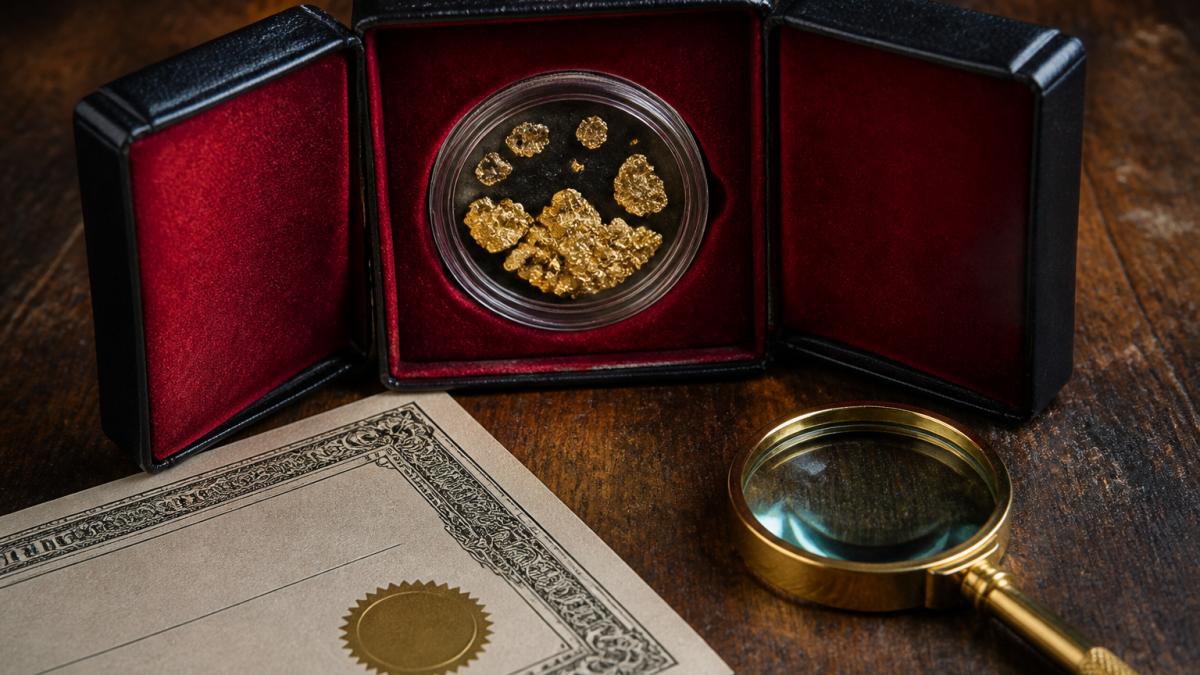
Check these five things before buying:
Parker Schnabel Yukon Gold Flakes – Dominion Creek Collector Package →
- A named source. The listing should say exactly where the gold came from, not just "authentic placer gold."
- A Certificate of Authenticity with specifics. A real certificate names the operation, the batch, and the weight. A generic "certified authentic" card means little.
- Stated weight. You should know the gram weight before you pay, so you can judge the price against the metal content and the collectible premium separately.
- Display quality. A handcrafted case signals a keepsake. A plastic bag signals a commodity.
- Shipping terms. Insured, tracked, signature-required delivery protects both the gift and the giver.
On the question we hear most: yes, the price sits above raw metal value. That premium buys sourcing, authentication, the display case, and insured shipping. If the recipient only wants gold as an investment, a bullion dealer is the better route; if they want a piece of the story, this category delivers.
Budget Tiers and Total Cost of Ownership
Budget tiers run from stocking stuffers under $50 to collector pieces near $200, and the smartest buys sit at the top of a tier rather than the bottom of the next. A $45 pan that lasts a decade beats a $70 kit that falls apart in a season.
Plan around three tiers:
- Under $50 (stocking stuffer): Snuffer bottles, vials, classifiers, crevice tools, gold-themed T-shirts, small books
- $50 to $150 (main gift): Quality pans, sluice accessories, rock tumblers, gem polishers, hoodies, display cases, vintage-style buckles
- $150 to $200+ (collector gift): Authenticated raw gold packages, framed memorabilia, jewelry
What each tier actually buys
A snuffer bottle and vial together run $15 to $30. A single classifier is roughly $20 to $40 depending on material, and a three-piece set sits between $50 and $90.
In the middle tier, a rock tumbler with a starter grit kit runs $70 to $130.
At the top, authenticated raw gold packages and framed memorabilia start around $150 and climb from there.
Total cost of ownership: the part most guides skip
Sticker price is only the first cost. Gear gifts carry recurring costs, and ignoring them can mean handing over a gift that sits unused.
- Rock tumblers: grit and polish refills. A full cycle needs coarse, medium, fine, and polish stages. Budget roughly $20 to $40 per refill set.
- Metal detectors: batteries and, over time, a replacement coil or headphones. Rechargeable packs cost more up front but cut recurring spend.
- Sluices and cleanup tables: replacement riffle matting, hoses, and pumps. Matting wears out, and a cheap pump is the most common failure point.
A simple rule: for any gear gift, add 20 to 30 percent to the sticker price as the first year of consumables and spares. If that total still fits the budget, the gift is a good fit.
Why the top of a tier beats the bottom of the next
A $45 pan that lasts a decade costs about $4.50 a year; a $70 kit that falls apart in one season costs $70 a year and delivers worse results.
For a single meaningful gift, the $150 to $200 tier is where gold mining fans tend to be most impressed, because that's where provenance and presentation become part of the product.
Display, Safety, and Legal Basics for Gold Gifts
Display and legal basics matter because gold gifts end up on a desk or shelf, and gear gifts end up in the field. Both come with rules worth knowing before you buy.
On display: raw gold and nuggets are soft, and bare fingers leave oils that dull the surface. A sealed or covered case protects the specimen, and pieces should stay out of direct sunlight, which can fade some display materials.
On safety and legality, three points cover most situations:
- Where you can pan. Prospecting rules vary by state and by land type. Federal lands, state lands, and private property each have their own requirements, and some areas are closed entirely. The Bureau of Land Management's mining and minerals guidance is the place to start for federal land questions.
- Claim markers and signs. If the recipient holds a mining claim, claim signs and markers are legal requirements in many jurisdictions, not decoration. Check the specific rules for the state before buying.
- Metal detecting. Detecting on public land can require a permit, and rules on historical sites are strict. The National Park Service regulations on metal detecting prohibit detecting on most federal park land, so confirm before gifting a detector.
Gift Bundles and Complementary Accessories
Gift bundles work when each item supports the others, not when they're a pile of related objects. The strongest pairings follow one activity from start to finish.
Bundles we'd actually build:
- The beginner panning kit: pan, classifier, snuffer bottle, and vial, all under $100 combined
- The display bundle: authenticated raw gold plus a small magnifier and a display stand
- The field bundle: multi-tool, crevice tool, and a durable hoodie for cold creek mornings
Pairing a consumable with a keepsake is the trick most gift guides miss: the consumable gets used immediately, making the keepsake feel like part of a hobby rather than a random object.
Finding a gift for a gold mining fan is hard because the hobby rewards knowledge, not stuff.
Parker's Gold solves that by skipping the guesswork entirely.
Frequently Asked Questions
What are some good gift ideas for someone who enjoys gold prospecting?
Match the gift to how they prospect. A casual panner will use a quality gold pan, classifier set, and snuffer bottle. Someone who works creeks regularly needs a sluice box, cleanup table, or gold wheel. For display-minded collectors, authenticated raw placer gold with a Certificate of Authenticity is a strong pick. Add a prospecting handbook or a claim sign if they are serious about staking ground.
What can you give a Gold Rush fan who already has prospecting gear?
Skip the equipment and go for something tied to the show or the history. Authenticated raw gold flakes from a known mining operation, a vintage-style buckle, or a display case for their existing finds all work. A subscription to a prospecting magazine or a gift card toward a paydirt sample also fits the fan who already owns the basics.
How do you display raw gold flakes safely?
Keep flakes in a sealed display case or a small glass vial to prevent loss and scratching. Store the case away from direct sunlight and humidity, which can tarnish surrounding materials. Handle flakes with tweezers, not fingers, to avoid oils. A handcrafted tri-fold display case with a Certificate of Authenticity keeps the gold protected and makes the origin easy to verify.
Is a raw gold flakes gift worth it compared to just buying bullion?
It depends on what the recipient values. Bullion is priced close to spot and is easy to resell. Raw placer gold from a specific operation carries a premium for provenance, documentation, and display appeal, so it is a collectible rather than a pure investment. If the person cares about the story and the source, the premium is worth it; if they want pure metal value, bullion is the simpler choice.