

Table of Contents
- Why Raw Gold Flakes Attract Investors and Collectors
- The Risks of Investing in Raw Gold Flakes
- Understanding Gold Purity, Karats, and Weight in Raw Form
- How to Value Raw Gold Nuggets and Flakes
- Investing in Gold Bullion vs Raw Gold: Which Fits Your Goals?
- How to Buy Raw Placer Gold Online Without Getting Burned
- The Verdict: Should You Invest in Raw Gold Flakes?
- Frequently Asked Questions
Last Updated: September 4, 2026
Why Raw Gold Flakes Attract Investors and Collectors
The market for investing in raw gold flakes sits at a curious intersection: it is neither a pure financial instrument nor a simple collectible. Unlike refined bullion, raw placer gold carries the story of its origin, which is why it commands attention from two very different audiences. For the collector, a vial of gold dust from a named creek is tangible history; for the investor, it represents a direct, unprocessed claim on a precious metal that has served as a store of value for millennia.
At Parker's Gold, we handle genuine raw placer gold recovered from Dominion Creek in the Yukon, the operation featured on Discovery Channel's Gold Rush. We see daily how the appeal splits between those seeking portfolio diversification through physical gold and those chasing the authenticity of a specific mining provenance. The reality is that raw gold flakes are a niche asset, and understanding that niche is the first step toward making a sound purchase.

The Risks of Investing in Raw Gold Flakes
The most significant risk in investing in raw gold flakes is the absence of a standardized pricing mechanism. When you buy a gold bar or a coin, the price is anchored to the spot price of gold plus a small premium. Raw gold, however, is priced as a novelty or specimen first and as a commodity second. This means you are exposed to what industry professionals call a "dealer spread," which can be substantial.
Several specific risks should temper expectations:
- Valuation subjectivity: There is no official "ask" price for a specific flake; value is determined by size, shape, and visual appeal.
- Liquidity constraints: Selling raw gold requires finding a buyer who values the specimen qualities, not just the melt value.
- Verification costs: Proving authenticity requires an assay or documentation, which adds friction to resale.
- Purity variance: Raw gold is rarely pure; it is an alloy of gold, silver, and other trace metals.
A common mistake is assuming that raw gold trades like bullion. It does not. The premium you pay for a collectible flake may not be recoverable when you sell, since the secondary market for specimens is significantly thinner than the market for standardized bars or coins.
Understanding Gold Purity, Karats, and Weight in Raw Form
Raw placer gold is nature's alloy, and its purity is measured differently than refined gold. While bullion is typically 99.99% pure (24 karat), raw gold flakes from placer deposits usually range between 80% and 95% pure, translating to roughly 19 to 22 karats. The remaining content is typically silver, which is why placer gold often has a pale yellow or greenish tint compared to the deep orange of refined gold.
Weight is measured in troy ounces for valuation, but most retail raw gold is sold in grams. A troy ounce weighs approximately 31.1 grams, which differs from the standard avoirdupois ounce used in everyday measurements (nist.gov). This distinction matters when calculating melt value against the spot price, which is always quoted per troy ounce.
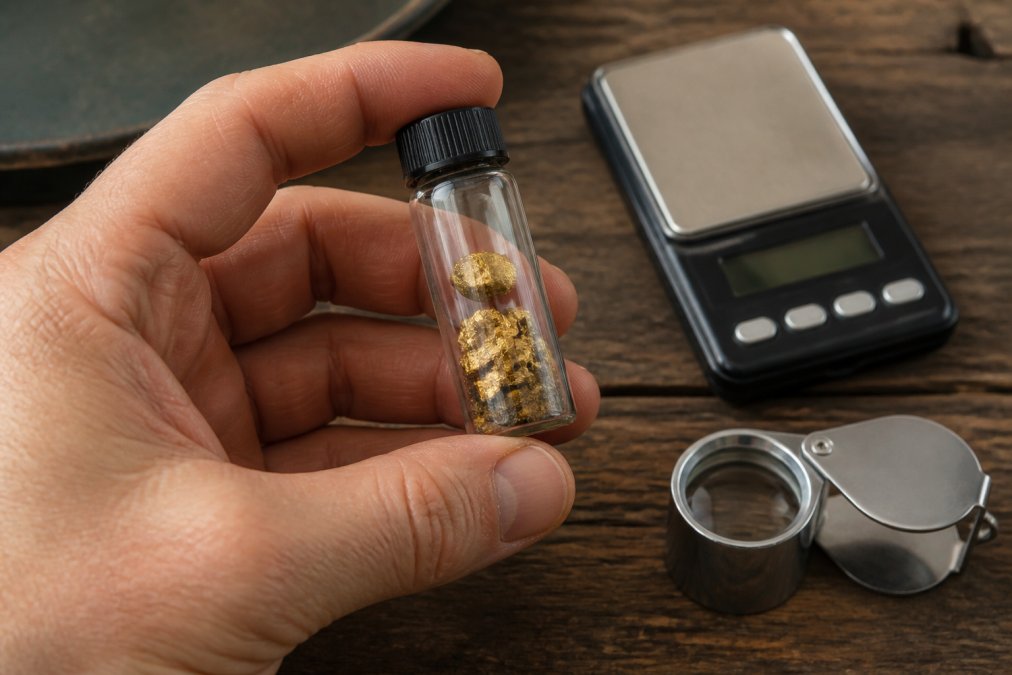
Since purity varies from flake to flake, the "melt value" of raw gold is an estimate, not a fixed number. To assess it, you must know the approximate karat content, which typically requires a specific gravity test or an acid test. Most reputable dealers price collectible raw gold at a significant premium above its melt value, reflecting the difficulty of sourcing and the specimen quality.
How to Value Raw Gold Nuggets and Flakes
Valuing raw gold requires a two-tier approach: establishing the intrinsic melt value and then estimating the specimen premium. Most guides stop at the formula, but the real challenge is getting the inputs right. Here is the practical process, including how to verify purity at home without sending your gold to a lab.
Step 1: Precise Weighing
Use a jeweler's digital scale that reads to 0.01 grams. Do not use a kitchen scale. Place the flakes on a clean, dry tray and weigh them multiple times to ensure consistency. Record the weight in grams. For reference, a troy ounce (31.1 g) is the standard for spot pricing, but retail transactions for raw gold are almost always quoted per gram.
Step 2: Estimating Purity Without a Lab
Raw placer gold is never 24 karat. It contains silver and trace copper, which is why it appears paler than refined gold. Two home methods are common:
- Specific Gravity Test: This is the most reliable non-destructive home test. Weigh the dry gold on a scale. Then, suspend it in water using a thin thread or wire and weigh it again. The formula is: Dry weight ÷ (Dry weight - Wet weight) = Specific gravity. Pure gold has a specific gravity of 19.3; placer gold typically falls between 15 and 18, depending on silver content. A reading below 15 suggests significant impurities or possible adulteration.
- Acid Test: This is destructive and only appropriate for a small sample. A jeweler's acid test kit uses nitric acid to determine karat level by observing the reaction. It will tell you if the gold is roughly 18k, 21k, or 22k, but it will not give you an exact percentage. Use this only if you are willing to sacrifice a tiny flake.
Step 3: Calculating Melt Value
Once you have an estimated purity percentage (e.g., 85% for 20k placer gold), the melt value formula is:
Weight (grams) × Purity (%) × Spot Price per gram = Melt Value
Spot price per gram is simply the spot price per troy ounce divided by 31.1. For example, if spot is $2,400 per troy ounce, that is roughly $77.17 per gram. A 5-gram flake at 85% purity would have a melt value of approximately $328 (5 × 0.85 × $77.17).
Step 4: Estimating the Specimen Premium
This is where subjectivity enters. The premium over melt value for raw placer gold is driven by three factors:
- Provenance: Gold from a named, documented operation (like Dominion Creek) commands a higher premium than unlabeled dust.
- Visual Appeal: Crystalline structures, bright color, and uniform flake size increase collector demand.
- Packaging and Documentation: A Certificate of Authenticity and a display case add resale value.
In practice, retail premiums on verified raw gold range from 50% to 300% above melt value. The premium is not recoverable on resale unless you find a collector who values the same provenance. This is the core economic reality: you are paying for the story, not the metal.
The Verification Gap Most Guides Ignore
If you buy raw gold and later want to sell it, the buyer will not take your word on purity. They will require an assay. A professional fire assay or X-ray fluorescence (XRF) analysis costs between $50 and $150 per sample at a commercial lab. For small quantities, this cost can exceed the value of the gold itself, which is why many dealers refuse to buy small lots of raw gold without documentation. This is the hidden friction that makes raw gold illiquid.
For a non-destructive home verification, the specific gravity test is your best tool. It is accurate enough to detect gross misrepresentation and costs nothing beyond a scale and a cup of water. Most hobbyist buyers find this sufficient for initial due diligence before committing to a purchase.
Investing in Gold Bullion vs Raw Gold: Which Fits Your Goals?
The choice between investing in gold bullion vs raw gold ultimately comes down to your objective: financial security or tangible history. Bullion, in the form of coins and bars, is the standard for portfolio diversification because it offers high liquidity, low premiums over spot, and easy verification. Raw gold offers none of those advantages, but it offers something bullion cannot: a direct, physical connection to a specific place and time.
| Criteria | Gold Bullion (Coins/Bars) | Raw Gold Flakes |
|---|---|---|
| Pricing | Spot price + small premium | Specimen premium, highly variable |
| Liquidity | High, global market | Low, niche collector market |
| Verification | Stamped weight and purity | Requires assay or documentation |
| Best For | Portfolio diversification | Collecting and display |
| Typical Purity | 99.99% (24 karat) | 80-95% (19-22 karat) |
For investors seeking exposure to gold as a hedge against inflation or market volatility, bullion or a gold ETF is the rational choice. These instruments track the spot price closely and can be sold quickly at a transparent market rate. Raw gold, by contrast, behaves more like art or antiques; its value is tied to the buyer's appreciation of the specimen, not just the metal it contains.
How to Buy Raw Placer Gold Online Without Getting Burned
For those who decide to buy raw placer gold online, the due diligence process is non-negotiable. The market has attracted sellers offering unverified material, and the consequences of a bad purchase are severe since authenticity is difficult to prove after the fact. Your first line of defense is documentation.
A credible seller must provide a clear chain of custody. This means the gold should come with a Certificate of Authenticity that traces the material to a named mining operation, not just a vague claim of "Alaskan" or "Yukon" origin. Look for sellers who can specify the creek or claim name and who back their product with insured shipping. As documented in the FTC guidance on deceptive advertising, claims about product origin must be substantiated, and the same standard should apply to your purchase.
When comparing options, remember that you are paying for provenance. A package of raw gold flakes from a verified, named operation like Dominion Creek carries a different value than unlabeled dust from an unknown source. The premium you pay for documented history is the price of authenticity, and it is the only thing protecting your resale value later.
The Verdict: Should You Invest in Raw Gold Flakes?
Investing in raw gold flakes is a defensible decision only when you understand what you are buying. If your goal is capital preservation or portfolio diversification, raw gold is the wrong vehicle; standardized bullion or a gold ETF offers better liquidity and tighter pricing. If your goal is owning a piece of mining history, a verified specimen with proper documentation is a meaningful acquisition.
The Tax Reality Most Guides Skip
One of the most overlooked differences between raw gold and other investments is how the IRS treats your gains. Under IRS Publication 544, gold is classified as a collectible, not a capital asset like stocks or bonds. This classification triggers a higher capital gains rate.
Here is the practical breakdown:
- Collectibles Rate: Gains from selling physical gold, whether raw flakes, coins, or bars, are taxed at a maximum rate of 28%, regardless of your income bracket. By contrast, long-term capital gains on stocks held over a year are taxed at 0%, 15%, or 20%, depending on your income.
- Holding Period: If you hold raw gold for less than one year, the gain is taxed as ordinary income, which can be as high as 37% for top earners. This is worse than the collectibles rate.
- Reporting Requirement: You must report the sale on Form 8949 and Schedule D. There is no exemption for small sales. Even a $200 gain from selling a vial of flakes requires reporting.
- No Wash-Sale Rule: Unlike stocks, you cannot sell gold at a loss and immediately buy it back to claim a tax deduction. The wash-sale rule does not apply to physical commodities.
How Raw Gold Compares to Bullion on Taxes
There is a common misconception that raw gold receives more favorable tax treatment than bullion. It does not. Both are classified as collectibles. However, there is one structural difference: bullion dealers issue Form 1099-B for transactions above certain thresholds, which creates a clear paper trail. Raw gold sold privately or to a dealer may not generate a 1099, but the IRS still requires you to self-report the gain. Failing to do so is tax evasion, regardless of whether you receive a form.
The Net Return Calculation
Consider a practical example. You buy a 5-gram flake at an 85% purity for $500 (a premium above its approximate $328 melt value). Two years later, spot gold has risen 20%, and you sell the flake for $600. Your gain is $100. At the 28% collectibles rate, you owe $28 in federal tax. After accounting for the premium you paid and the tax, your net return is significantly lower than if you had bought a gold ETF with no collectible premium and lower tax drag.
The Bottom Line for Your Portfolio
Raw gold flakes are best for collectors and fans of mining history who value the display piece and the story behind it, not for investors seeking a liquid, low-premium store of value. If you do proceed, keep meticulous records of your purchase price, date, and any documentation of purity. These records are your basis for calculating gains and your defense in an audit.
For most buyers, the wisest approach is to treat raw gold as a collectible purchase, not a financial trade. If you are drawn to the authenticity of Yukon gold, seek out a source with verifiable provenance and a clear chain of custody. The Parker's Gold Dominion Creek Collector Package offers exactly that: genuine flakes from Parker Schnabel's operation, presented in a handcrafted display case with a Certificate of Authenticity and fully insured delivery. It is a purchase made for the story and the connection to the goldfields, not for the melt value.
Frequently Asked Questions
Are raw gold flakes worth any money?
Yes, raw gold flakes hold real monetary value based on their weight and purity. The value is calculated against the current spot price for gold, then adjusted for the flakes' purity, which typically ranges from 18 to 23 karats for placer gold. Because raw gold has not been refined, dealers and buyers often apply a discount to the spot price to account for impurities and the cost of refining.
How is the purity of raw placer gold determined?
The purity of raw placer gold is usually determined through an assay, with fire assay being the most accurate method. This process involves melting a sample and separating the gold from other metals to measure its exact fineness. For a less destructive check, a specific gravity test compares the weight of the gold in air to its weight in water. Most placer gold from the Yukon tests between 85% and 95% pure, which is roughly 20 to 23 karats.
What is the difference between gold flakes and gold dust?
The difference comes down to size and how they are classified. Gold dust refers to very fine particles, often resembling sand or powder, that can pass through a fine mesh screen, typically smaller than 1 millimeter. Gold flakes are larger, flat pieces that are visible and can be picked up with tweezers. Flakes are generally easier to handle and weigh on a scale, making them more common for collectible sales and display.
Why are gold flakes cheaper than bullion coins or bars?
Gold flakes are priced lower than bullion per troy ounce because they are unrefined and carry extra costs for the buyer. The price includes a discount from the spot price to cover the cost of assaying, refining, and the risk of impurities. Bullion, like coins or bars, has already been refined to a guaranteed purity, usually 99.99%, so its price tracks the spot price much more closely with a smaller premium.
How should raw gold flakes be stored to maintain their value?
Store raw gold flakes in a secure, dry container, such as a small glass vial with a tight seal or a display case. Placer gold is already in a stable metallic state, so it will not tarnish or corrode, but keeping it dry prevents dirt and debris from clinging to it. Keep the container in a safe or safety deposit box. Always store the Certificate of Authenticity alongside the gold to preserve its provenance for resale.
Are raw gold flakes a good investment compared to bullion?
As a pure financial investment, bullion is generally a better choice because it offers higher liquidity and a lower premium over the spot price. Raw gold flakes carry a higher risk due to purity uncertainty and a narrower resale market. However, raw gold flakes can serve a different purpose: they act as a tangible piece of history and a collectible. The value lies in the combination of the gold content and the documented origin.
This article was written using GrandRanker